
Teacher Portal
Investigation 2: Faith & Reason
Science helps us understand how the world works.
Faith, philosophy, and theology invite us to ask why these discoveries matter and what they reveal about the human person. The slides below continue that conversation.
Click on any image below to expand
As you view each slide, think carefully about the questions it raises. Your teacher may invite you to discuss some or all of them with your classmates.
Slide 1 — Human Cognition: Simple Information Processing
During Investigation 2, you explored how your nervous system receives information, processes it, and responds to the world around you.
Science helps us understand how these remarkable processes occur.
Now you’ll consider a different kind of question:
What might these discoveries tell us about ourselves, truth, and what it means to be human?
Faith & Reason begins with what science has discovered and extends the conversation to questions of meaning, truth, and the human person.
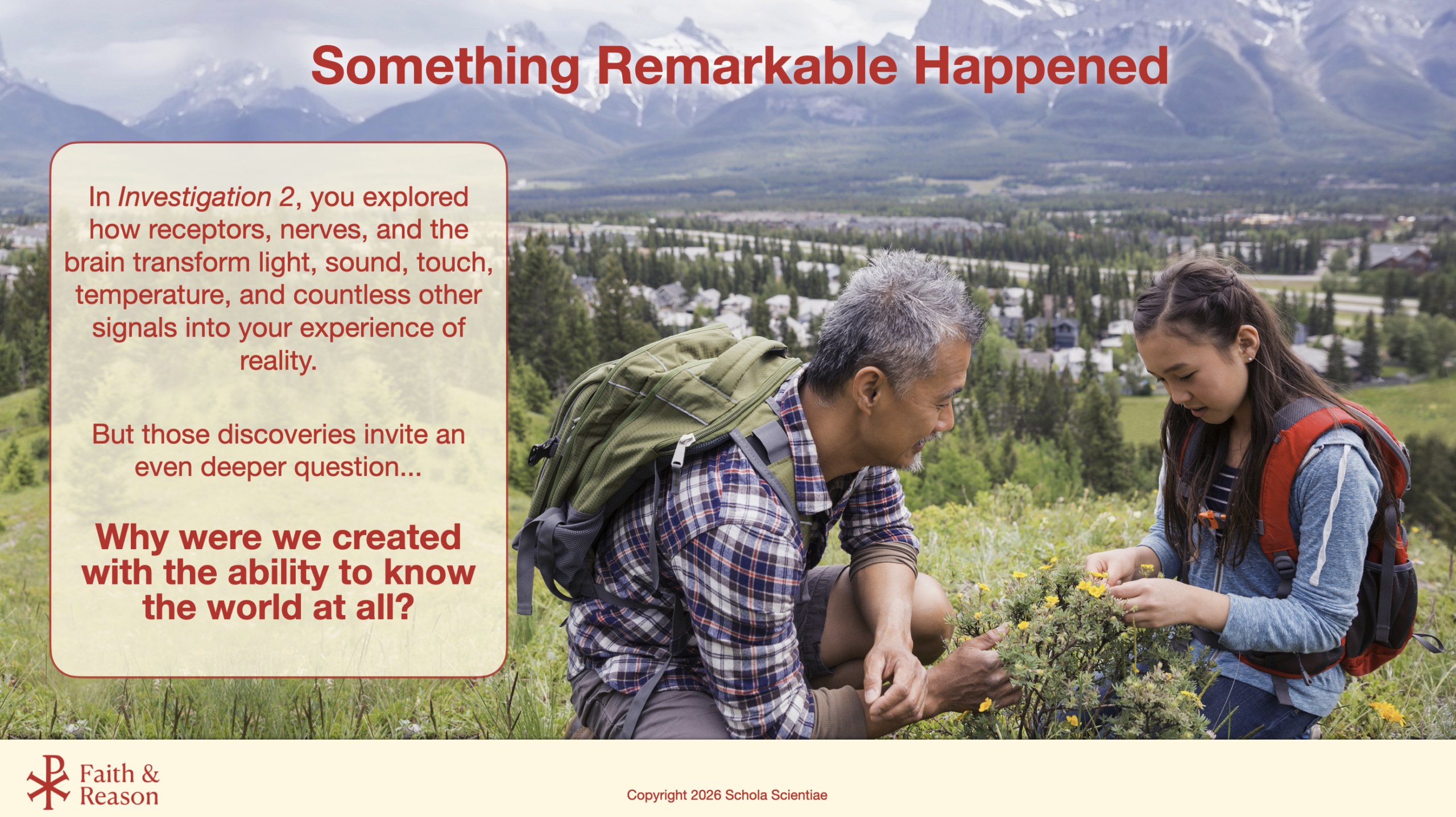
Slide 2 — Something Remarkable Happened
During Investigation 2, you discovered how receptors, neurons, the spinal cord, and the brain work together to receive information from the world around you.
You may have become so familiar with these discoveries that it’s easy to overlook something extraordinary:
Human beings can know the world.
We recognize patterns, learn from experience, discover scientific laws, create works of art, solve problems, and search for truth.
That ability is so familiar that we rarely stop to ask:
Why do human beings possess the remarkable ability to know and understand the world at all?
The slides that follow invite you to think about that question.
As you view each slide, think about the ideas and questions it raises. Your teacher may invite you to discuss some or all of them with your classmates.
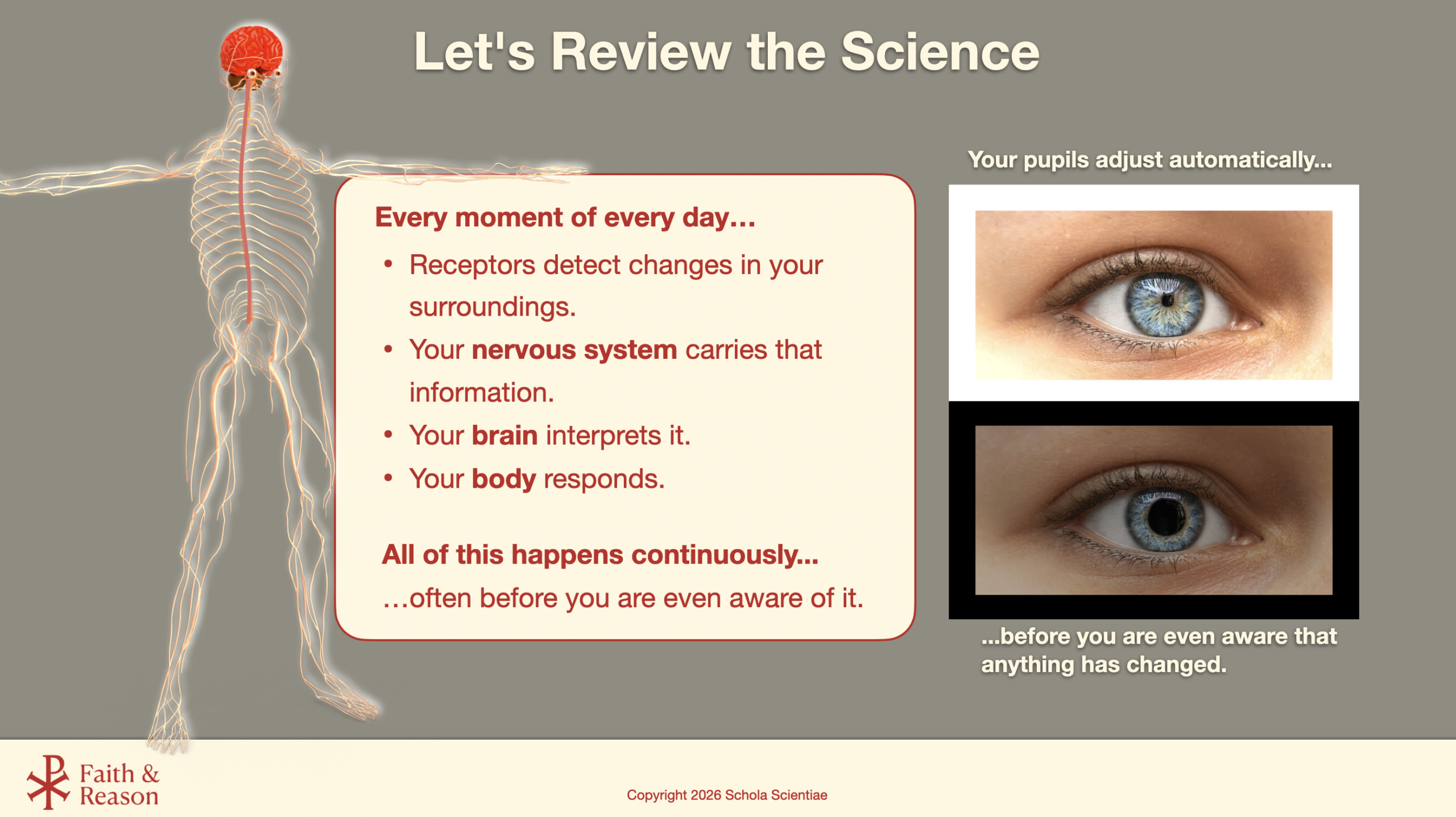
Slide 3 — Let’s Review the Science
Before asking deeper questions, let’s briefly remember what you discovered during Investigation 2.
You learned that:
- Receptors detect changes in the world around you.
- Your nervous system receives and processes that information.
- Many responses happen automatically, often before you are consciously aware of them.
- These remarkable processes allow you to interact safely and effectively with the world.
These scientific discoveries provide the foundation for everything that follows.
Now ask yourself:
If our nervous system makes it possible for us to know and understand the world, what might that reveal about the human person?
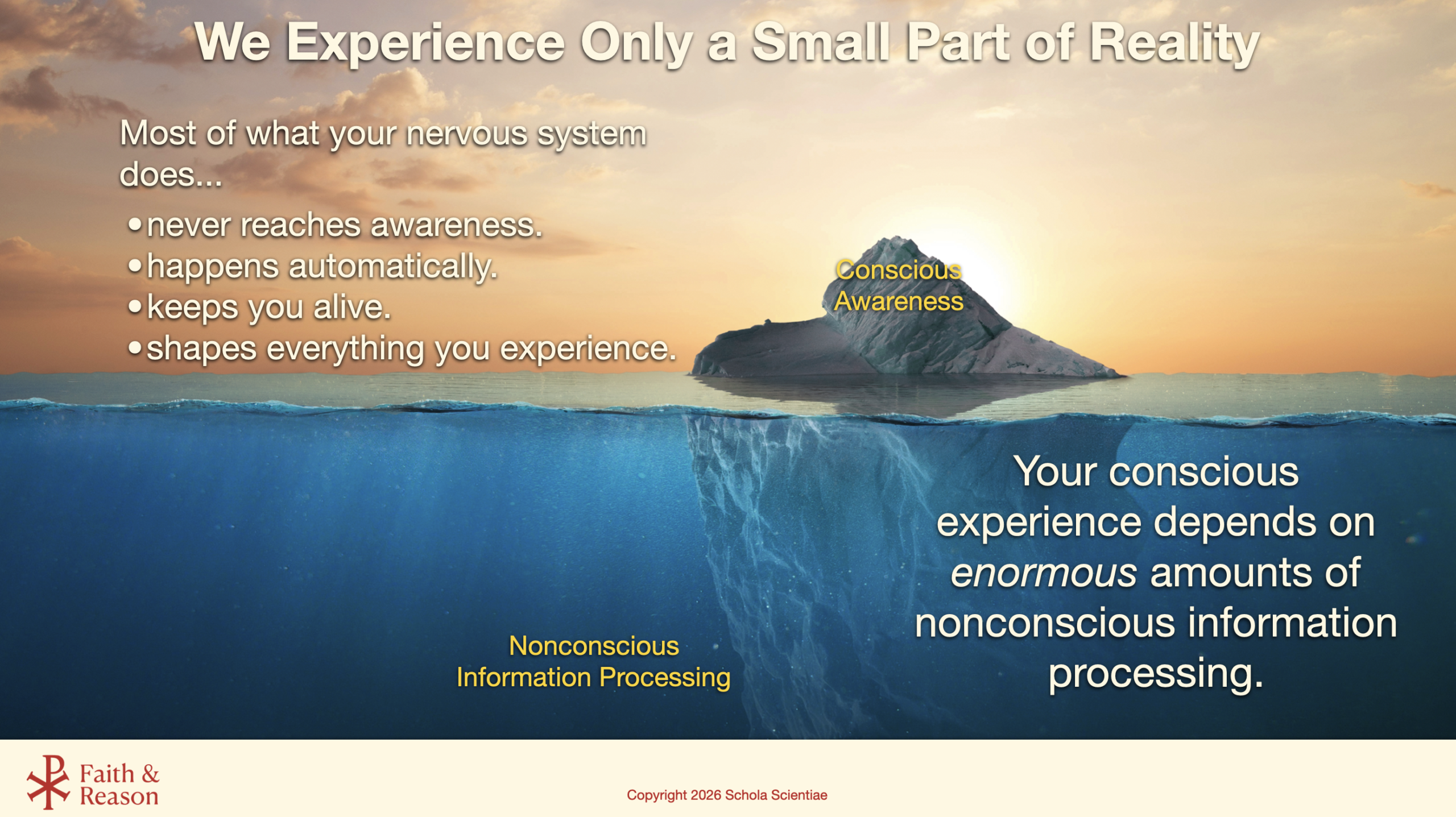
Slide 4 — We Experience Only a Small Part of Reality
During Investigation 2, you discovered that your nervous system is constantly receiving and processing enormous amounts of information.
Yet only a small portion of that information ever reaches your conscious awareness.
Your brain automatically filters, organizes, and interprets what is most important, allowing you to focus on the world around you.
This remarkable ability helps us live safely and effectively—but it also reminds us that our understanding is limited.
Now consider this question:
If we experience only a small part of reality, how should that shape the way we think about ourselves, others, and the search for truth?
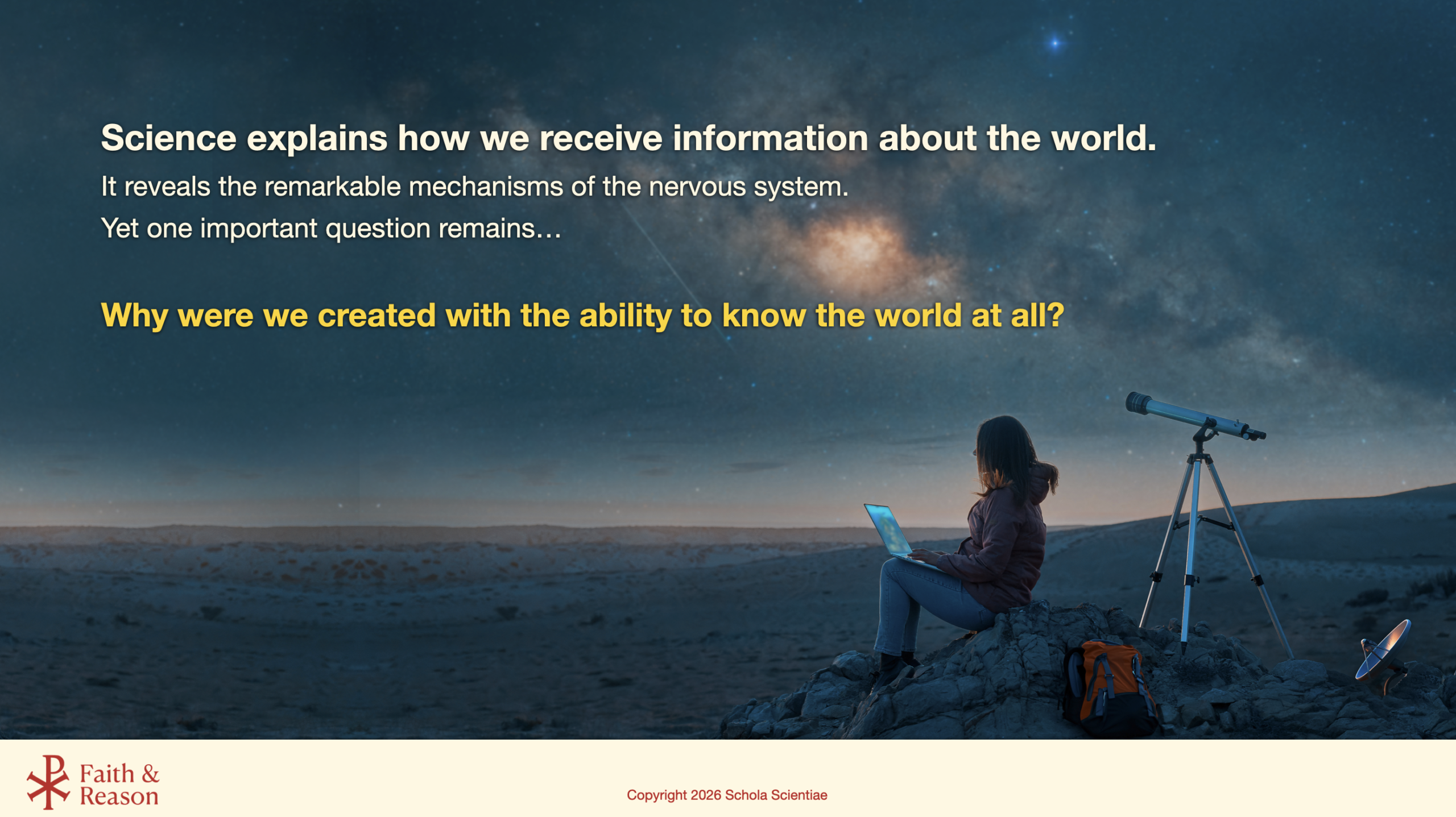
Slide 5 — Humans Have the Ability to Know
During Investigation 2, you explored how the nervous system receives and processes information about the world.
But something equally remarkable is easy to overlook:
Human beings are capable of understanding what they experience.
We can observe, reason, recognize patterns, ask questions, and intentionally seek knowledge about ourselves and the world around us.
Now consider:
Why do human beings possess this remarkable ability to know and understand the world at all?
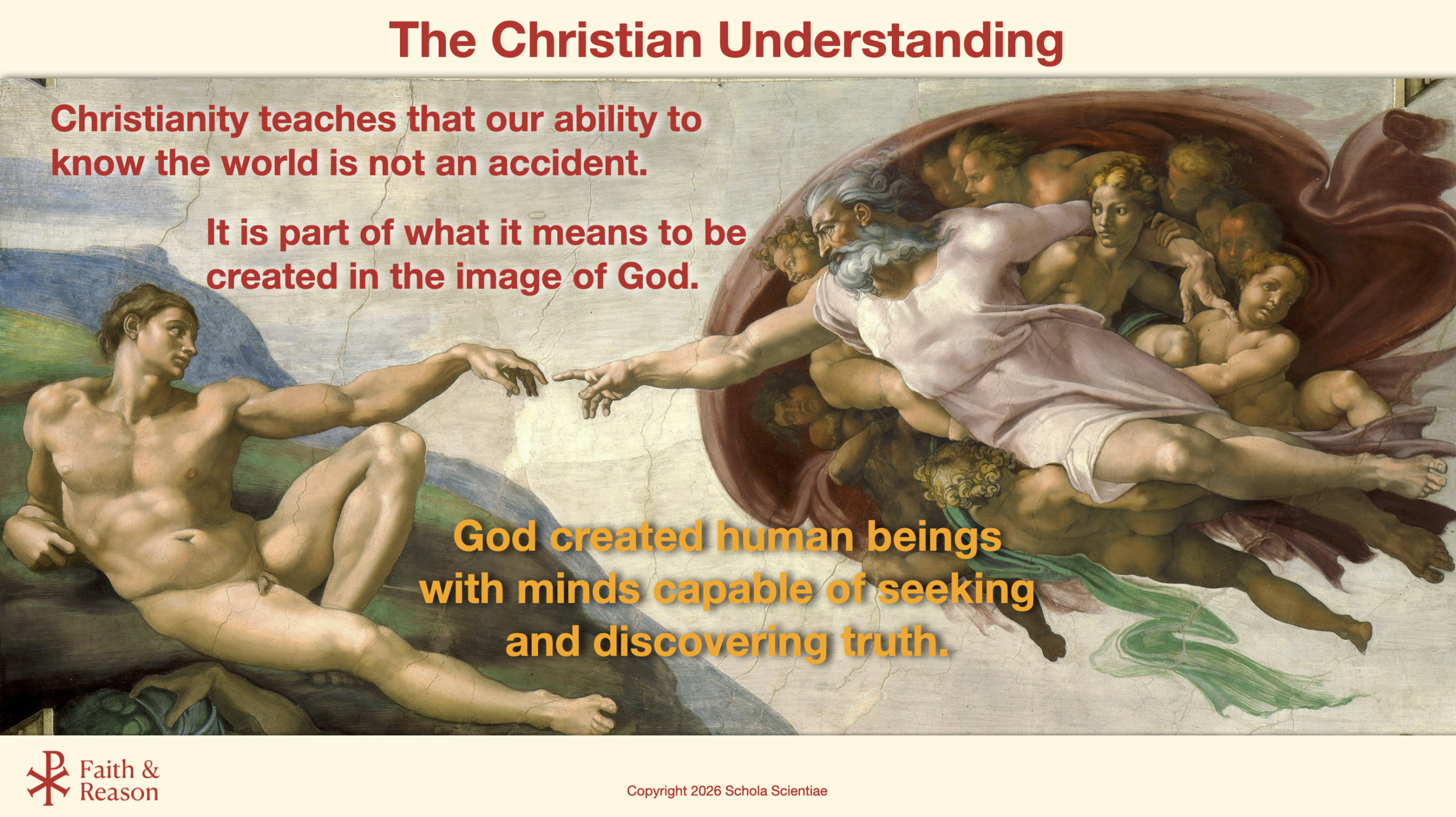
Slide 6 — The Christian Understanding
Throughout this investigation, you discovered that human beings possess a remarkable ability to receive information, understand the world, discover patterns, and seek truth.
Christianity teaches that this ability is not an accident.
Human beings were created in the image and likeness of God (Genesis 1:26–27).
Because God is the source of truth and reason, Christians believe that human beings were created with minds capable of knowing, understanding, and freely responding to reality.
This understanding has inspired centuries of learning, science, philosophy, education, and the search for wisdom.
Now consider:
If our ability to know is part of being created in God’s image, what responsibilities come with that gift?
As you view the following slides, think about how this idea connects with what you discovered during your scientific investigation.
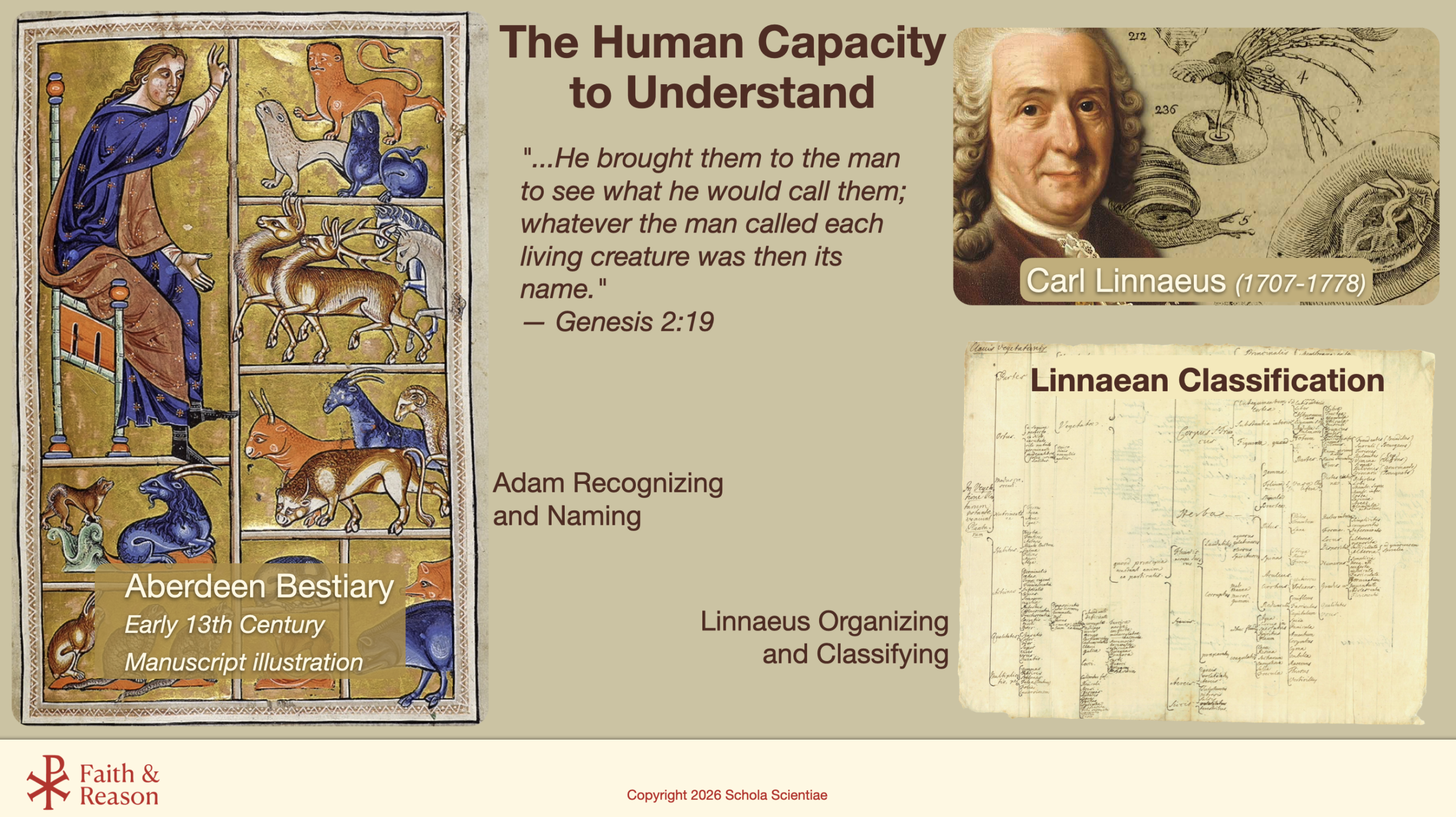
Slide 7 — Human Capacity to Understand
Throughout history, people have tried to understand the world.
In Genesis, Adam names the animals.
Centuries later, Carl Linnaeus organized living things into a scientific classification system.
Both activities required careful observation, comparison, and the search for patterns.
Although separated by thousands of years, they reveal something remarkable about human beings.
We naturally seek to understand the world around us.
Think About It
- Why do human beings want to understand the world?
- Why isn’t it enough simply to see something?
- What does our desire to observe, organize, and discover suggest about us?
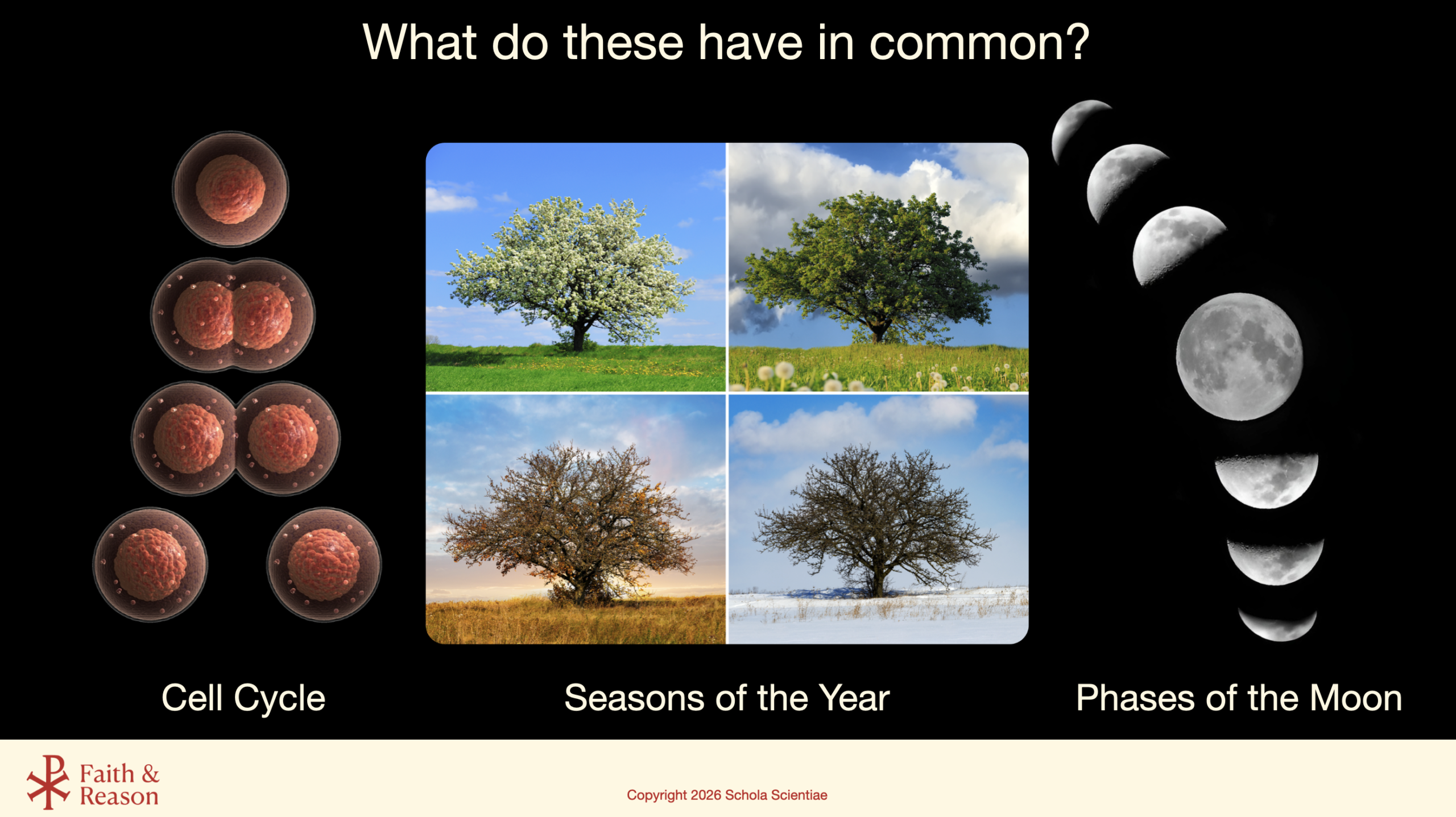
Slide 8 — What Do These Have in Common?
At first glance, these examples seem very different.
One comes from biology.
One comes from Earth science.
One comes from astronomy.
Yet scientists study all three for the same reason.
Each reveals an organized pattern in nature.
Recognizing patterns is one of the first steps toward understanding how the world works.
Think About It
- What pattern do you notice in each example?
- Why do scientists look for patterns?
- How do patterns help us make predictions?
- Why is the human mind able to recognize patterns at all?
Discuss
Suppose these patterns existed…
…but no one could recognize them.
Would science be possible?
Why or why not?
Looking Ahead
Science explains how many patterns work.
Faith and philosophy invite another question:
Why is the universe understandable in the first place?
Slide 9 — Patterns and Cycles
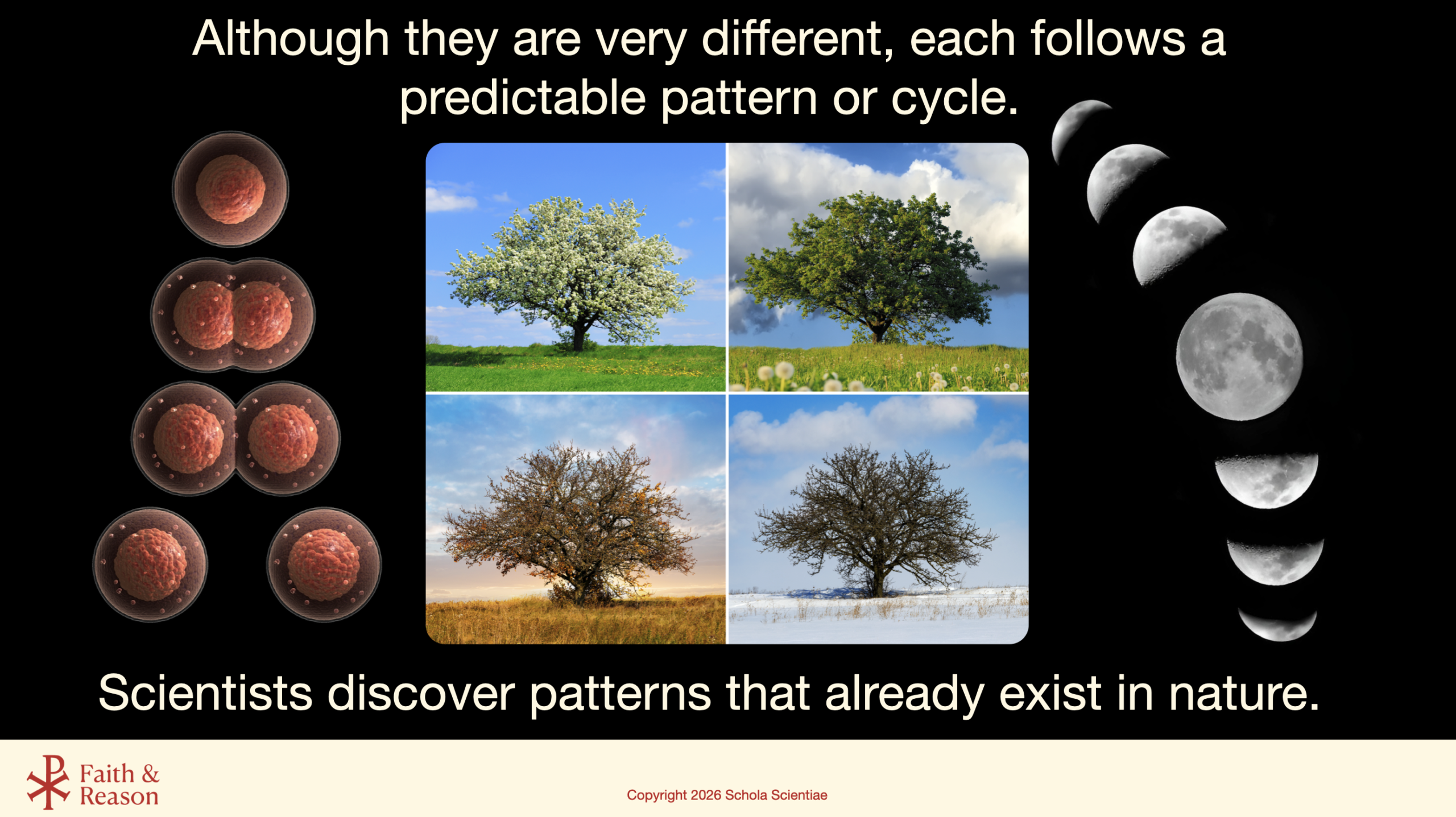
The examples on the previous slide all have something in common.
Each follows a predictable pattern or cycle.
Scientists look for patterns because patterns help explain how the natural world works.
But scientists do not create these patterns.
They discover patterns that already exist in nature.
Think About It
- Why are patterns important in science?
- How do patterns help scientists make predictions?
- What is the difference between creating a pattern and discovering one?
- If patterns already exist in nature, what does that suggest about the world we live in?
Discuss
Consider this statement:
Scientists discover patterns—they do not invent them.
Do you agree?
Can you think of examples from science that support this idea?
Looking Ahead
If the natural world contains order that can be discovered…
…why is the universe so understandable?
Slide 10 — Knowledge of What Exists
During this Investigation, you discovered that your nervous system constantly receives information, processes it, and helps you understand the world.
Science investigates the biological processes that contribute to our ability to perceive and understand the world.
But another question remains.
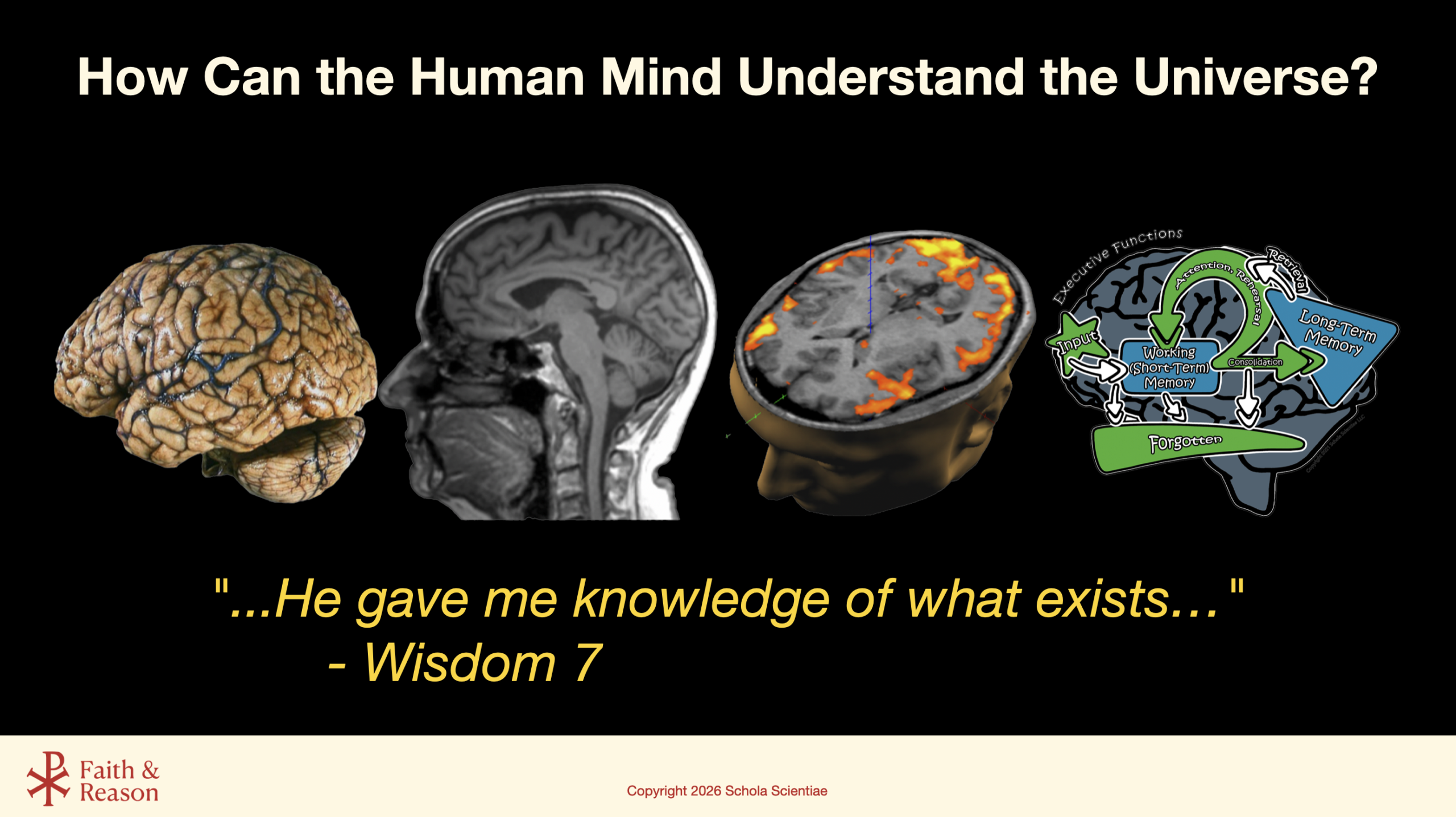
How is it possible that human beings are able to understand the universe at all?
The Book of Wisdom offers this reflection:
“He gave me knowledge of what exists…”
Wisdom 7
Rather than explaining how the brain works, this passage invites us to wonder why human beings have the remarkable ability to know and understand reality.
Think About It
- Why are human beings able to discover truths about nature?
- Why is the universe understandable?
- Is our ability to know simply useful…or is it also a gift?
- If the ability to understand is a gift, what responsibility comes with that gift?
Discuss
Science provides powerful ways to investigate and discover truths about the natural world.
The Book of Wisdom asks us to consider why we possess that ability in the first place.
How are those two questions different?
Can both be important?
Looking Ahead
If our ability to understand the world is a gift…
…how should we use that gift?
Slide 11 — From Sensation...to Understanding...to Wise Action
During this Investigation, you discovered that your nervous system constantly receives information from the world around you.
You learned that your brain processes that information, helping you recognize patterns, understand relationships, and make decisions.
Science investigated the biological processes that allow us to receive and process information.
Reflection & Meaning asked why that knowledge matters.
Faith & Reason invited you to consider what these discoveries reveal about the human person.
Remember
Information alone is not enough.
Knowledge becomes valuable when it leads to understanding.
Understanding becomes meaningful when it guides wise action.
Sensation → Understanding → Wise Action
Before You Leave…
Take a moment to think about these questions.
- What idea from this Investigation surprised you the most?
- How has your understanding of your own mind changed?
- How might what you learned help you become a wiser learner…and a wiser person?
Looking Ahead
In our next Investigation, you’ll explore another remarkable ability of the human mind.
How do we learn?
How do experiences become memories?
Why do we remember some things for a lifetime while forgetting others?
The journey of discovery continues!