
Teacher Portal
Investigation 2: Faith & Reason
NAVIGATE
Once the slide presentation is launched
- use your left and right arrows to advance or go back in the slide presentation, and
- hover your mouse over the left edge of the presentation to get a view of the thumbnails for all the slides so that you can quickly move anywhere in the presentation.
Click on any image below to expand
Human Cognition - Simple Information Processing
Teaching Tips
• Build on the scientific discoveries students made during Investigation 2.
• Welcome thoughtful questions before introducing philosophical or theological perspectives.
• Emphasize that science, philosophy, and theology ask different—but complementary—questions.
• Remind students that today’s goal is not to replace science, but to extend their thinking by considering questions of truth, meaning, and purpose.
Purpose
This title slide marks the beginning of the Faith & Reason discussion for Investigation 2. Students have completed the scientific investigation and are now ready to consider how scientific discoveries about the human brain can be placed within a broader search for truth, meaning, and purpose.
Faith & Reason does not replace science—it begins with science and builds upon it.
Key Idea
Science helps us understand how the nervous system works. Faith and philosophy invite us to consider why these remarkable human abilities exist and what they reveal about the human person.
Together they offer a richer understanding than either perspective alone.
Leading the Conversation
Explain that today’s discussion is different from the laboratory investigation. Students will not be learning new neuroscience. Instead, they will use what they have already discovered to explore larger questions that thoughtful people have asked throughout history.
You might begin by saying:
“Throughout this investigation we asked scientific questions about how the brain receives, processes, and responds to information. Today we’ll ask a different kind of question: What might these discoveries tell us about ourselves and about what it means to be human?”
Encourage students to support their ideas with evidence from the investigation while remaining open to philosophical and theological reflection.
Connections
Science Investigation
Today’s discussion builds directly upon the Concepts, Background Reading, PreLab, Lab, and PostLab activities. Students should continually connect new ideas to the scientific discoveries they have already made.
Reflection & Meaning
Reflection & Meaning asked what these discoveries reveal about ourselves and the lives we choose to live.
Philosophy
Philosophy explores questions about knowledge, truth, and the human person.
Theology
Theology considers how the Christian tradition understands these same questions in light of Scripture and reason.
Together, these perspectives provide a richer understanding of what it means to be human.
Something Remarkable Happened
Teaching Tips
- Build on the scientific discoveries students made during Investigation 2.
- Welcome thoughtful questions before introducing philosophical or theological perspectives.
- Emphasize that science, philosophy, and theology ask different—but complementary—questions about the human person.
- Remind students that today’s goal is not to replace science, but to extend their thinking by considering questions of truth, meaning, and purpose.
- Reinforce that Reflection & Meaning grows naturally from accurate scientific understanding, not apart from it.
- Allow discussion to develop naturally. Use open-ended questions and everyday examples to encourage participation when needed.
Purpose
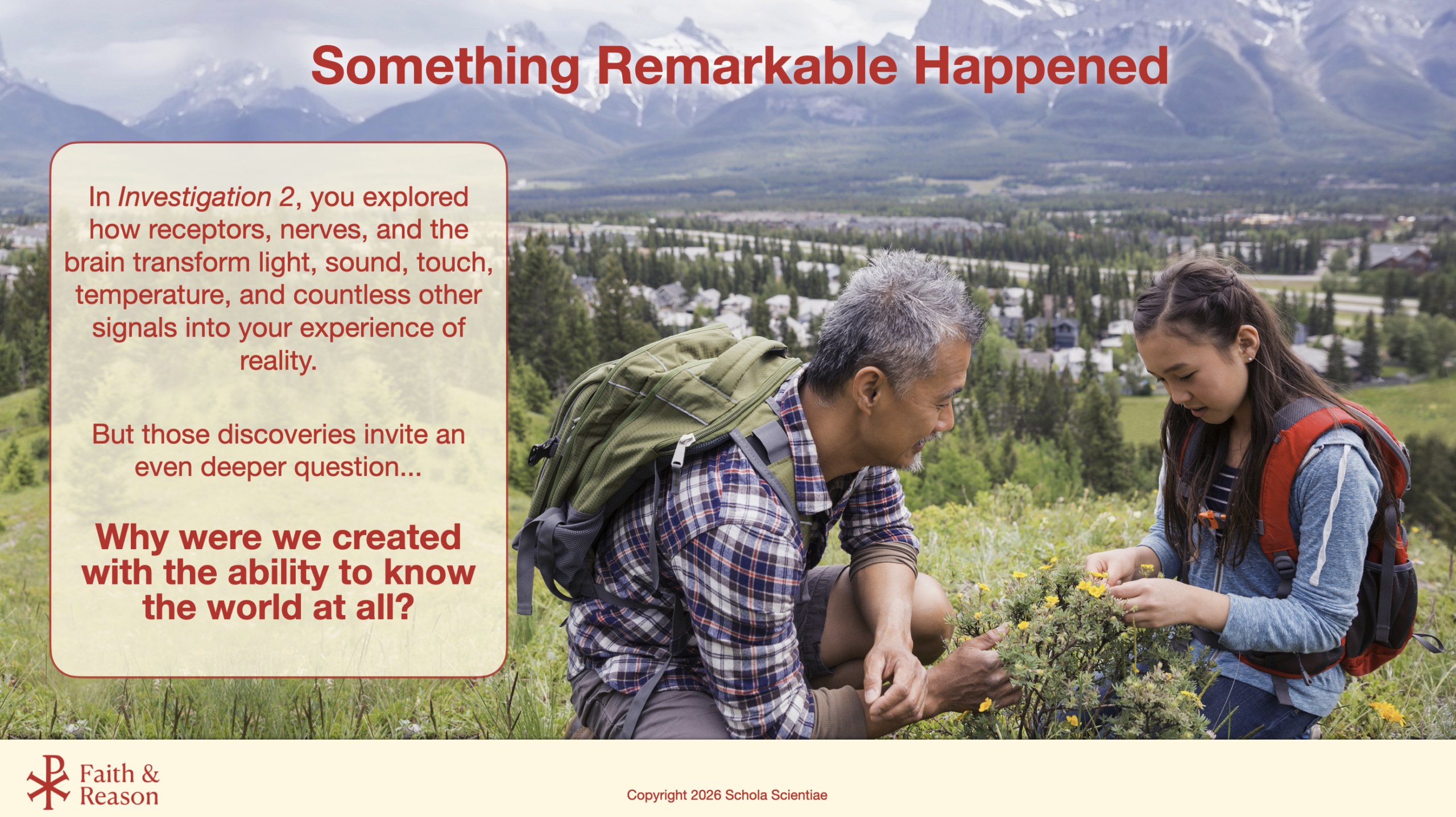
This slide marks the transition from the scientific discoveries students made during Investigation 2 to a deeper question: Why do human beings possess the remarkable ability to know and understand the world? It invites students to recognize that their nervous system does far more than process information—it makes knowledge, discovery, and understanding possible. This question prepares students for the Christian perspective presented in the slides that follow.
Key Idea
The ability to receive information, understand the world, recognize patterns, and discover truth is one of the most remarkable characteristics of human beings. Before asking what Christianity teaches about this capacity, students should first appreciate that this extraordinary ability exists at all.
Leading the Conversation
Begin by reviewing what students discovered during Investigation 2. Their nervous systems constantly receive information from the environment, process that information, and produce appropriate responses.
Then ask:
“Have you ever stopped to wonder why human beings are able to understand the world at all?”
Allow students time to think before answering.
Encourage them to consider examples such as recognizing a friend’s face, learning a new skill, understanding a scientific concept, or discovering patterns in nature.
Explain that scientists often study how these remarkable abilities work. Today’s discussion begins asking a different—but equally important—question:
Why do human beings possess these remarkable abilities in the first place?
Let students recognize that this question naturally grows out of the science they have already learned.
Connections
Science Investigation
Students discovered that receptors, sensory neurons, the brain, and motor neurons work together to gather information from the world and guide appropriate responses. Those discoveries provide the scientific foundation for today’s discussion.
Everyday Life
Every day we observe, learn, solve problems, recognize patterns, and make decisions—often without realizing how extraordinary these abilities truly are.
Faith & Reason
Faith & Reason begins by affirming the scientific discoveries students have made and then asks a deeper question about their meaning and purpose. Rather than replacing science, it builds upon science to explore why human beings possess the remarkable ability to know and understand the world.
Let's Review the Science
Teaching Tips
- Keep this review brief and student-centered. The goal is to reactivate understanding—not reteach the investigation.
- Invite students to explain the science in their own words rather than providing the answers yourself.
- Clarify any misconceptions before moving into Reflection & Meaning. Today’s discussion depends on a solid scientific foundation.
- Help students recognize that these discoveries are the evidence they will use throughout today’s discussion.
- Encourage students to respond to one another and build on classmates’ ideas rather than speaking only to the teacher.
- Transition by reminding students: “Now that we understand how the nervous system works, let’s ask what these discoveries might mean for the way we live.”
Purpose
Before exploring the Christian understanding of human cognition, students briefly review the most important scientific discoveries from Investigation 2. This review ensures that today’s discussion remains firmly grounded in accurate scientific knowledge and reminds students that faith builds upon truth discovered through careful observation and reason.
Key Idea
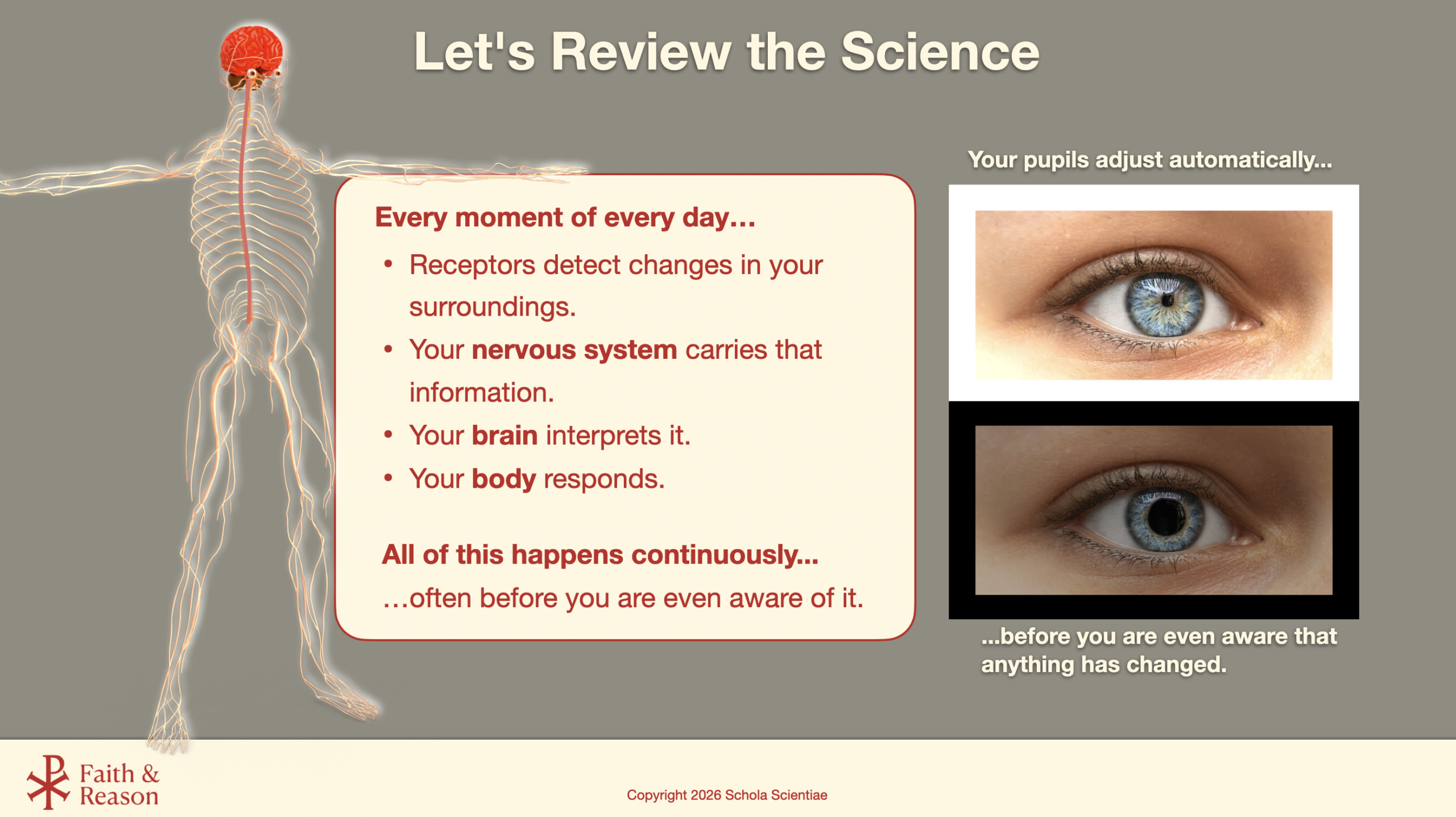
The nervous system continually receives information, processes that information, and produces appropriate responses. These remarkable biological processes enable us to perceive and understand the world around us. Today’s discussion begins with these scientific discoveries before considering their deeper meaning and purpose.
Leading the Conversation
Invite students to explain the investigation in their own words rather than reteaching the material yourself.
Ask students to describe:
- how receptors detect changes in the world around us,
- how the nervous system processes information,
- why many responses occur automatically before we are even aware of them,
- why these abilities are essential for understanding and interacting with the world.
Encourage students to respond to one another, clarify misunderstandings together, and support their explanations with observations from the laboratory investigation.
After the review, ask:
“Scientists can explain how these remarkable processes work. But why do human beings possess such extraordinary abilities in the first place?”
Explain that this question naturally leads into today’s Faith & Reason discussion.
Connections
Previous Investigation
HC1 introduced the brain as the organ responsible for perception, learning, memory, emotion, and decision making. HC2 explains how information reaches the brain and how the nervous system allows us to interact intelligently with the world.
Everyday Life
Every moment of every day, your nervous system detects changes in the world around you, processes that information, and allows you to respond appropriately—often before you are consciously aware of what has happened.
Faith & Reason
The Christian tradition begins with the same scientific observations students have made during this investigation. It then asks a deeper question: Why were human beings created with the remarkable ability to know, understand, and respond to the world?
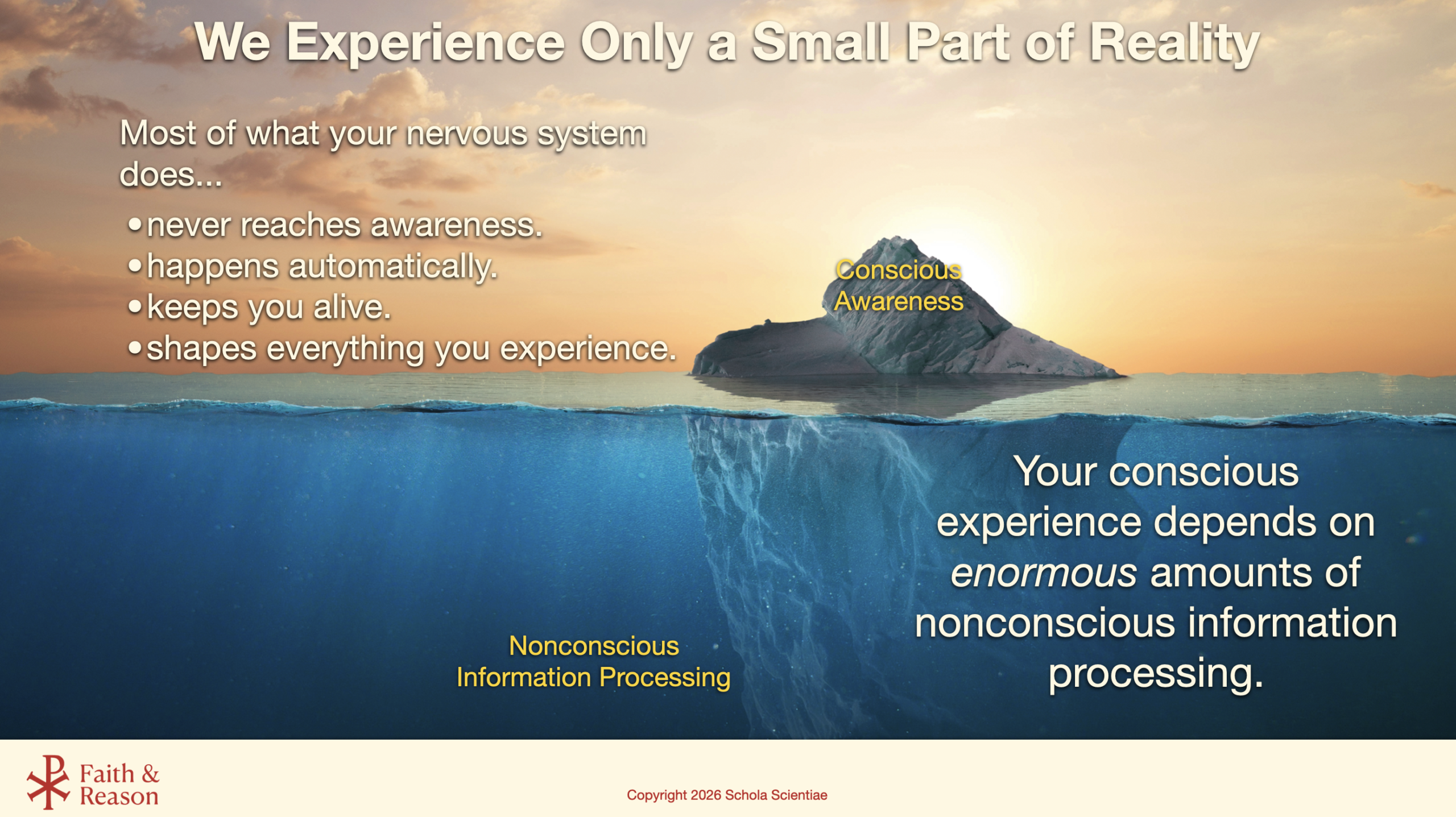
We Experience Only a Small Part of Reality
Teaching Tips
- Keep this review brief and student-centered. The goal is to reactivate understanding—not reteach the investigation.
- Invite students to explain the science in their own words rather than providing the answers yourself.
- Clarify any misconceptions before moving into Reflection & Meaning. Today’s discussion depends on a solid scientific foundation.
- Help students recognize that these discoveries are the evidence they will use throughout today’s discussion.
- Encourage students to respond to one another and build on classmates’ ideas rather than speaking only to the teacher.
- Transition by reminding students: “Now that we understand how the nervous system works, let’s ask what these discoveries might mean for the way we live.”
Purpose
This slide helps students recognize that conscious awareness represents only a small portion of the information continuously processed by the nervous system. Appreciating this limitation encourages intellectual humility and prepares students to consider what science can—and cannot—tell us about human understanding.
Key Idea
Human beings experience only a small fraction of the information their nervous systems continuously receive and process. While our conscious awareness is remarkably powerful, it is also limited. Recognizing both the power and the limits of human cognition provides an important foundation for the discussion that follows.
Leading the Conversation
Invite students to reflect on how much of their daily experience occurs without conscious awareness.
Ask questions such as:
- Why aren’t you aware of every sound, sensation, and visual detail around you?
- What important processes does your brain perform without your conscious attention?
- Why might it be beneficial that your brain filters so much information before it reaches awareness?
Help students recognize that the nervous system is constantly selecting, organizing, and interpreting information long before they become consciously aware of it.
Then ask:
“If we experience only a small part of reality, what does that suggest about the importance of remaining humble as we seek to understand the world?”
Allow students to discuss this question before introducing the Christian perspective presented in the following slides.
Connections
Science Investigation
Students discovered that receptors continuously gather enormous amounts of information while the nervous system filters, processes, and interprets that information before conscious awareness.
Everyday Life
Whether driving a car, playing a sport, reading a book, or talking with friends, most of the brain’s information processing occurs automatically, allowing us to function efficiently without becoming overwhelmed.
Faith & Reason
The Christian tradition has long recognized both the remarkable abilities and the natural limitations of human understanding. Appreciating these limits encourages intellectual humility while reminding us that the search for truth requires both careful scientific investigation and thoughtful reflection.
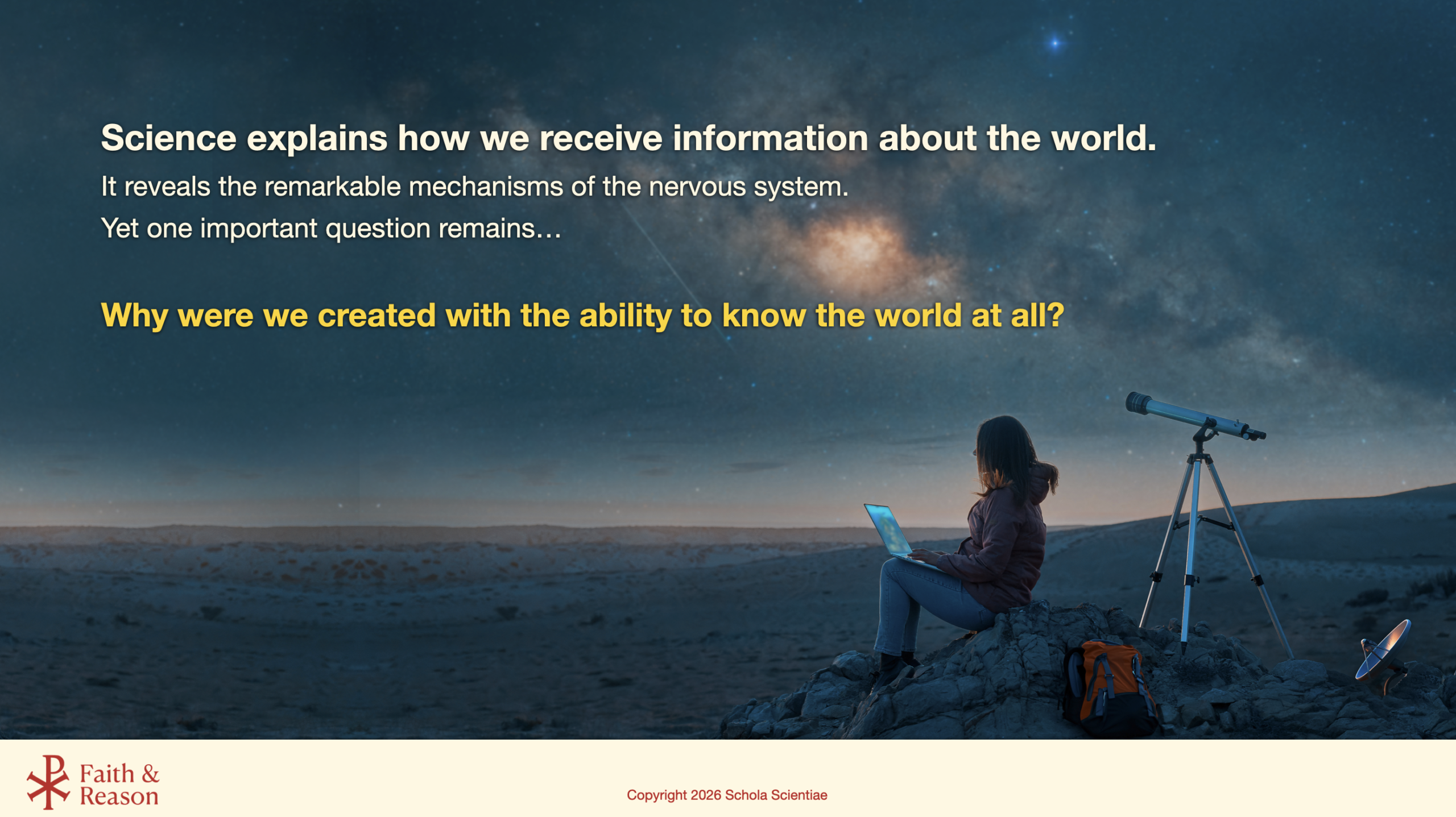
Humans Have the Ability to Know
Teaching Tips
- Help students recognize that reflexes and deliberate thought serve different purposes. Neither is “better”—each is essential in the right situation.
- Use familiar examples to compare automatic responses (touching a hot stove) with situations that require reflection (responding to criticism, making an important decision).
- Encourage students to identify examples from their own lives when pausing before acting led to a better outcome.
- Emphasize that one remarkable ability of the human brain is knowing when to react immediately and when to stop and think.
- Reinforce that this capacity for thoughtful decision-making prepares students for later investigations on executive function, self-control, and wisdom.
- Transition by asking: “If we can choose not only how we act, but also why we act, what does that suggest about the human person?”
Purpose
This slide introduces one of the central questions of Human Cognition: not simply how the nervous system receives and processes information, but why human beings possess the remarkable ability to know and understand the world. It prepares students to consider that this capacity is fundamental to what it means to be human.
Key Idea
Science explains the biological mechanisms that allow us to receive and process information. An equally remarkable fact is that human beings are capable of understanding, discovering truth, and intentionally seeking knowledge about themselves and the world around them.
Leading the Conversation
Begin by asking students to think about the many things they know every day.
Ask questions such as:
- How do you know when someone is happy or sad?
- How do scientists discover new knowledge about the natural world?
- How are you able to recognize patterns, solve problems, or understand new ideas?
Encourage students to recognize that these abilities are so familiar that we often take them for granted.
Then ask:
“Science explains how our brains receive information. But why do human beings possess the ability to know the world at all?”
Allow students to reflect on this question before introducing the Christian perspective in the following slides.
Connections
Science Investigation
Students discovered how receptors, sensory neurons, the brain, and motor neurons work together to process information. These scientific discoveries explain the mechanisms that make human understanding possible.
Everyday Life
Every conversation, scientific discovery, work of art, invention, and act of learning depends upon humanity’s remarkable ability to know, understand, and seek truth.
Faith & Reason
Faith & Reason begins with the scientific understanding of human cognition and then asks a deeper question about its meaning and purpose. Christianity teaches that the human capacity to know and understand the world is not accidental, but an essential part of being created in the image of God.
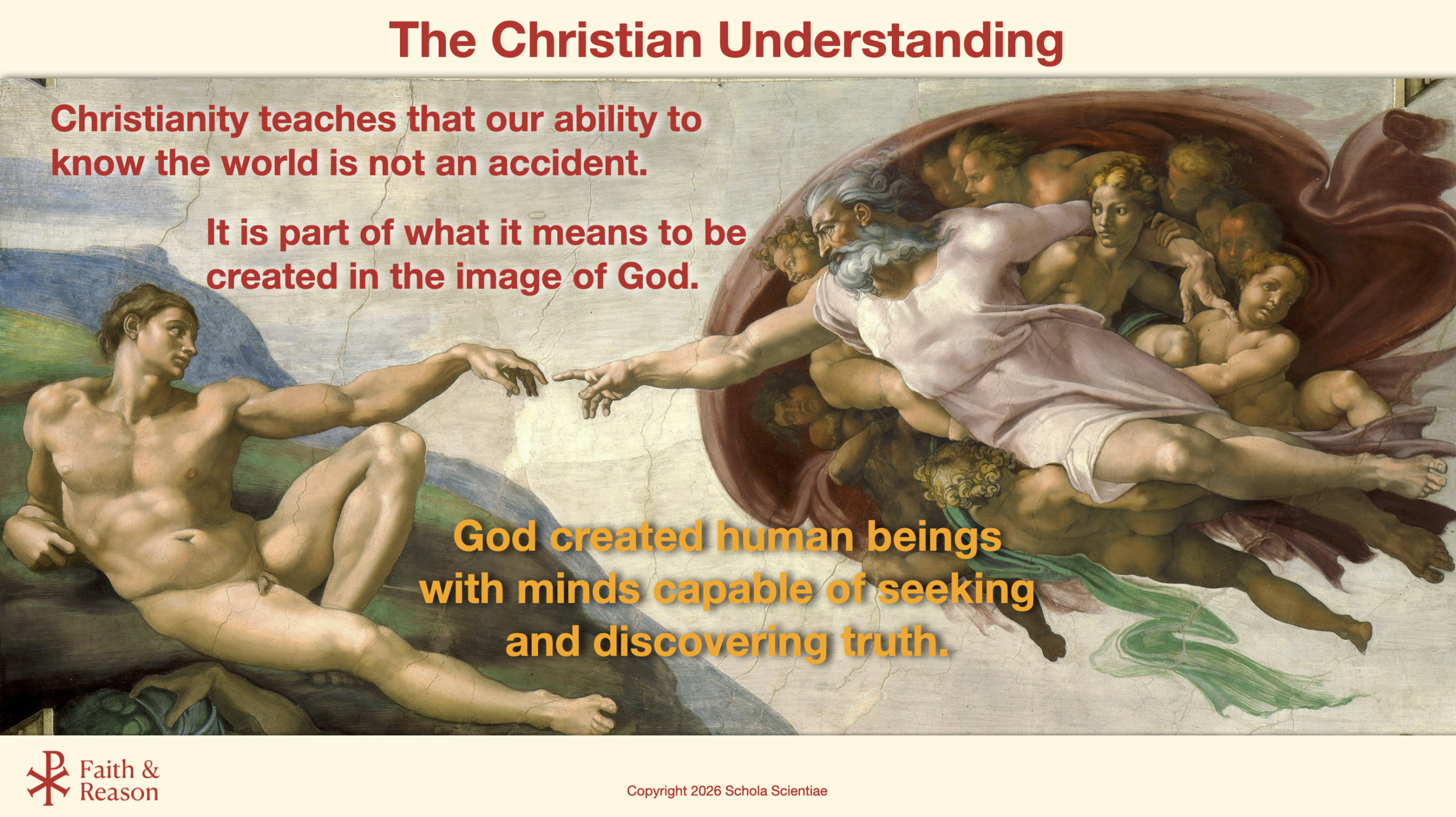
The Christian Understanding
Teaching Tips
- Explain that this slide introduces the Christian understanding of why human beings possess the remarkable ability to know, understand, and seek truth.
- Emphasize that Christianity teaches our capacity to reason is not accidental, but part of being created in the image of God.
- Remind students that this discussion builds on the science they have already learned—it does not replace it.
- Encourage thoughtful discussion by asking what responsibilities might accompany the human ability to reason, learn, and discover truth.
- Welcome respectful questions and discussion, recognizing that students may come from different backgrounds while exploring the Christian perspective presented in this curriculum.
- Transition by asking: “If our ability to know and understand the world is a gift, what should we do with that gift?”
Purpose
This slide introduces the Christian understanding of one of the central questions raised throughout this investigation: Why do human beings possess the remarkable ability to know and understand the world? Christianity teaches that this capacity is not accidental, but an essential part of being created in the image of God. This slide marks the beginning of the theological portion of the lesson by building directly upon the scientific discoveries students have already made.
Key Idea
Christianity teaches that God created human beings with minds capable of seeking, understanding, and discovering truth. Our ability to know the world is one expression of being created in the image and likeness of God and provides the foundation for science, learning, creativity, and our relationship with God and one another.
Leading the Conversation
Remind students that science has already explained how the nervous system receives and processes information.
Then ask:
“Science explains how we come to know the world. But why do human beings possess this remarkable ability at all?”
Allow students to share their thoughts before introducing the Christian perspective presented on the slide.
Discuss the significance of being created in the image of God. Encourage students to consider how our abilities to reason, learn, discover truth, communicate, and create distinguish human beings in unique ways.
Invite respectful discussion by asking:
- Why might the ability to seek truth be important?
- How does this understanding influence the way we view learning, science, and other people?
- If our ability to reason is a gift, what responsibilities accompany that gift?
Emphasize that the Christian understanding does not replace science. Rather, it builds upon scientific knowledge by considering its deeper meaning and purpose.
Connections
Science Investigation
Students discovered how the nervous system receives, processes, and responds to information. Those scientific discoveries explain the biological mechanisms that make human understanding possible.
Everyday Life
Every act of learning, scientific discovery, artistic creation, moral decision-making, and meaningful relationship depends upon humanity’s remarkable ability to know, understand, and seek truth.
Faith & Reason
Faith & Reason demonstrates that science and Christian theology ask complementary questions. Science investigates how human cognition works, while Christianity considers why human beings possess these extraordinary abilities and what they reveal about our nature and purpose.
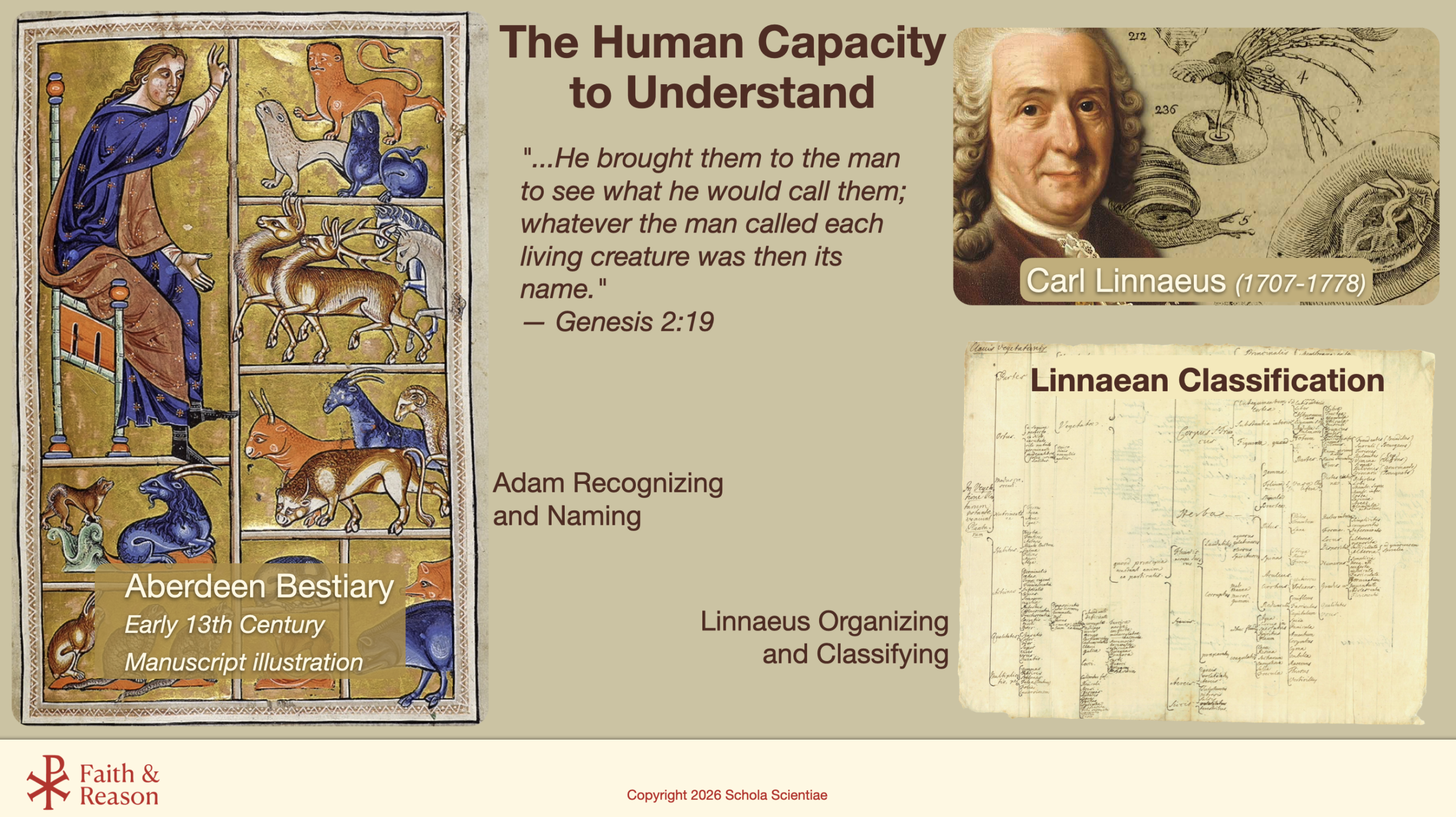
Human Capacity to Understand
Teaching Tips
- Explain that this slide illustrates how the human capacity to understand has been expressed throughout history, from the biblical account of Adam naming the animals to Linnaeus’ scientific classification of living things.
- Emphasize that both examples reflect humanity’s natural desire to observe, organize, and understand creation.
- Do not treat the historical examples as facts students must memorize. Instead, use them to illustrate the enduring human pursuit of knowledge.
- Encourage students to compare Adam’s naming of the animals with Linnaeus’ classification system, asking what these two events reveal about the human mind.
- Reinforce that scientific discovery is built upon careful observation, pattern recognition, and the ability to communicate knowledge to others.
- Transition by asking: “If human beings have always sought to understand the world, what might that suggest about who we are?”
Purpose
This slide demonstrates that the human desire to understand the world has been present throughout history. From Adam naming the animals to Carl Linnaeus developing a scientific system for classifying living things, human beings have consistently used their God-given ability to observe, understand, organize, and discover truth about creation.
Key Idea
The human capacity to know and understand the world is expressed in many ways throughout history. Scientific observation, naming, classification, and discovery reflect one of the remarkable abilities that Christianity understands as part of being created in the image of God.
Leading the Conversation
Invite students to compare the two historical examples shown on the slide.
Ask questions such as:
- Why did Adam give names to the animals?
- Why was Linnaeus interested in organizing and classifying living things?
- What do these two people, separated by thousands of years, have in common?
Help students recognize that both examples demonstrate humanity’s natural desire to understand the world.
Explain that throughout history people have observed nature, searched for patterns, organized knowledge, and shared discoveries with others. Science builds upon this uniquely human capacity to know, understand, and communicate truth.
Then ask:
“What does our continual desire to understand the world suggest about human nature?”
Allow students to discuss before moving to the next slide.
Connections
Scripture
Genesis describes Adam naming the animals, illustrating humanity’s earliest responsibility to observe, understand, and care for creation. Naming reflects understanding rather than simply assigning labels.
Science
Carl Linnaeus transformed biological classification by organizing living organisms into a systematic framework that scientists still use today. His work illustrates how careful observation and reason expand human knowledge.
Faith & Reason
Faith & Reason recognizes that scientific discovery is one expression of humanity’s God-given capacity to know and understand creation. Throughout history, Christians have viewed the study of nature as a meaningful way of exploring the order and intelligibility of God’s creation.
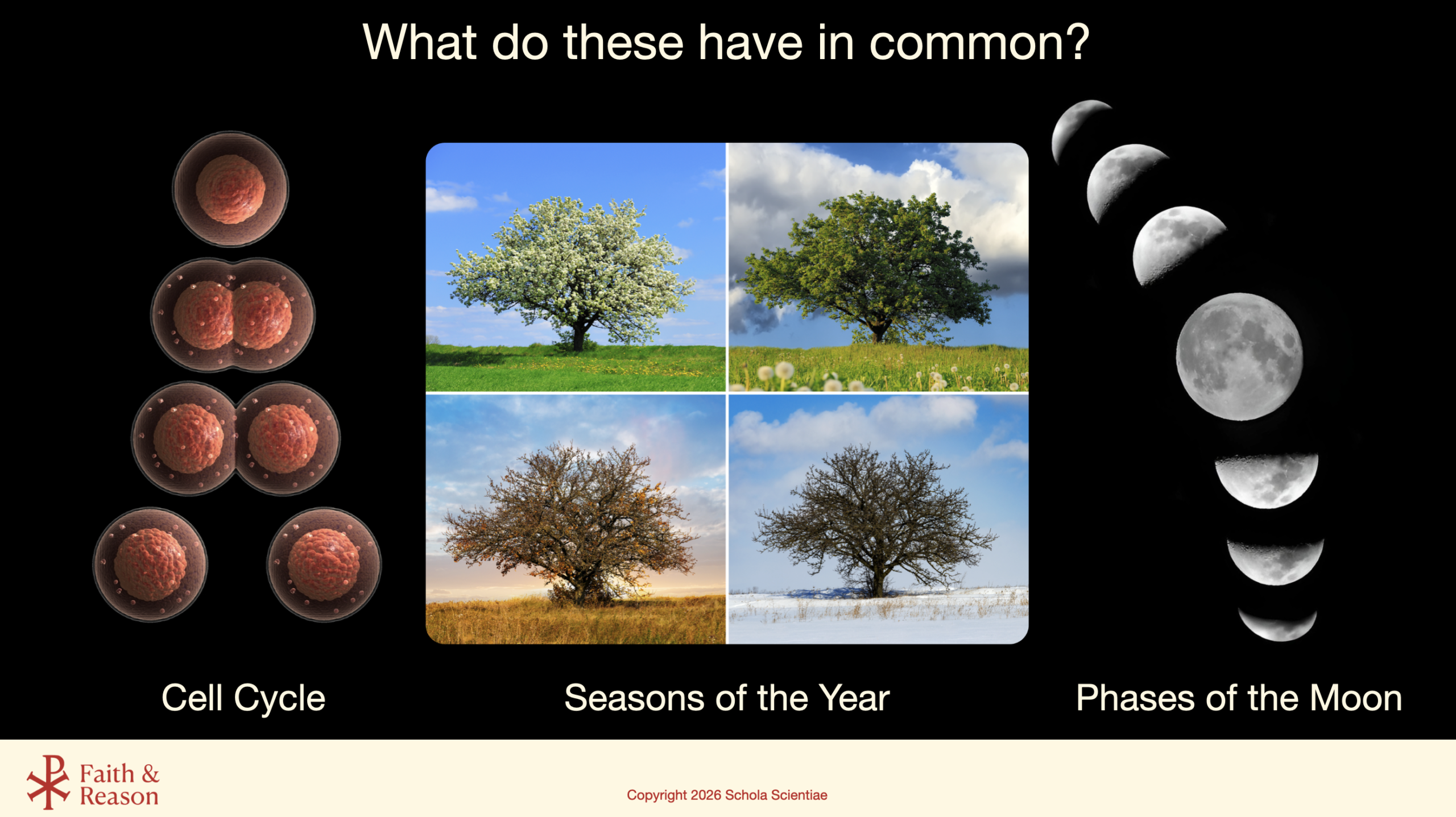
What Do These Have in Common?
Teaching Tips
- Encourage students to identify patterns rather than immediately looking for the “correct” answer.
- Give students time to compare the examples and explain their reasoning to one another before revealing the common feature.
- Reinforce that recognizing patterns is one of the fundamental ways scientists make discoveries and develop explanations.
- Explain that the ability to recognize order in nature prepares students for the next question: Why are human beings capable of discovering these patterns at all?
- Allow multiple observations during discussion before guiding students toward the central idea that each example follows an organized, predictable pattern.
- Transition by asking: “If the natural world displays order, why are human beings able to recognize that order?”
Purpose
This slide encourages students to identify a common characteristic shared by several very different natural phenomena. As they recognize that each follows an organized, predictable pattern, students begin to appreciate one of the remarkable abilities of the human mind—the ability to discover order in the natural world. This prepares them to consider why human beings are uniquely capable of recognizing such patterns.
Key Idea
One of the defining characteristics of human cognition is the ability to recognize patterns, relationships, and order within the natural world. Scientific discovery begins when people observe these patterns and ask why they exist.
Leading the Conversation
Present the three examples without immediately revealing the answer.
Ask students:
- What do these examples appear to have in common?
- What similarities do you notice even though they involve very different subjects?
- Why do scientists pay close attention to recurring patterns?
Allow students to discuss several possibilities before guiding them toward the central idea that each example follows an organized, predictable cycle or pattern.
Once students identify the common characteristic, continue by asking:
“Why do you think human beings are able to recognize patterns that many other living things never notice?”
Explain that recognizing order is one of the foundations of scientific thinking and prepares students for the Christian discussion that follows.
Connections
Science
Much of science consists of recognizing patterns, identifying relationships, and developing explanations for the orderly behavior observed throughout nature.
Everyday Life
People recognize patterns every day—learning language, predicting the weather, understanding music, recognizing faces, driving automobiles, and solving problems all depend upon the brain’s remarkable ability to detect order and relationships.
Faith & Reason
The Christian tradition has long viewed the order and intelligibility of creation as consistent with a world created by a rational God. Human beings are uniquely capable of discovering and understanding that order because they have been created with minds capable of seeking truth.
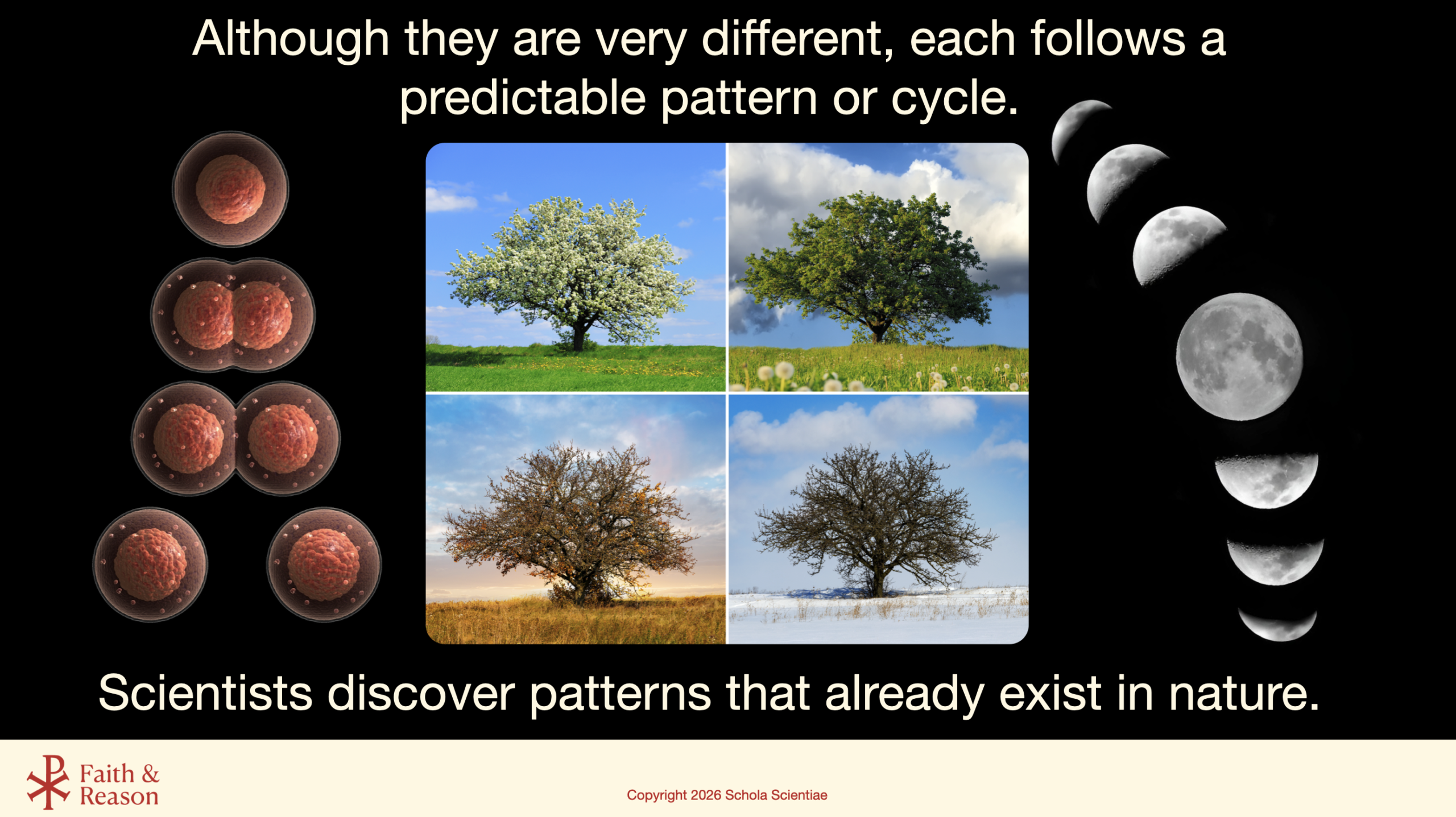
Patterns and Cycles
Teaching Tips
- Allow students to discover the common characteristic before providing the answer yourself.
- Emphasize that scientists discover patterns that already exist in nature—they do not invent them.
- Encourage students to explain how recognizing patterns allows scientists to make predictions and develop scientific explanations.
- Reinforce that identifying order is one of the defining characteristics of scientific thinking.
- Use the discussion to prepare students for the next question: Why is the universe understandable, and why are human beings able to understand it?
- Transition by asking: “If order exists throughout nature, what might that suggest about both the universe and the human mind?”
Purpose
This slide helps students recognize that many natural phenomena, although very different, exhibit consistent patterns and cycles. By discovering this common characteristic, students begin to appreciate that science is fundamentally the search for order within the natural world. This observation also prepares students to consider why the universe is understandable and why human beings are capable of recognizing its orderly design.
Key Idea
Scientists do not invent the patterns found in nature—they discover them. The natural world displays remarkable order, and the human mind possesses the unique ability to observe, recognize, and understand that order.
Leading the Conversation
Ask students to compare the three examples shown on the slide.
Guide the discussion with questions such as:
- What do the cell cycle, the seasons, and the phases of the Moon have in common?
- Why are predictable patterns so important to scientific investigation?
- How do scientists use recurring patterns to make predictions?
After students recognize that each follows a predictable cycle, ask:
“Did scientists create these patterns, or did they discover patterns that already existed?”
Help students recognize that scientific investigation depends upon discovering the order already present in nature.
Then continue:
“If the universe contains discoverable order, why are human beings able to recognize and understand that order?”
Explain that this question prepares students for the next stage of the Faith & Reason discussion.
Connections
Science
Science advances by observing recurring patterns, identifying relationships, testing explanations, and using those discoveries to better understand the natural world.
Everyday Life
People depend upon predictable patterns every day—from calendars and weather forecasts to medicine, agriculture, transportation, and countless daily decisions.
Faith & Reason
The Christian tradition teaches that creation possesses an intelligible order because it was created by a rational God. Human beings are uniquely capable of discovering that order because they have been created with minds capable of seeking and understanding truth.
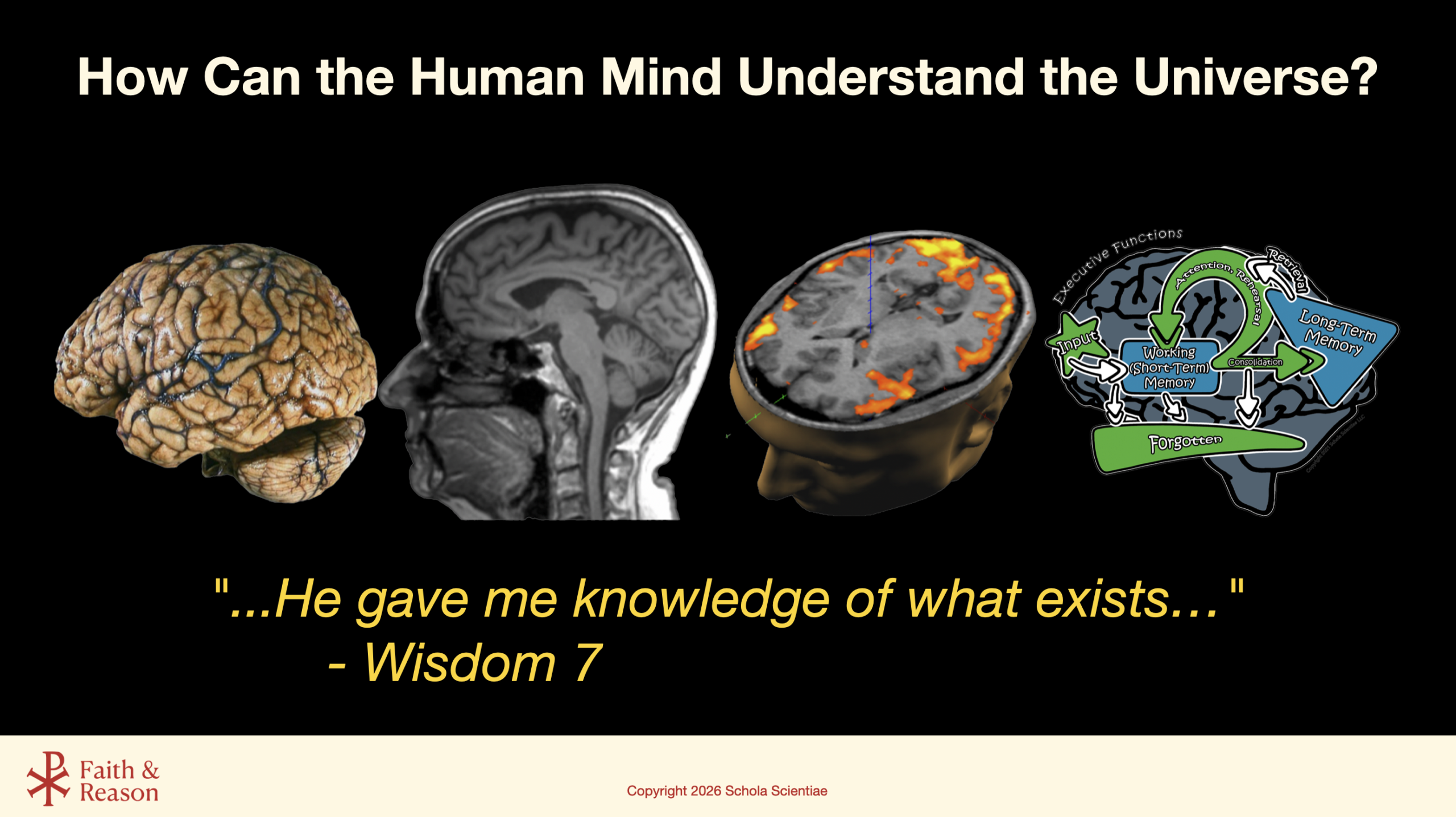
Knowledge of What Exists
Teaching Tips
- Begin by asking students to quietly consider the title before reading the quotation from Wisdom 7: “How can the human mind understand the universe?”
- Emphasize that this slide asks a different question than science alone addresses. Students have already learned how the nervous system processes information. Now they are invited to consider why human beings possess the remarkable ability to understand reality.
- Encourage thoughtful discussion rather than quick answers. Questions about knowledge, truth, and human nature often require careful reflection.
- Explain that the quotation from Wisdom 7 presents the Christian understanding that our ability to know and understand the world is a gift—one that makes scientific discovery possible rather than unnecessary.
- Invite students to reflect on how science and faith complement one another in this investigation. Science explains the biological processes that make understanding possible; Christianity reflects on the meaning and purpose of those remarkable abilities.
- Transition by asking: “If our ability to understand the universe is a gift, how should we use that gift?”
Purpose
This slide invites students to consider one of the most remarkable characteristics of the human mind: its ability to understand the natural world. After discovering how the nervous system receives and processes information, students now ask a deeper question: How is it possible that human beings can understand the universe at all? The quotation from the Book of Wisdom introduces the Christian perspective that knowledge is a gift that enables us to discover truth.
Key Idea
Human beings possess an extraordinary ability to observe, reason, recognize patterns, and understand the natural world. Science investigates how these abilities function, while the Christian tradition recognizes them as gifts that enable us to seek and discover truth.
Leading the Conversation
Ask students to consider the title of the slide before reading the quotation.
“How can the human mind understand the universe?”
Encourage discussion with questions such as:
- Why are human beings able to understand the laws of nature?
- Why can scientists discover truths that already exist?
- What abilities make scientific investigation possible?
After students have discussed these questions, introduce the quotation from Wisdom 7:
“…He gave me knowledge of what exists…”
Explain that the Christian tradition understands our ability to know the world as a gift that makes scientific discovery possible rather than unnecessary.
Then ask:
“If knowledge is a gift, what responsibilities come with that gift?”
Connections
Science
Throughout Investigation 2, students have discovered how the nervous system gathers information, processes sensory input, recognizes patterns, and enables understanding.
Human Cognition
Human cognition allows us not only to respond to the world but also to investigate it, develop scientific explanations, communicate discoveries, and build knowledge across generations.
Faith & Reason
Faith & Reason recognizes that the human ability to understand the universe is consistent with both scientific investigation and the Christian understanding that human beings have been created with minds capable of seeking truth.
From sensation...to understanding...to wise action.
Teaching Tips
- Allow students to summarize the investigation in their own words rather than providing the summary yourself.
- Emphasize the progression shown on the slide: Sensation → Understanding → Wise Action. Help students recognize that each step builds naturally upon the previous one.
- Encourage students to connect the scientific discoveries from Investigation 2 with the broader question of how knowledge should be used.
- Reinforce that wisdom is more than possessing information—it is using knowledge thoughtfully, responsibly, and ethically.
- Invite students to reflect on one idea from this investigation that changed the way they think about themselves or the world.
- Conclude by reminding students that every Human Cognition investigation will continue building upon this same journey—from understanding how the brain works to understanding what it means to live wisely.
Purpose
This concluding slide brings together the central themes of Human Cognition Investigation 2. Students have discovered how the nervous system receives sensory information, processes that information, and enables understanding of the world. The investigation concludes by emphasizing that knowledge finds its highest purpose when it guides thoughtful judgment and wise action.
Key Idea
Human cognition is more than receiving information. It is the remarkable ability to transform sensation into understanding and understanding into wise action. Science explains the biological processes that make this possible, while the Christian tradition reminds us that knowledge carries both purpose and responsibility.
Leading the Conversation
Invite students to look back over the entire investigation.
Ask:
- What scientific discovery surprised you the most?
- How has your understanding of the nervous system changed?
- Why is understanding more valuable than simply collecting information?
Then focus students on the progression shown on the slide:
Sensation → Understanding → Wise Action
Discuss each step together.
Help students recognize that sensation provides information, understanding gives that information meaning, and wisdom guides how knowledge should be used.
Conclude by asking:
“If our ability to understand the world is a gift, how should that understanding influence the way we live, treat other people, and seek truth?”
Allow students to summarize the investigation in their own words before concluding the lesson.
Connections
Science
Throughout this investigation, students explored how receptors, sensory neurons, the spinal cord, and the brain work together to transform sensory information into meaningful understanding of the world.
Human Cognition
Human cognition extends beyond sensation by allowing people to recognize patterns, develop scientific explanations, communicate ideas, solve problems, and make thoughtful decisions.
Faith & Reason
Faith & Reason concludes that scientific knowledge and Christian wisdom are complementary. Science explains how human cognition works, while the Christian tradition encourages us to use that remarkable ability wisely—in the pursuit of truth, the service of others, and the glory of God.