Back to: Human Cognition – Teacher
Teacher Portal
Investigation 1: Faith & Reason
NAVIGATE
Once the slide presentation is launched
- use your left and right arrows to advance or go back in the slide presentation, and
- hover your mouse over the left edge of the presentation to get a view of the thumbnails for all the slides so that you can quickly move anywhere in the presentation.
Click on any image below to expand
Slide 1 — Human Cognition: Faith & Reason
Teaching Tips
Use this opening slide to signal a change in perspective.
Students have investigated the human brain scientifically. They will now consider some of the larger questions raised by what they have discovered.
You might say:
“We have learned a great deal about the human brain. Now we are going to ask what those discoveries might tell us—and what they cannot tell us—about ourselves.”
Emphasize that Faith & Reason continues the scientific Investigation. Students should continue to use what they learned through observation, evidence, and scientific reasoning as the foundation for the discussion.
Then explain:
“Science can tell us remarkable things about the brain. Some discoveries also raise questions about the human person that science was not designed to answer by itself.”
Keep this introduction brief. The intellectual work begins on the next slide.
Purpose
This opening slide establishes Faith & Reason as a continuation of Investigation 1 rather than a separate theology lesson.
Students have studied the structure and function of the human brain. They will now use those scientific discoveries as the starting point for broader questions about the human person.
Key Idea
Scientific discovery can raise questions that extend beyond science.
Faith & Reason does not replace scientific explanation. Instead, it invites students to consider what philosophy and Catholic theology can contribute when the questions move from How does the brain work? toward What does this tell us about ourselves?
Leading the Conversation
Do not begin by teaching theology. Begin with what students already know about the brain.
The purpose of this section is to help students recognize that different kinds of questions may require different kinds of inquiry. Science remains essential throughout the discussion.
Encourage curiosity rather than rushing toward conclusions. Several of the questions raised in this slide set are intentionally left open long enough for students to think and discuss before Catholic theological perspectives are introduced.
Connections
Scientific Investigation
Investigation 1 introduced students to brain anatomy, specialized brain regions, and evidence that changes to the brain can affect behavior, emotion, judgment, and other aspects of human cognition.
Human Cognition
The science of the brain provides the foundation for asking a larger question that will recur throughout the unit: How much does understanding the brain tell us about the human person?
Faith & Reason
Catholic theology will be referred to when it illuminates questions raised by the science. The goal is not to teach a separate theology lesson or to use theology as a substitute for scientific explanation.
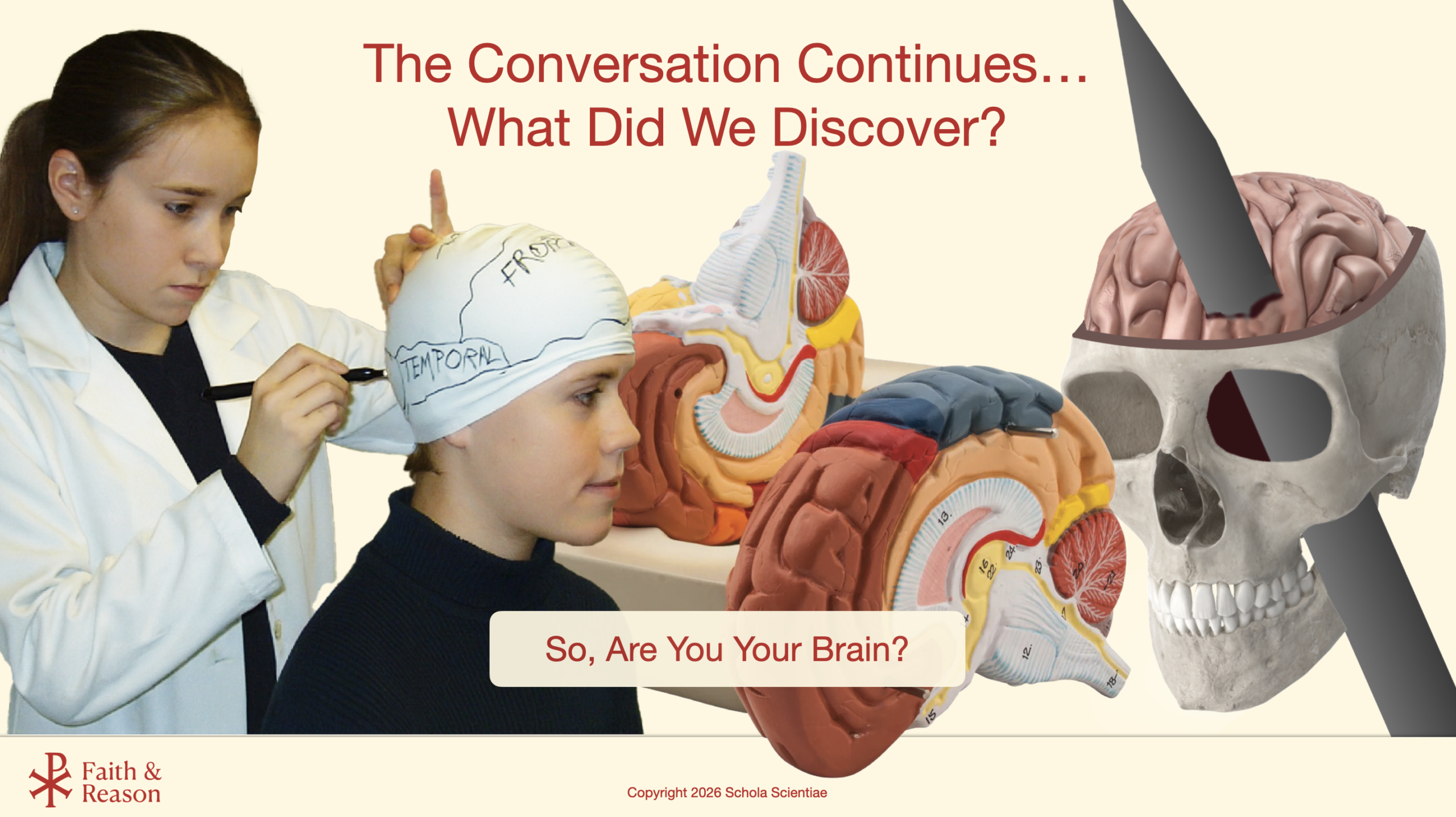
Slide 2 — The Conversation Continues: What Did We Discover?
Teaching Tips
Let the images do the work.
This slide is an opportunity for students to recall what they discovered during the scientific Investigation. Rather than reteaching the material, point to the images and invite students to explain what each one represents.
You might ask:
“What do you remember about this? What did it teach us about the brain?”
Encourage students to supply the scientific ideas themselves. Help clarify misconceptions when necessary, but keep the conversation moving.
Then turn to the larger question.
After students have recalled what they learned about the brain and its importance for thought, emotion, memory, behavior, and other aspects of cognition, ask:
“So, are you your brain?”
Do not answer the question yet. Give students time to think and respond. Different answers are useful here because the question opens the discussion that follows.
Purpose
This slide reconnects Faith & Reason directly to the scientific work students have already completed. Before asking what Catholic theology says about the human person, students first recall what science has shown them about the brain.
Key Idea
The brain is extraordinarily important to who we are and how we experience the world.
That scientific fact naturally raises a larger question: If changes in the brain can change so much about how we think, feel, remember, and act, what is the relationship between the brain and the person?
Leading the Conversation
Allow students to wrestle with “Are you your brain?” before introducing theological language. Some students may immediately say yes; others may sense that something is missing from that answer.
Do not resolve the tension. The purpose is to make the question real enough that students want to investigate it.
This is also an important moment to model intellectual humility. Science has given students genuine knowledge about the brain. The next question is whether that knowledge tells us everything that can be known about the human person.
Connections
Scientific Investigation
Students draw directly upon their study of brain structure and function and the evidence that brain activity and brain injury can affect cognition, emotion, memory, behavior, and judgment.
Faith & Reason
The question “Are you your brain?” creates the bridge from neuroscience to the broader question of the human person. Theology has not yet supplied an answer; students first encounter the limits of what their scientific observations alone can establish.
Looking Ahead
The slides that follow will distinguish between questions science can investigate directly and broader questions addressed through reason, philosophy, and revelation.
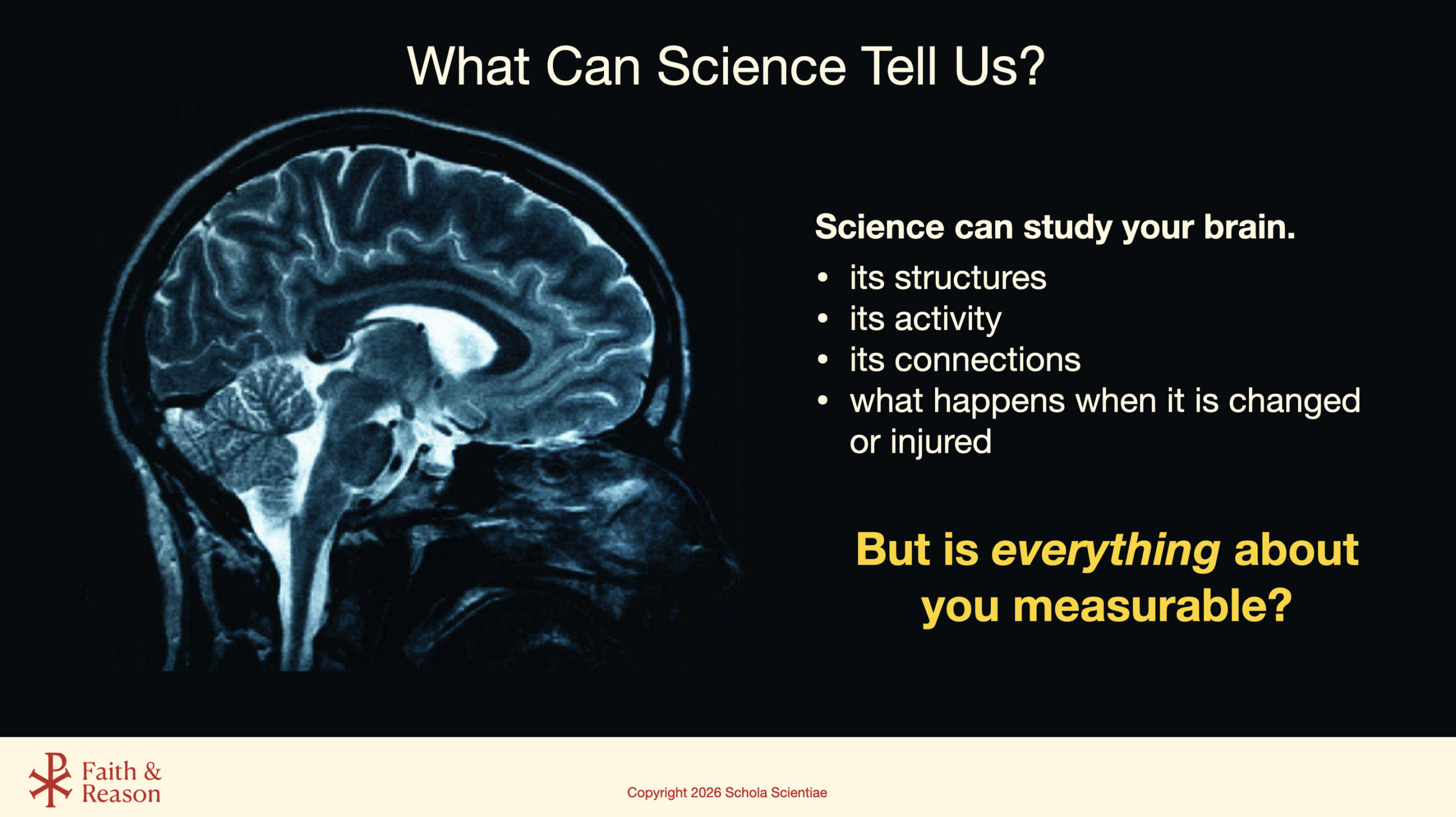
Slide 3 — What Can Science Tell Us?
Teaching Tips
Begin with what science does extraordinarily well.
Students have just spent an entire Investigation using science to study the brain. Use this slide to make explicit what scientific investigation allows us to know.
You might ask:
“What kinds of things about your brain can scientists actually observe or measure?”
Use the slide prompts to reinforce their answers: scientists can investigate brain structures, activity, connections, and what happens when the brain is changed or injured.
Then focus on the question at the bottom.
“But is everything about you measurable?”
Give students time to respond. They may immediately think of things that seem difficult or impossible to measure. Welcome those examples without trying to classify or resolve them yet.
The important distinction is not “science versus faith.” It is that the method we use must fit the kind of question we are asking.
Purpose
This slide establishes both the power and the proper scope of scientific investigation. Science gives us reliable ways to investigate the physical world, including the human brain.
The closing question prepares students to consider whether every meaningful truth about a human person can be approached through measurement alone.
Key Idea
Science can tell us an enormous amount about the brain—but not every question about a human person is a scientific question.
This is not a limitation or criticism of science. Scientific methods are powerful precisely because they are designed to investigate particular kinds of questions.
Leading the Conversation
Be careful not to suggest that anything science cannot measure must therefore belong to religion. The distinction is more thoughtful than that.
Students are beginning to recognize that different questions may require different ways of seeking truth. Some questions can be investigated experimentally. Others may require philosophical reasoning, moral reflection, human experience, or revelation.
Keep the discussion exploratory. The next slide provides concrete examples—love, truth, beauty, friendship, courage, right and wrong, purpose, and hope—that will make this distinction much easier for students to grasp.
Connections
Scientific Investigation
The MRI image reconnects students with the physical brain they have been studying. Brain anatomy, activity, connections, and the consequences of injury are all legitimate subjects of scientific investigation.
Faith & Reason
This slide introduces an important habit of mind for the entire curriculum: before trying to answer a question, first ask what kind of question it is and what methods are appropriate for investigating it.
Next Slide
Slide 4 moves from the abstract question “Is everything about you measurable?” to familiar realities students already recognize as deeply important in human life.
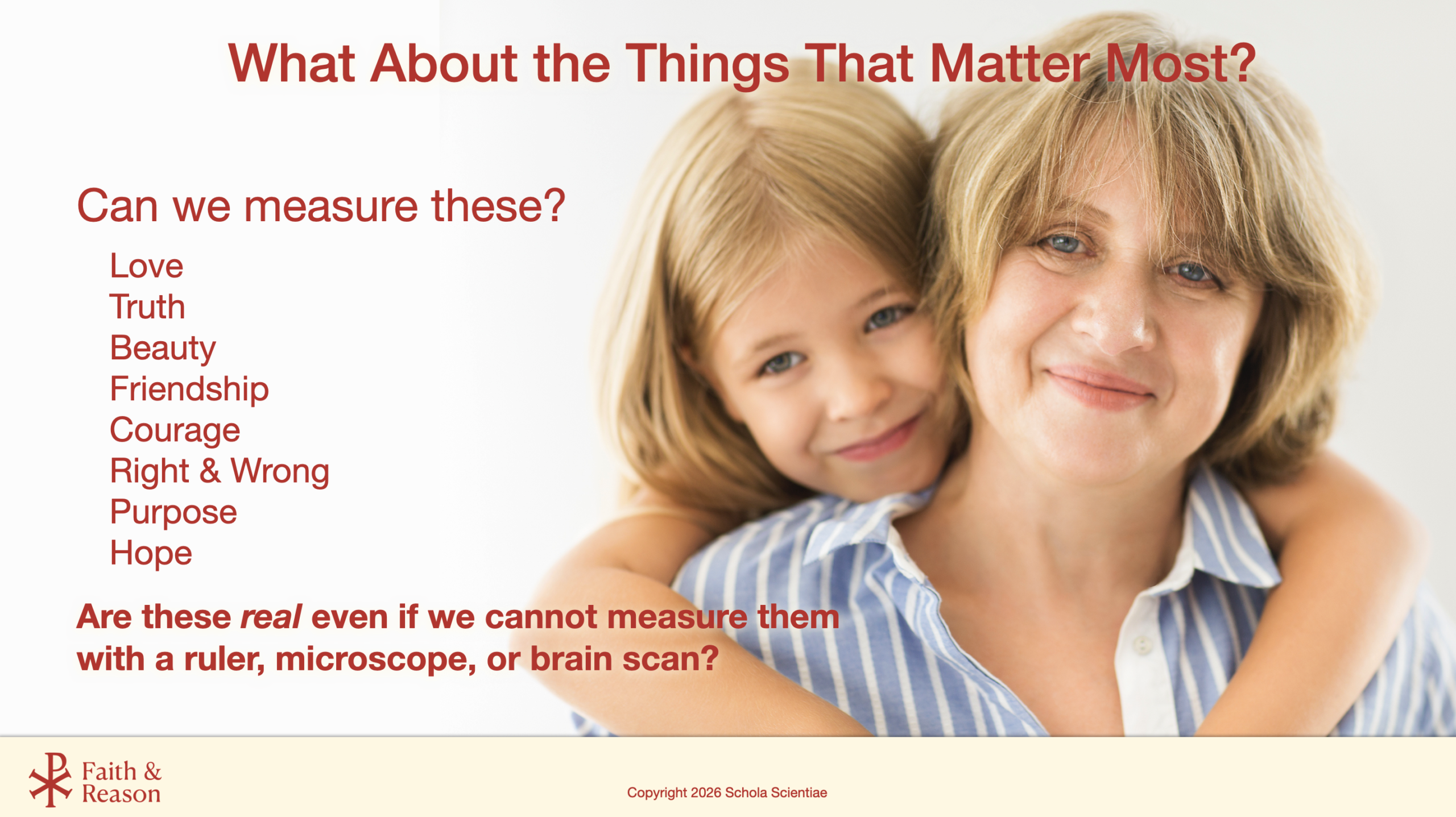
Slide 4 — What About the Things That Matter Most?
Teaching Tips
Let students begin with ordinary human experience.
Read through the words on the slide: love, truth, beauty, friendship, courage, right and wrong, purpose, and hope.
Then ask:
“Which of these are real?”
Students will likely say that all of them are real. Follow with the question on the slide:
“If they are real, how could we know that? Can we measure them with a ruler, microscope, or brain scan?”
Keep the scientific distinction precise.
Neuroscience can investigate brain activity associated with experiences such as love, hope, moral judgment, or the perception of beauty. That does not necessarily mean that measuring the associated brain activity completely explains what those experiences mean.
You might give students a concrete example:
“If scientists scanned your brain while you looked at someone you love, they might learn something important about what your brain is doing. Would the scan tell them everything about why you love that person?”
Allow the question to remain open. The goal is to help students recognize that something can be real and important even when its full meaning cannot be captured by physical measurement alone.
Purpose
This slide makes the question raised on Slide 3 concrete. Students encounter familiar realities that matter deeply in human life but are not easily reduced to physical measurements.
Key Idea
“Real” and “scientifically measurable” do not mean exactly the same thing.
Science can investigate many physical aspects of human experiences. But questions about truth, beauty, friendship, courage, right and wrong, purpose, and love may also involve meaning, value, relationships, and judgment.
Leading the Conversation
Avoid presenting this as a list of things that “science cannot study.” That would be inaccurate. Scientists can—and do—study many biological, psychological, and behavioral aspects of these experiences.
The deeper question is whether a scientific description provides a complete account of the reality being considered.
For example, neuroscience may identify patterns of brain activity associated with love. Psychology may study attachment and relationships. Neither observation by itself answers every question about what love means, why a particular person is loved, or whether an act is truly loving.
This distinction prepares students for the next slide, where science, philosophy, and theology are introduced as different ways of approaching different kinds of questions.
Connections
Human Cognition
Everything students experience—including relationships, emotions, moral decisions, and appreciation of beauty—involves the functioning brain they are studying. Faith & Reason does not separate these experiences from biology.
Scientific Thinking
Good scientific thinking includes recognizing what a particular method can establish and avoiding conclusions that go beyond the evidence.
Faith & Reason
The slide begins opening intellectual space for other forms of inquiry without diminishing science. Students are being prepared to ask not only “What can we measure?” but also “What kind of question are we trying to answer?”
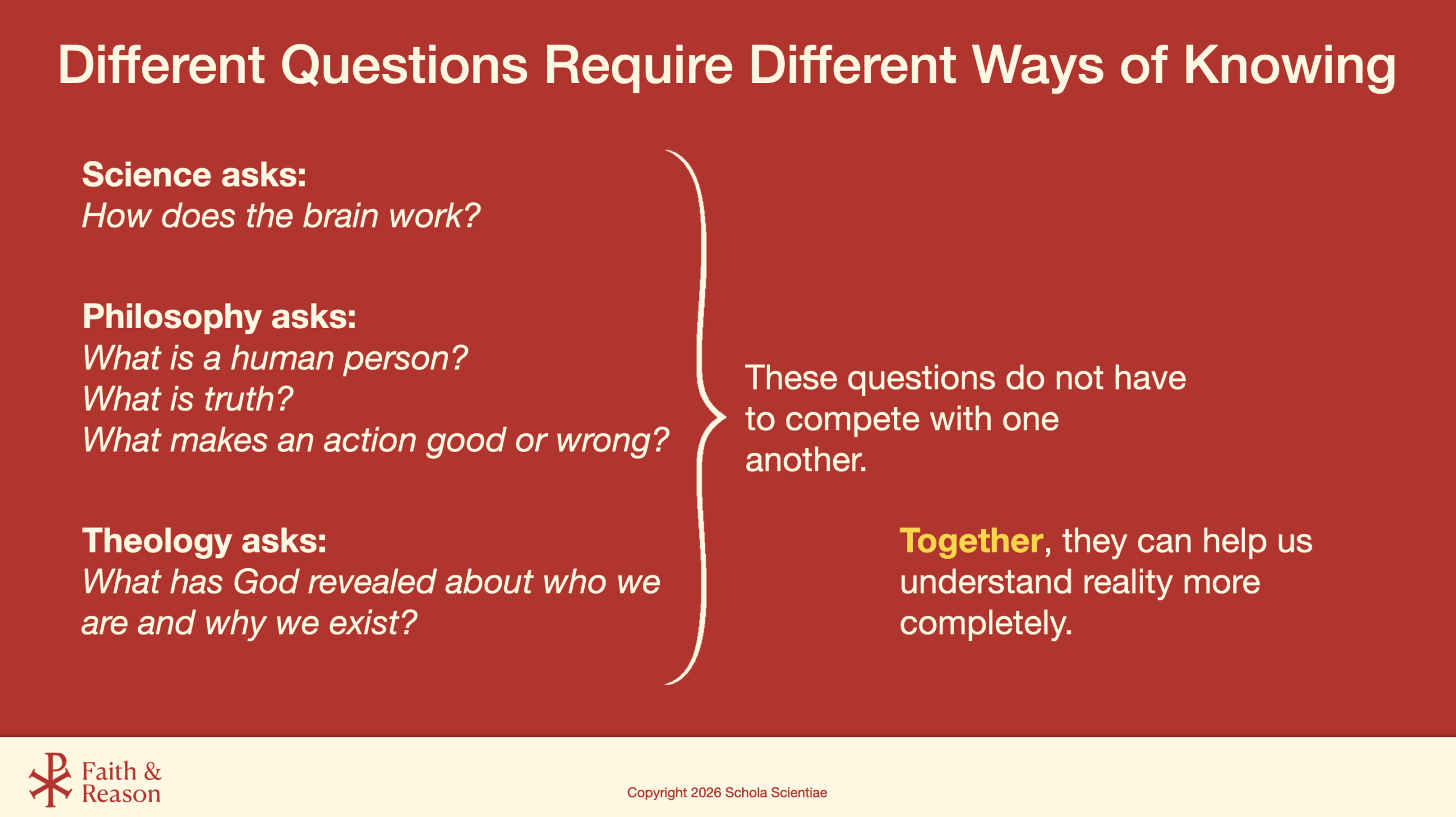
Slide 5 — Different Questions Require Different Ways of Knowing
Teaching Tips
Focus on the questions before the disciplines.
Read the three sets of questions with students. Ask them to notice that science, philosophy, and theology are not simply giving different answers to the same question. They often begin by asking different kinds of questions.
You might ask:
“Which of these questions could we investigate by doing an experiment or making scientific observations?”
Students should readily recognize that “How does the brain work?” is suited to scientific investigation. Then consider the other questions.
“Could an experiment alone tell us what truth is—or whether an action is right or wrong?”
Now introduce the central Faith & Reason idea.
Draw students’ attention to the word Together on the slide.
“These ways of seeking truth do not have to compete. Each can help us ask and answer questions appropriate to it.”
Keep this distinction simple. Students do not need a lesson in philosophy of science or theology. They need to recognize that the kind of question being asked helps determine the appropriate way to investigate it.
Purpose
This slide makes explicit the intellectual framework that has been developing since Slide 2. Students have encountered questions that arise from studying the brain but cannot all be answered using the same methods.
The slide introduces science, philosophy, and theology as distinct but potentially complementary ways of seeking truth.
Key Idea
Different kinds of questions may require different ways of knowing.
Science asks questions that can be investigated through observation, measurement, evidence, and testing. Philosophy uses reason to examine questions such as truth, human nature, morality, and meaning. Theology considers what can be known through reason together with what God has revealed.
These approaches need not compete when each remains attentive to the kinds of questions it is equipped to address.
Leading the Conversation
This is an important slide for preventing a false choice between science and faith.
Avoid suggesting that science deals with facts while philosophy and theology deal merely with opinions or beliefs. Likewise, do not imply that theology should be used to fill gaps in current scientific knowledge.
Instead, help students see that human beings can ask more than one kind of truthful question about the same reality.
For example, a scientist can investigate what happens in the brain when a person makes a decision. Philosophy can ask what it means to choose freely or to act responsibly. Theology can ask what revelation tells us about human freedom, dignity, and our relationship with God.
The disciplines can therefore meet around the human person without becoming interchangeable.
Connections
Scientific Investigation
HC1 has given students scientific knowledge about the physical brain. Nothing on this slide diminishes that knowledge or changes the standards by which scientific claims are evaluated.
Catholic Intellectual Tradition
The Catholic tradition has long held that faith and reason are compatible paths toward truth. This slide introduces that tradition through the students’ own experience of asking different kinds of questions rather than through a separate theology lesson.
Looking Ahead
The next slide introduces the first explicit reference to revelation: Genesis 1:27. The sequence is intentional. Students first recognize that some questions extend beyond scientific measurement; only then are they invited to consider what revelation contributes to the question of who we are.
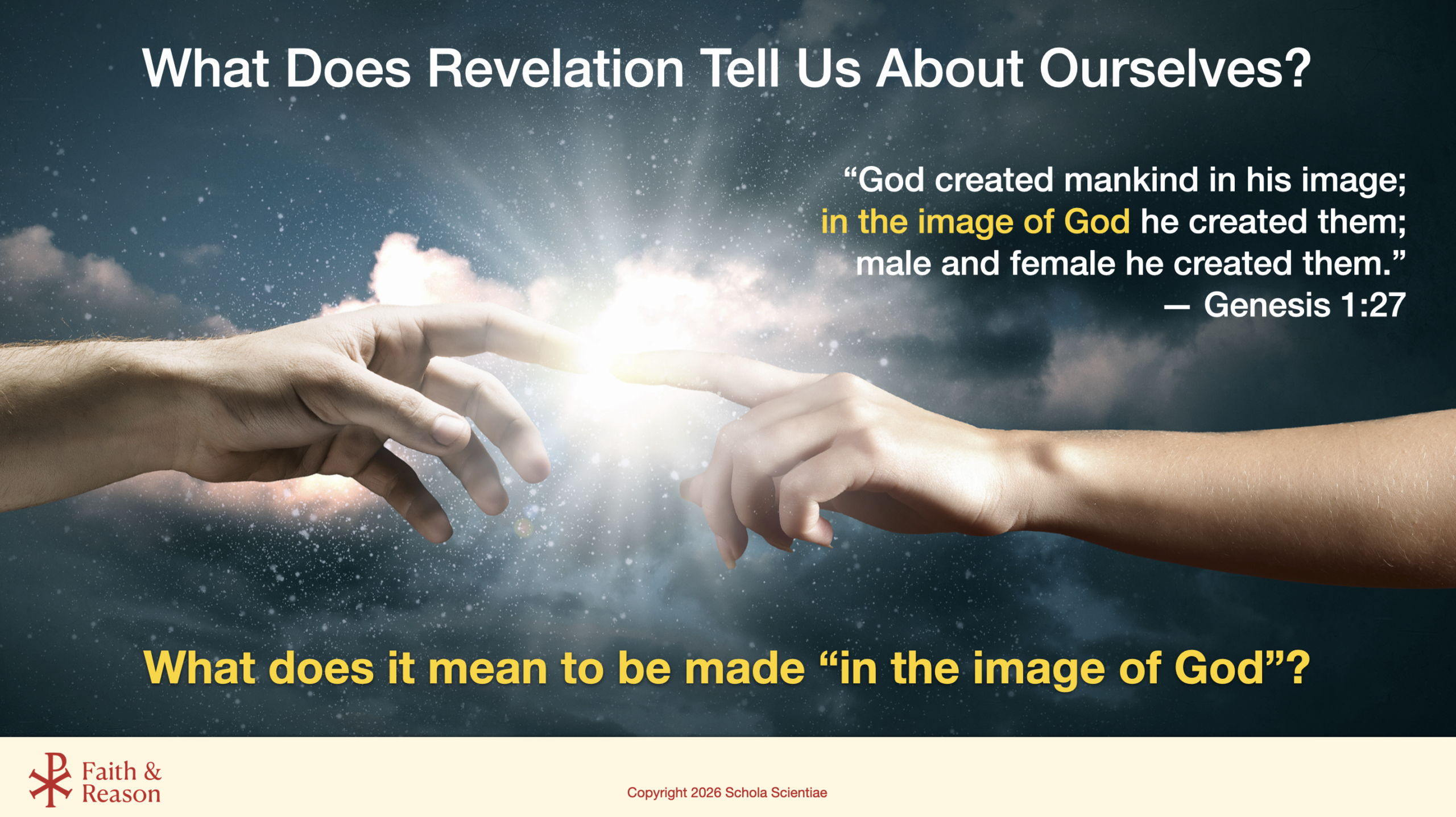
Slide 6 — What Does Revelation Tell Us About Ourselves?
Teaching Tips
Let the Scripture raise the question before explaining it.
Read Genesis 1:27 aloud, emphasizing the phrase “in the image of God.” Then pause at the question on the slide:
“What do you think it means to be made ‘in the image of God’?”
Invite several responses before offering any explanation. Students may suggest appearance, intelligence, goodness, creativity, love, freedom, or other possibilities. Use their answers to open the conversation rather than immediately evaluating each one.
Clarify one important misconception.
The phrase image of God does not mean that human beings physically resemble God.
You might ask:
“Do you think Genesis is telling us that God has a human face, hands, and body just like ours? If not, what kind of ‘image’ might this be?”
Do not try to provide a complete theological explanation of imago Dei here. The next slide gives students several concrete ways to begin thinking about what the phrase can mean.
Purpose
This slide introduces revelation into the conversation for the first time. Students have considered what science can tell us about the brain and have recognized that some questions about the human person extend beyond scientific measurement. They are now invited to consider what Scripture says about who we are.
Key Idea
Genesis describes every human being as created “in the image of God.”
The statement is not offered as a scientific explanation of the brain. It is a theological claim about the human person and our relationship to God.
Leading the Conversation
Resist the temptation to turn this slide into a lesson on the entire Catholic theology of imago Dei. The purpose is to refer to theology in response to the question already raised by the science: What is a human person?
Allow students to wonder about the meaning of the Genesis passage. The image of human hands reaching toward one another can help prompt ideas about relationship, love, creativity, and human action without defining the answer for them.
If students ask whether being made in God’s image is something we can detect in the brain, that is a valuable question. The appropriate distinction is that imago Dei is a theological description of the human person, not a structure or feature that neuroscience is expected to locate.
Connections
Scripture
Genesis 1:27 places the human person within creation while making a distinctive theological claim: human beings are created in the image of God.
Human Cognition
Students have been studying remarkable human capacities associated with the brain. The Genesis passage invites them to consider those capacities within a larger question about the nature and dignity of the person who possesses them.
Faith & Reason
This is an important example of the distinction introduced on Slide 5. Science asks how the brain works. Revelation addresses a different question: what has God revealed about who we are?
Looking Ahead
Slide 7 will give students several concrete ways to consider the meaning of the divine image—our capacities to reason, choose, love, and know God—while keeping the discussion connected to their study of human cognition.
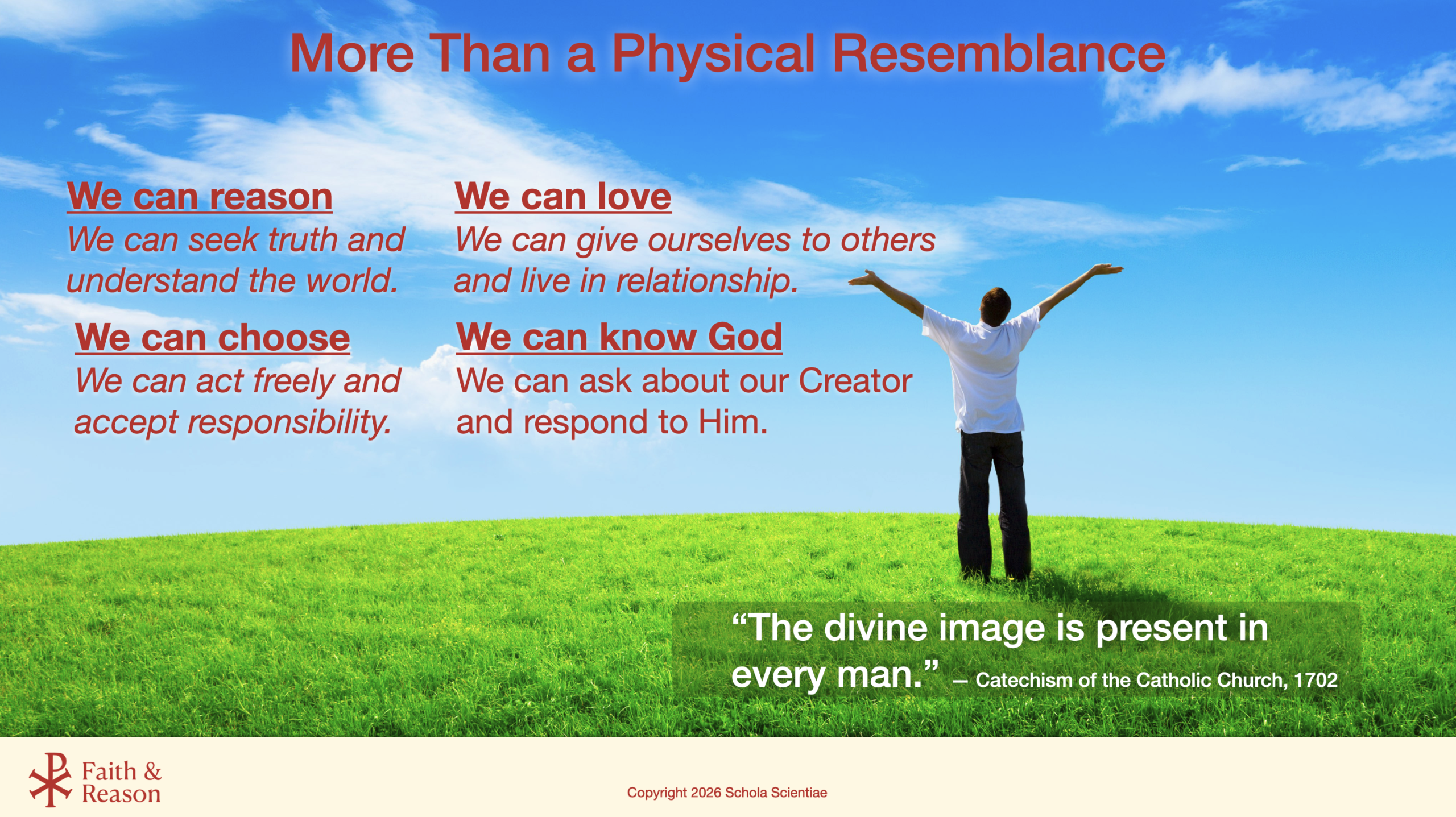
Slide 7 — More Than a Physical Resemblance
Teaching Tips
Return to the students’ ideas from the previous slide.
Remind students that Genesis does not mean that human beings physically look like God. The slide offers four ways Catholic thought helps us reflect on what it means to be made in God’s image: we can reason, choose, love, and know God.
Take the four ideas one at a time. Ask students for an example of each rather than simply reading the explanations from the screen.
You might ask:
“What is something humans can understand that requires reasoning? When have you had to choose between two things you really wanted to do? What makes loving someone different from simply liking something?”
Bring the conversation back to Human Cognition.
Students should recognize that several of these capacities already intersect with the science they are studying. Reasoning, choosing, and relationships all involve the functioning brain.
You might say:
“We can study what the brain is doing while a person thinks, chooses, or interacts with someone. Catholic theology asks us to consider something more: What do these human capacities tell us about the person?”
Do not make ability the basis of human worth.
Be careful not to imply that a person is made in the image of God because he or she can demonstrate these abilities. The Catechism statement at the bottom of the slide is important: “The divine image is present in every man.”
The next slide will make the consequence of that statement explicit: every human person possesses dignity.
Purpose
This slide begins answering the question raised on Slide 6: What does it mean to be made “in the image of God”? It gives students several accessible ways to think about the divine image without attempting a complete theological treatment of imago Dei.
Key Idea
Human capacities such as reasoning, choosing, loving, and knowing God can help students reflect on what Catholic theology means when it speaks of the human person as created in God’s image.
These capacities should be understood as expressions of human nature—not as achievements that determine whether an individual possesses human dignity.
Leading the Conversation
The distinction between having human dignity and demonstrating particular abilities is essential.
A newborn cannot reason or exercise freedom in the same way as an adolescent. A person with severe brain injury or cognitive disability may be unable to demonstrate some of these capacities. Catholic teaching does not therefore regard that person as less human or less fully made in the image of God.
This distinction is especially important in a unit on the brain. Students are learning that neurological development, injury, and disease can profoundly affect what a person is able to do. The theological claim on this slide concerns who the person is, not a measurable level of cognitive performance.
Connections
Catechism
The slide refers to Catechism of the Catholic Church 1702: “The divine image is present in every man.” This provides the bridge from imago Dei to the inherent dignity explored on the next slide.
Human Cognition
Reasoning and choosing will become increasingly important as students continue through Human Cognition. The curriculum will investigate the biological systems involved in these capacities while Faith & Reason keeps the focus on the human person who exercises them.
Faith & Reason
This slide illustrates the approach of the entire section: neuroscience investigates human capacities scientifically; Catholic theology is referred to as students consider what those capacities may mean within a larger understanding of the human person.
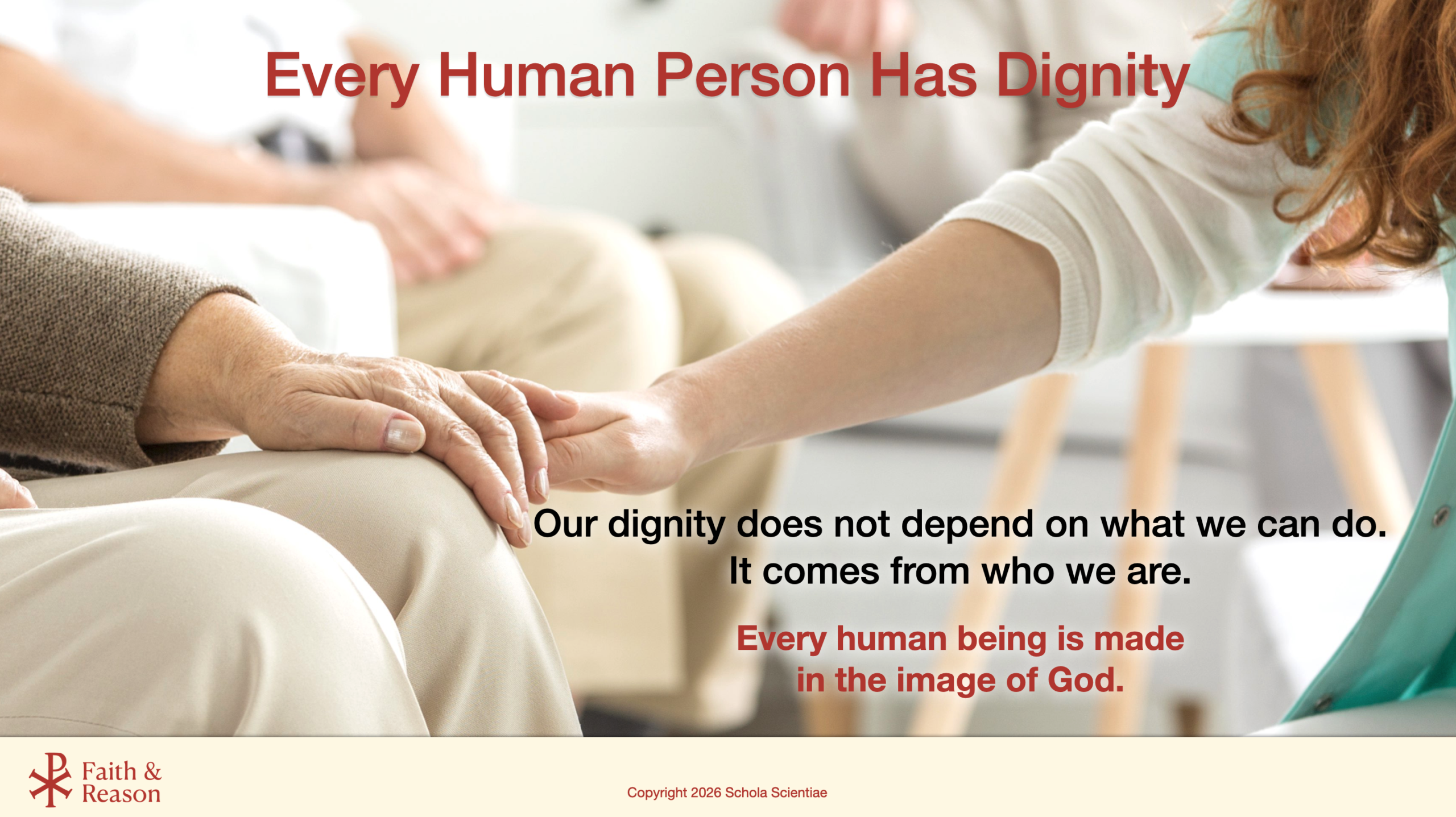
Slide 8 — Every Human Person Has Dignity
Teaching Tips
Focus on who a person is—not what a person can do.
Begin with the two statements on the slide:
“Our dignity does not depend on what we can do. It comes from who we are.”
Ask students to think about what this means. The image of an older person and a child can help make the idea concrete.
You might ask:
“Does a baby have less dignity because an adult can think, speak, and do things the baby cannot?”
Then extend the question:
“What about someone whose brain has been injured and can no longer do some of the things he or she once could?”
Return to the theological foundation.
Draw students’ attention to the statement at the bottom of the slide: Every human being is made in the image of God.
The Catholic understanding presented here is simple but important: human dignity is not earned by intelligence, achievement, independence, health, or any other ability.
Avoid turning the discussion into a survey of difficult moral issues. The central idea is enough: changes in ability do not make someone less human.
Purpose
This slide draws an important consequence from the previous discussion of imago Dei: every human person possesses dignity. That dignity does not rise or fall with cognitive ability, physical ability, achievement, age, or health.
Key Idea
Human dignity belongs to the person, not to the person’s level of ability.
For Catholic theology, the statement that every human being is made in the image of God provides a foundation for recognizing the inherent dignity of every human person.
Leading the Conversation
This idea has particular significance in Human Cognition because students are studying an organ whose development, injury, and function can profoundly affect what a person is able to do.
Use examples students can understand: an infant who cannot yet speak, an older person who has lost some abilities, or a person whose brain has been injured.
Ask whether any of these changes should cause us to say that the individual has become less of a person.
This provides an opportunity to distinguish ability from dignity. Abilities can develop, improve, decline, or be lost. The dignity of the person does not depend upon them.
Connections
Human Cognition
Students have learned that the brain contributes to many capacities we associate with human life. This slide prevents an important misunderstanding: the value of a person should not be equated with the performance of the person’s brain.
Faith & Reason
Science can describe differences in development, brain function, injury, and cognitive ability. Catholic theology contributes a different claim: those differences do not determine the fundamental dignity of the human person.
Looking Ahead
The next slides deepen the connection between the biological person students are studying and Catholic anthropology by considering the human person as a unity of body and soul.
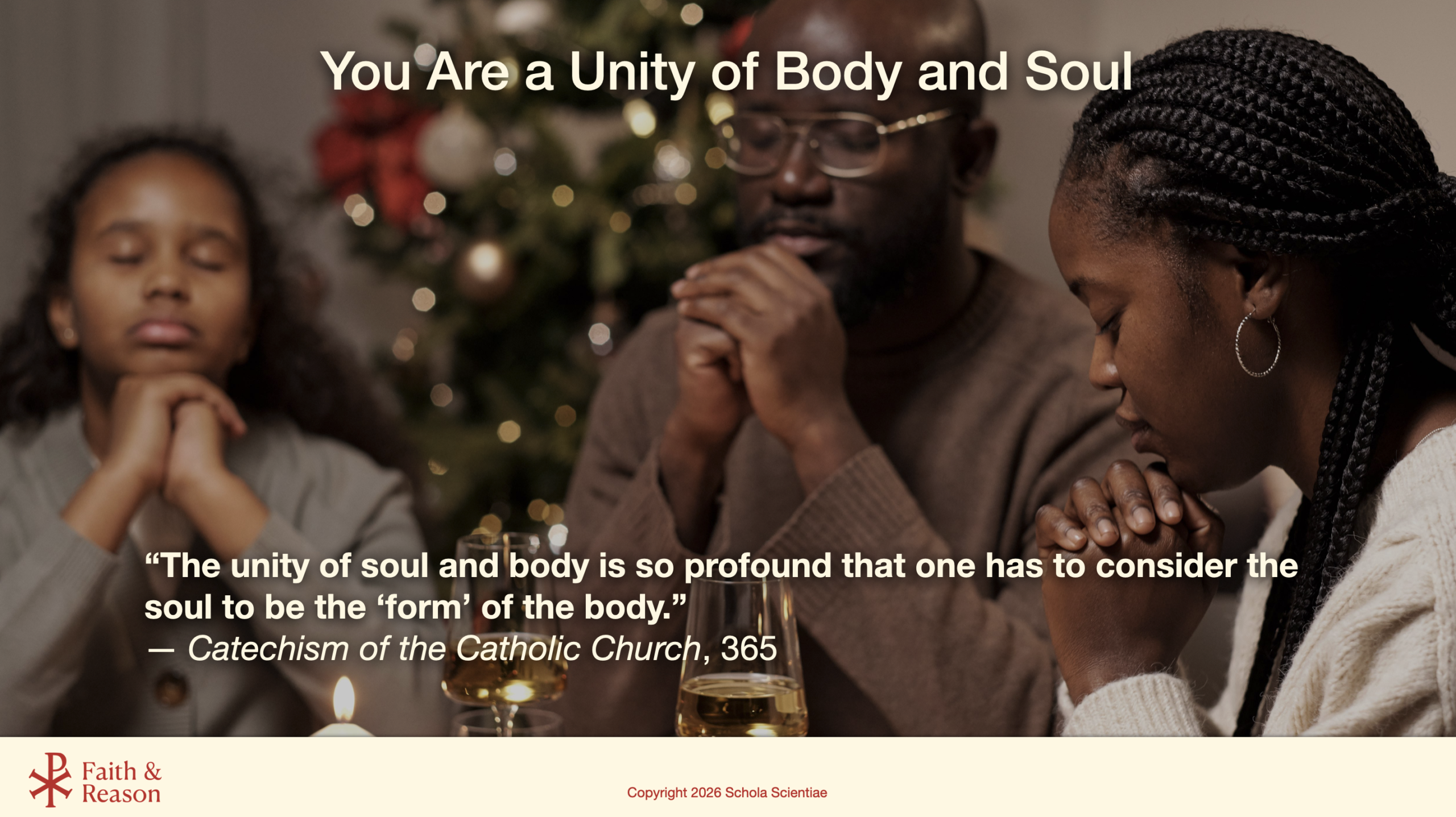
Slide 9 — You Are a Unity of Body and Soul
Teaching Tips
Begin by correcting a common picture of the soul.
Students may imagine the soul as an invisible “thing” living inside the body. The Catholic understanding presented on this slide is different: the human person is a profound unity of body and soul.
You might ask:
“Are you a soul that happens to live inside a body—or is your body actually part of who you are?”
Allow students to think about the distinction before discussing the Catechism quotation.
Explain “form of the body” simply.
The word form in the Catechism quotation does not mean physical shape. It comes from a philosophical tradition associated especially with Aristotle and St. Thomas Aquinas.
For this age group, keep the explanation simple:
“The Church is not describing the soul as something sitting inside your body. Body and soul belong together as one human person.”
Bring the discussion immediately back to the brain.
The importance of the brain is not diminished by speaking about the soul. The brain is part of the body, and the body is part of the human person.
You might say:
“That helps explain why studying the brain matters so much. We are not studying a machine that the real person happens to use. We are studying part of the human person.”
Purpose
This slide introduces the Catholic understanding of the human person as a unity of body and soul. It helps students move beyond two inadequate pictures: that a person is merely a brain or body, or that the body is simply a container inhabited by the “real” person.
Key Idea
The Catholic tradition understands the human being as one person—body and soul.
The Catechism states that this unity is so profound that the soul is described as the “form” of the body. The quotation should be used to introduce the idea, not to require middle-school students to master its philosophical background.
Leading the Conversation
This is an important place to maintain the Faith & Reason approach of the lesson. The existence or nature of the soul is not being presented as a scientific conclusion derived from brain anatomy.
Neuroscience investigates the physical brain. Catholic theology contributes its understanding of the person whose brain is being studied.
The two perspectives also help prevent an unintended devaluation of the body. If the human person is truly a unity of body and soul, then our bodies matter. What happens physically—including what happens to the brain—can profoundly affect how a person experiences and acts in the world.
Connections
Catechism
The slide refers to Catechism of the Catholic Church 365: “The unity of soul and body is so profound that one has to consider the soul to be the ‘form’ of the body.”
Human Cognition
HC1 has demonstrated that changes to the physical brain can affect behavior, emotion, judgment, memory, and other aspects of cognition. Body–soul unity gives students a theological framework in which the biological importance of the brain is taken seriously rather than dismissed.
Faith & Reason
Science and theology are addressing related but different questions. Neuroscience investigates how the brain functions. Catholic theology asks students to consider what kind of being possesses that brain.
Looking Ahead
Slide 10 returns directly to Phineas Gage. Students will consider what brain injury can change—and whether those changes can alter the fundamental dignity of the person.
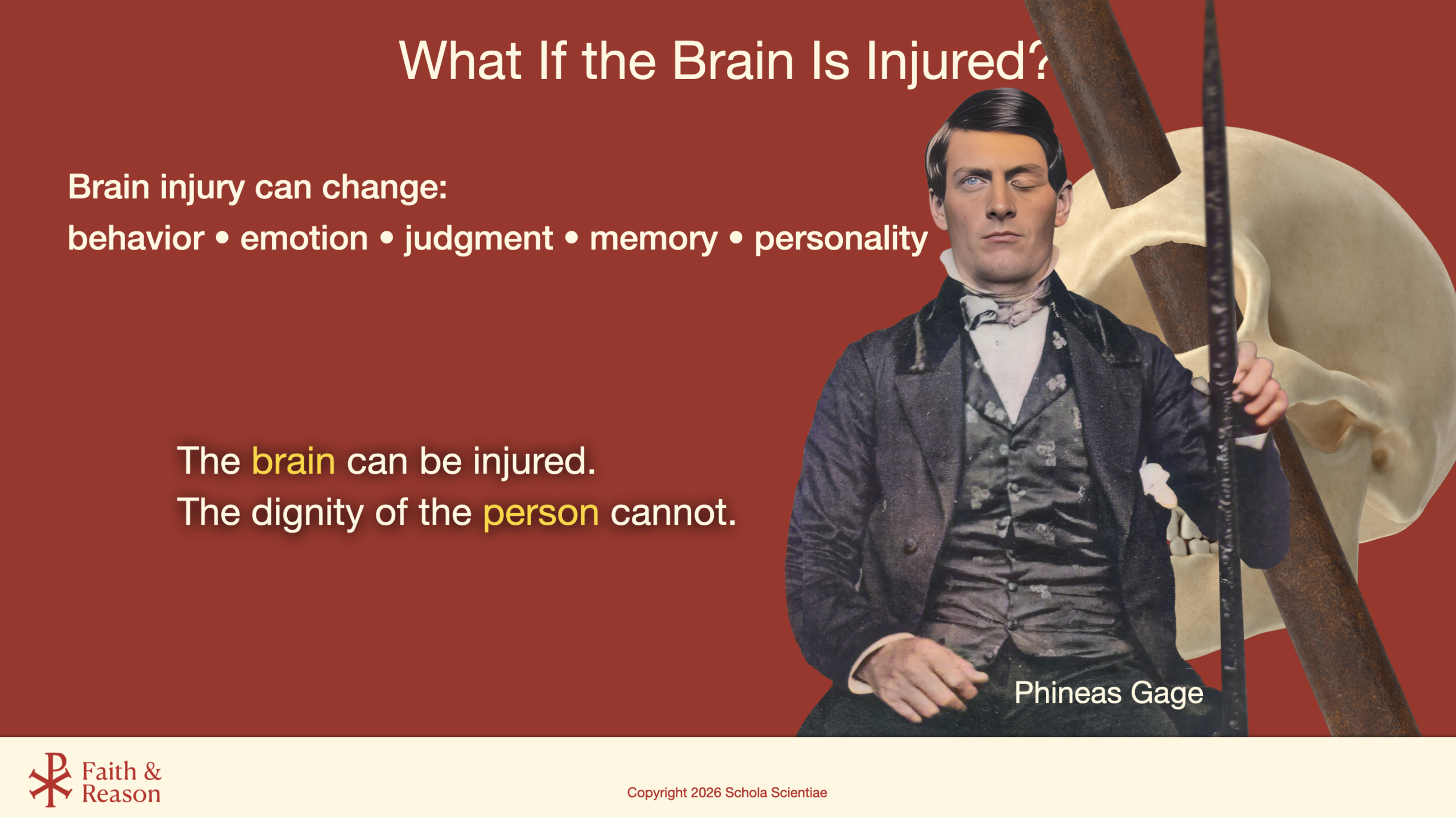
Slide 10 — What If the Brain Is Injured?
Teaching Tips
Return to Phineas Gage.
Students already know this case from the scientific Investigation. Ask them to recall what Gage taught scientists about the relationship between the frontal lobes and behavior.
You might ask:
“What changed after Gage’s brain injury? What does that tell us about the importance of the brain?”
Use student responses to reinforce the central scientific point: injury to the brain can affect behavior, emotion, judgment, memory, personality, and other aspects of how a person functions.
Then ask what did not change.
Draw attention to the statement at the bottom of the slide:
“The brain can be injured. The dignity of the person cannot.”
Ask students what they think this means. If Gage’s behavior and abilities changed after his injury, did he become less human? Did he become less deserving of care or respect?
Keep the distinction clear.
The lesson is not that brain injury is unimportant. Quite the opposite. Brain injury can profoundly affect a person’s life and abilities.
The Faith & Reason point is that these changes do not reduce the person’s fundamental human dignity.
Purpose
This slide brings the theological discussion directly back to one of the strongest pieces of scientific evidence from HC1: the case of Phineas Gage. Students apply the distinction between ability and dignity to a person whose brain was dramatically injured.
Key Idea
Brain injury can change how a person functions without changing the fundamental dignity of the person.
This allows students to hold two important ideas together: the physical brain matters enormously, and human worth cannot be reduced to the condition or performance of the brain.
Leading the Conversation
Let the science come first. Students should be able to explain why the Gage case became important evidence that particular regions of the brain contribute to judgment, behavior, and personality.
Then change the question from “What happened to Gage’s brain?” to “What happened to Gage as a person?”
Students may initially equate major changes in personality or behavior with becoming a “different person.” This is a useful distinction to explore. A person can change dramatically over a lifetime—through development, experience, illness, or injury—without becoming less human or losing fundamental dignity.
Scientific note: Avoid overstating the historical evidence about Gage. His injury and subsequent behavioral changes were significant, but popular accounts sometimes exaggerate the claim that his entire personality was permanently transformed. The important HC1 evidence is that frontal-lobe injury can affect behavior, judgment, and self-regulation.
Connections
Scientific Investigation
Phineas Gage provides a direct connection to students’ study of localization of brain function and the importance of the frontal lobes. The case demonstrates that physical changes to the brain can produce meaningful changes in behavior and cognition.
Human Dignity
Slide 8 established that dignity does not depend upon what a person can do. Gage gives students a concrete opportunity to apply that principle when neurological injury changes what a person is able to do.
Body and Soul
Slide 9 described the human person as a unity of body and soul. Gage demonstrates why the physical side of that unity must be taken seriously: injury to the body—and particularly to the brain—can profoundly affect how the person functions in the world.
Faith & Reason
Science explains what brain injury can do. Catholic theology contributes the conviction that the injured individual remains a person of enduring dignity. Neither claim requires us to diminish the other.
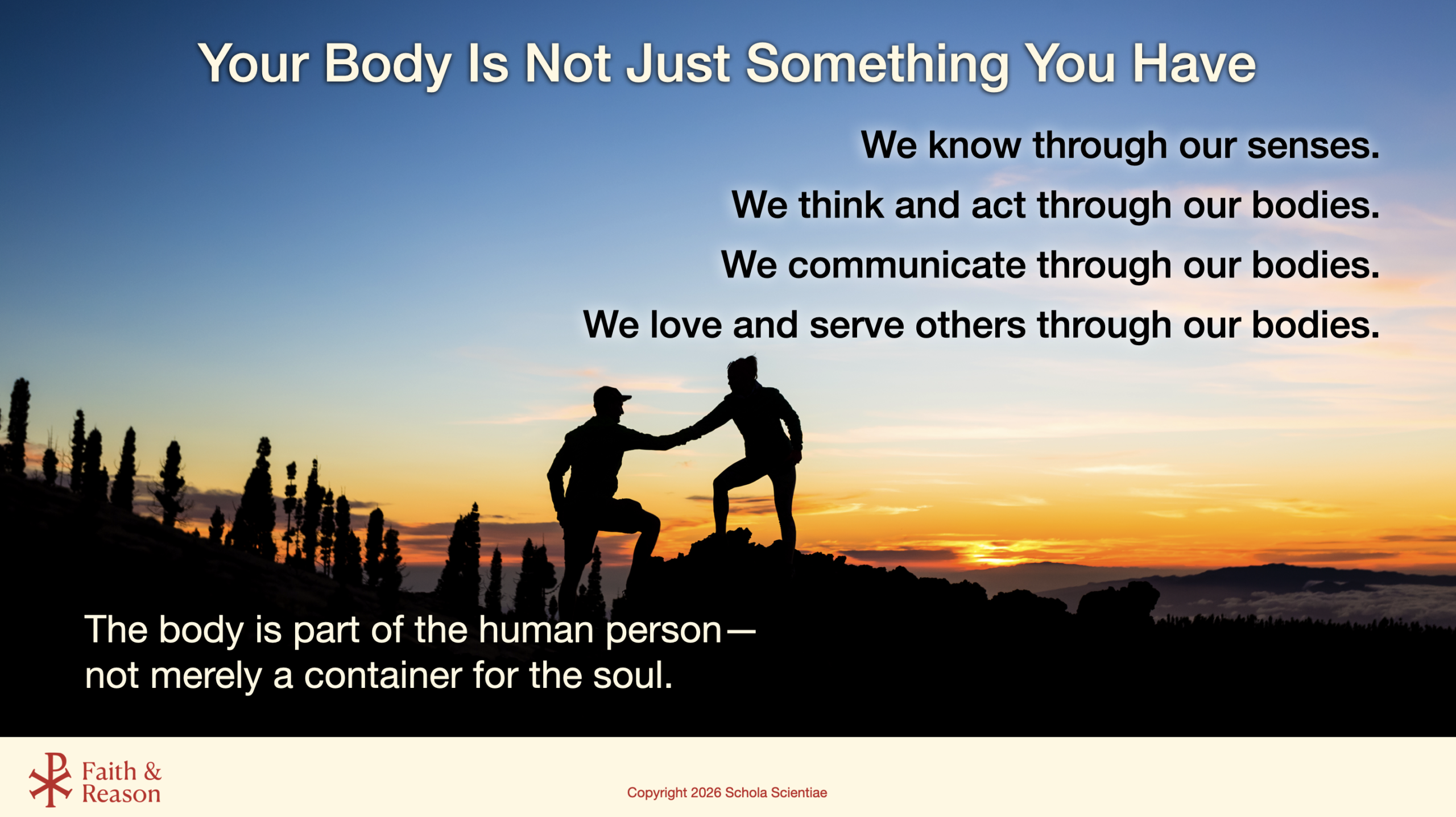
Slide 11 — Your Body Is Not Just Something You Have
Teaching Tips
Make embodiment concrete.
Read the four statements on the slide slowly: we know through our senses, think and act through our bodies, communicate through our bodies, and love and serve others through our bodies. :contentReference[oaicite:0]{index=0}
Ask students for ordinary examples:
“How did your body help you learn something today? How do you show another person that you care about them?”
Students might mention seeing, hearing, speaking, writing, hugging, helping, smiling, working, or simply being present with someone.
Return to the body–soul discussion.
The point is not simply that we use our bodies to accomplish things. In the Catholic understanding introduced on the previous slide, the body belongs to who the human person is.
You might say:
“Your body is not like a bicycle or a computer that you own and operate. Your body is part of you.”
Reconnect explicitly to the brain.
The brain is part of this embodied human person. That is why changes in the brain can have such profound effects on perception, thought, emotion, communication, and action.
Do not turn this into a detailed theology lesson about the body. The goal is simply to help students see why the scientific study of the body—and especially the brain—matters within a Catholic understanding of the person.
Purpose
This slide develops the idea of body–soul unity by helping students recognize that the body is not merely something a person possesses. It is part of the embodied human person.
Key Idea
Human life is embodied.
We encounter the world through our senses, communicate and act through our bodies, and express care, service, and relationship through embodied actions.
Leading the Conversation
Middle-school students may readily understand the body as something they “have.” This slide invites a subtle but important shift: the body is part of who they are.
Use ordinary experiences rather than abstract philosophy. Seeing a friend’s face, hearing music, speaking a word, reaching out to help someone, or kneeling to pray are all examples of human experiences that involve embodiment.
This also prevents a misunderstanding that can arise when discussing the soul. Catholic theology does not require students to regard the physical body as unimportant or inferior. The body has genuine significance because the human person is a unity of body and soul.
Connections
Human Cognition
The scientific content of HC1 strongly supports attention to embodiment. Sensory input, brain processing, movement, communication, and behavior all depend upon physical structures and processes within the nervous system.
Body and Soul
Slide 9 introduced the Catholic description of the person as a unity of body and soul. This slide translates that theological reference into familiar human experience.
Phineas Gage
Slide 10 demonstrated that injury to the physical brain can profoundly alter how a person functions. The importance of such an injury makes sense precisely because the physical body is not irrelevant to the human person.
Faith & Reason
Studying the physical brain and affirming the spiritual dimension of the human person are not competing activities. The Catholic understanding of embodiment gives the scientific study of the brain genuine significance within a larger understanding of the person.
Looking Ahead
The next slide turns from embodiment to human choice: the brain contributes to emotions, impulses, attention, judgment, and decision-making—but what does that mean for responsibility?
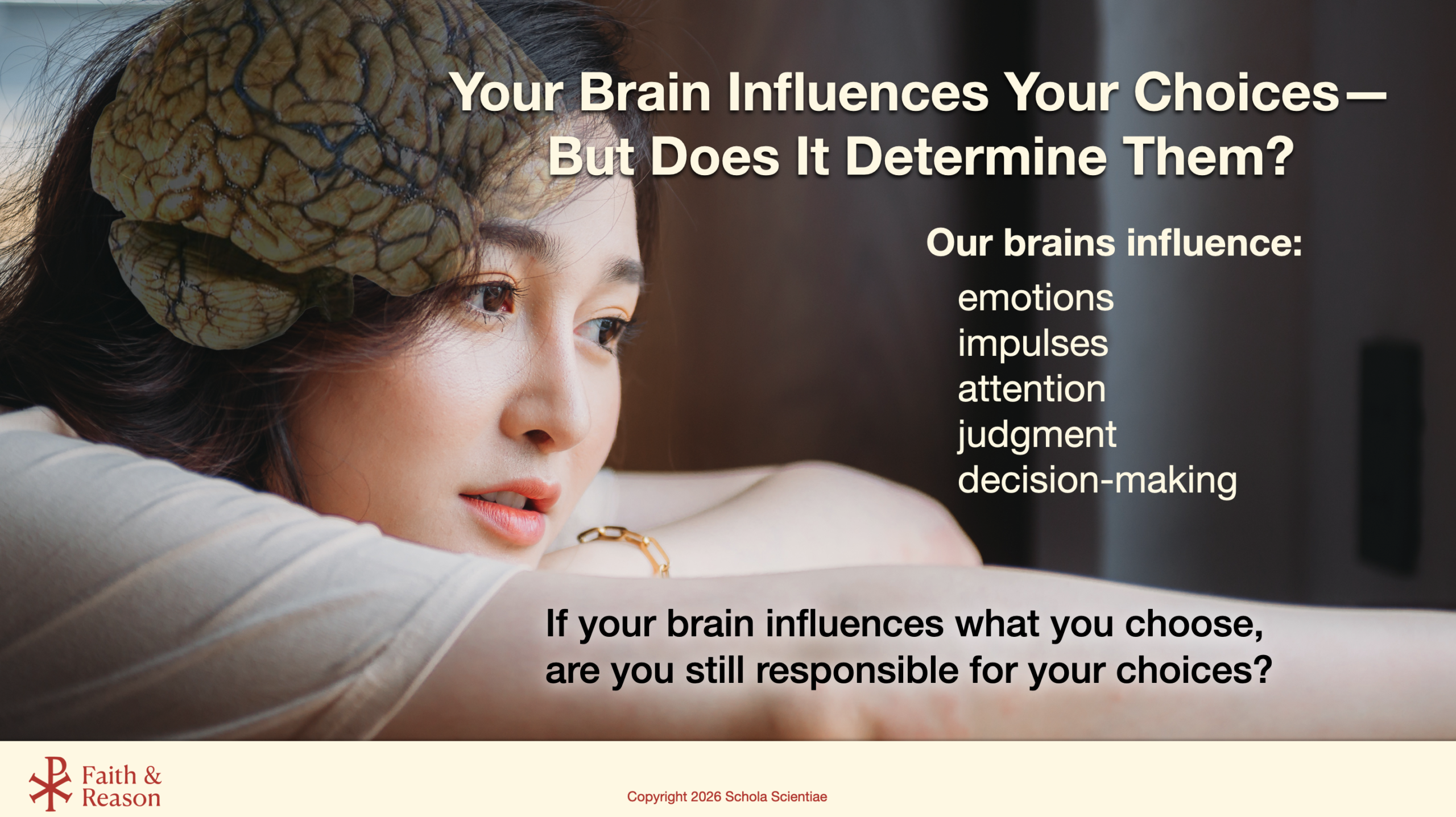
Slide 12 — Your Brain Influences Your Choices—But Does It Determine Them?
Teaching Tips
Start with what students already know from experience.
Read through the list on the slide: emotions, impulses, attention, judgment, and decision-making. These are all influenced by brain function. :contentReference[oaicite:0]{index=0}
Then ask:
“Can you think of a time when you felt like doing one thing but chose to do something else?”
Students may mention being angry but deciding not to say something hurtful, wanting to quit but continuing, feeling nervous but speaking anyway, or resisting pressure from friends.
Keep the discussion concrete.
Avoid introducing abstract language about determinism or free will unless students raise it themselves.
The central question is simpler:
“If your brain affects what you feel, notice, and think about, does that mean you have no real choice about what you do?”
Allow students to discuss this without forcing a quick answer. The goal is to help them recognize that brain processes matter greatly while human experience also includes choosing among possible actions.
Return briefly to Phineas Gage if useful.
Gage reminds students that injury to the frontal lobes can affect judgment and self-control. This helps them see why biology matters when we think about human choice and responsibility.
Do not turn the slide into a moral theology lesson. The question itself is enough to prepare students for the simple synthesis on Slide 13.
Purpose
This slide brings one of the most important HC1 questions into focus: if brain function contributes to emotion, impulse, attention, judgment, and decision-making, what does that mean for human choice and responsibility?
Key Idea
The brain plays an essential role in human decision-making, but studying the brain raises rather than settles the larger question of human freedom.
Students do not need to solve the philosophical problem of free will. They need to recognize that neuroscience and questions about personal responsibility are connected but are not identical questions.
Leading the Conversation
Use familiar examples. Hunger can influence a choice. Anger can influence a choice. Fear, habit, excitement, fatigue, and peer pressure can all affect what a person feels inclined to do.
Then ask whether having those influences means that every action is unavoidable.
The goal is not to prove freedom scientifically. It is to let students notice a feature of their own experience: they often feel competing impulses and still experience themselves as making choices.
Keep the language modest. Neuroscience can investigate the brain processes involved in decision-making. Philosophy and theology ask broader questions about freedom, responsibility, and the meaning of human choice.
Connections
Human Cognition
The slide draws directly from students’ study of frontal-lobe function and the role of the brain in behavior, judgment, and self-regulation.
Phineas Gage
Gage provides a concrete example of how changes in the brain can influence behavior and judgment. His case makes the relationship between biology and choice more than an abstract question.
Faith & Reason
The Catholic tradition affirms human freedom and responsibility while also taking seriously the embodied conditions under which people think and act. At this point, however, the slide simply refers to that larger question rather than teaching a full theology of free will.
Looking Ahead
Slide 13 offers the synthesis students need: the brain matters, and choices matter too. It brings the discussion back from abstract questions to the student’s own life.
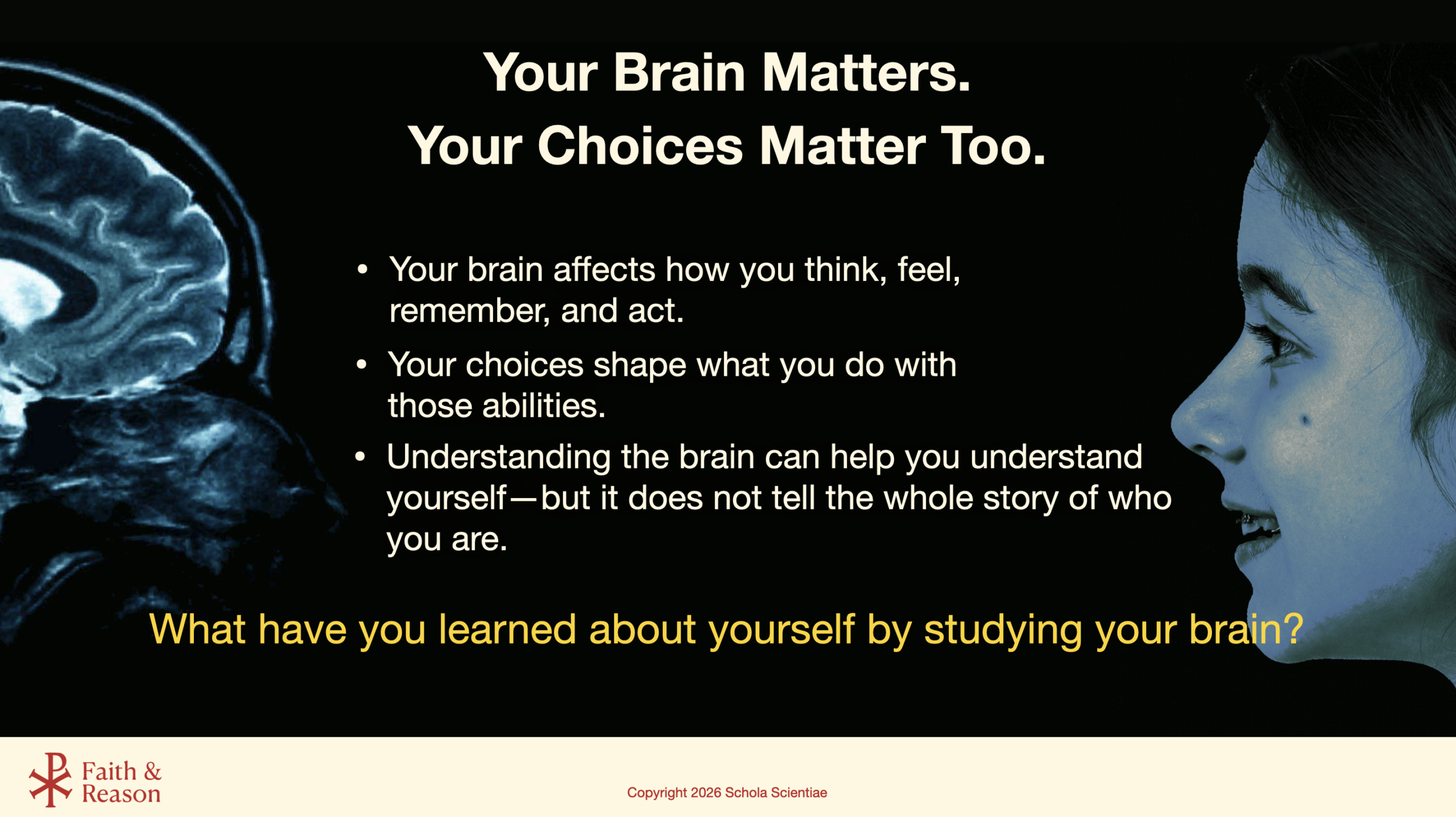
Slide 13 — Your Brain Matters. Your Choices Matter Too.
Teaching Tips
Use this slide as a synthesis, not as new content.
Students have reached the central conclusion of the discussion: the brain matters enormously, and human choices matter too. The slide summarizes that the brain affects how we think, feel, remember, and act; our choices shape what we do with those abilities; and understanding the brain does not tell the whole story of who we are. :contentReference[oaicite:0]{index=0}
Pause after the title and ask:
“After everything we have discussed, why do you think both parts of this statement are important?”
Let students make the connections. They may refer to brain anatomy, Phineas Gage, emotions, judgment, body and soul, dignity, or choice.
Make the final question personal.
Give students a moment to consider the question at the bottom of the slide:
“What have you learned about yourself by studying your brain?”
There is no single correct response. Encourage students to move beyond recalling brain facts and reflect on what those facts have caused them to notice about themselves.
If students need help getting started, ask whether studying the brain has changed how they think about their senses, emotions, behavior, choices, abilities, or relationships with other people.
Allow open questions to remain open.
Students do not need to leave this slide with every question resolved. The goal is for them to recognize both how much science has revealed about the brain and how studying the brain can lead to larger questions about the human person.
Purpose
This slide brings the major ideas of HC1 Faith & Reason back together and returns the discussion to the student. It shifts from asking abstract questions about “the human person” to asking what students have discovered about themselves.
Key Idea
Understanding the brain is essential to understanding ourselves—but it does not tell the whole story of who we are.
This conclusion preserves the importance of neuroscience without reducing the human person to brain function alone.
Leading the Conversation
Invite students to reconstruct the path of the discussion rather than summarizing it for them.
You might ask:
What did science teach us?
The brain has specialized structures and functions, and changes to the brain can affect thought, emotion, memory, judgment, and behavior.
What larger questions did the science raise?
Are we simply our brains? Is everything important about a person measurable? What does brain function mean for choice and responsibility?
What did Catholic theology contribute to the conversation?
Students encountered the ideas that human beings are created in the image of God, possess inherent dignity, and are understood as a unity of body and soul.
These are not intended as competing explanations. They represent different kinds of questions brought together around the same human person.
Connections
Science
The scientific understanding developed during HC1 remains foundational. Faith & Reason has not replaced or weakened any scientific explanation students learned during the Investigation.
Theology
The theological references have helped students consider the dignity and nature of the person whose brain they have been studying. They are not presented as scientific conclusions.
Reflection & Meaning
The final question—“What have you learned about yourself by studying your brain?”—returns to the reflective habit developed throughout HC: scientific knowledge can lead to deeper questions about ourselves and our experience of the world.
Looking Ahead
The final slide does not introduce another problem to solve. It closes HC1 Faith & Reason with a simple affirmation of science, human dignity, and the continuing search for truth.
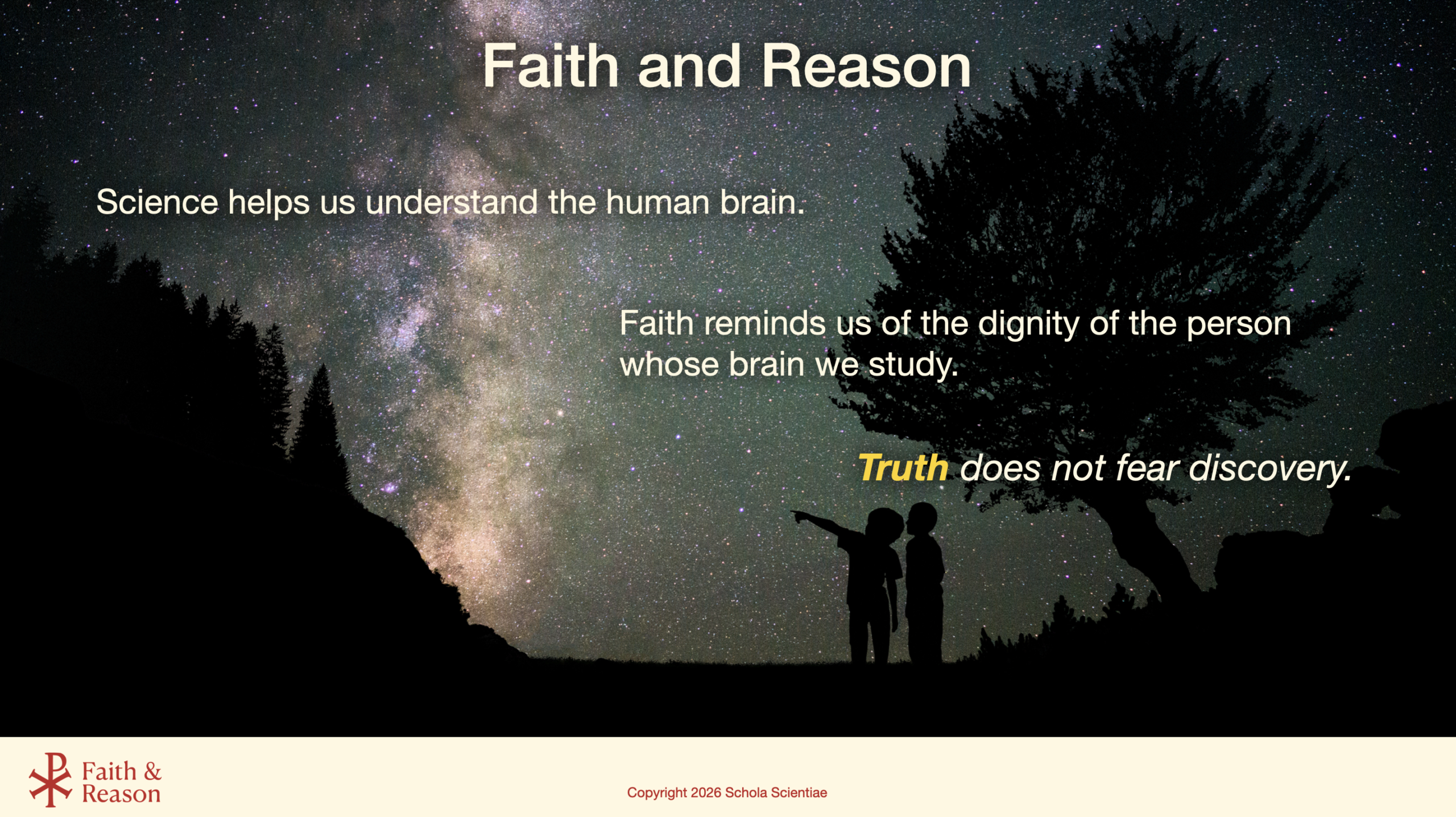
Slide 14 — Faith and Reason
Teaching Tips
Let this slide be the landing.
This final slide is intentionally simple. It brings the discussion to three concluding statements: science helps us understand the human brain; faith reminds us of the dignity of the person whose brain we study; and truth does not fear discovery. :contentReference[oaicite:0]{index=0}
Read the first two statements slowly, then ask:
“After everything we have discussed, why don’t these two statements have to compete with each other?”
Invite several responses. Students may refer to the different kinds of questions explored throughout the lesson, the importance of the physical brain, the dignity of the human person, or the distinction between scientific and theological claims.
End with the final sentence.
Draw attention to the last line:
“Truth does not fear discovery.”
Ask students what they think that sentence means.
If helpful, follow with:
“If something is true, should learning more about the world threaten it—or help us understand reality more deeply?”
There is no need to add another lesson or theological explanation. Allow the image, the statements, and the students’ responses to provide the conclusion.
Purpose
This slide closes HC1 Faith & Reason by returning to the central relationship between scientific discovery and the Catholic understanding of the human person.
Rather than ending with another unresolved problem, students leave with a simple conclusion: studying the brain is worthwhile, the person whose brain is being studied possesses enduring dignity, and the search for truth should be welcomed rather than feared.
Key Idea
Faith and reason need not fear one another because truth is not threatened by genuine discovery.
Science helps students understand the physical brain. Catholic theology reminds them that the subject of that scientific investigation is a human person possessing dignity that cannot be reduced to measurable ability or brain function.
Leading the Conversation
Keep the ending reflective rather than argumentative. Students have not been asked to prove theology scientifically or to use theology to explain neuroscience.
Instead, they have practiced a habit of mind: take scientific evidence seriously, ask what conclusions the evidence supports, recognize when a question extends beyond the methods of science, and remain open to what reason and faith may contribute.
The night-sky image reinforces the sense of wonder that should accompany the conclusion. Scientific discovery does not have to make the human person less mysterious or less significant. Greater knowledge can lead to deeper questions and greater wonder.
Connections
Human Cognition
HC1 began with the physical brain—its structures, functions, and relationship to behavior. Faith & Reason ends without leaving that science behind.
Human Dignity
The theological thread running through the slides is intentionally simple: every human being is made in the image of God, and human dignity therefore does not depend upon intelligence, ability, achievement, health, or neurological condition.
Faith & Reason
The lesson models the relationship the curriculum seeks to cultivate: science, philosophy, and theology can ask different questions while sharing a commitment to truth.
Enduring Understanding
Students should leave HC1 recognizing that the brain is an extraordinary and essential part of the human person—but that understanding the brain does not exhaust the question of what it means to be human.