Back to: Human Cognition – Teacher
Student Portal
Investigation 1: Faith & Reason
Science has helped you explore the remarkable structure and function of the human brain. Faith & Reason invites you to continue the conversation by asking what these discoveries may tell us about the human person and our relationship with God.
Click on any image below to expand
Slide 1 — Human Cognition: Faith & Reason
You have learned a great deal about the human brain through observation, evidence, and scientific reasoning.
Now we are going to ask what those discoveries might tell us—and what they cannot tell us by themselves—about the human person.
Science can tell us remarkable things about how the brain works. But some scientific discoveries raise questions that science was not designed to answer on its own.
What can science tell us about ourselves—and when might we need other ways of seeking truth?
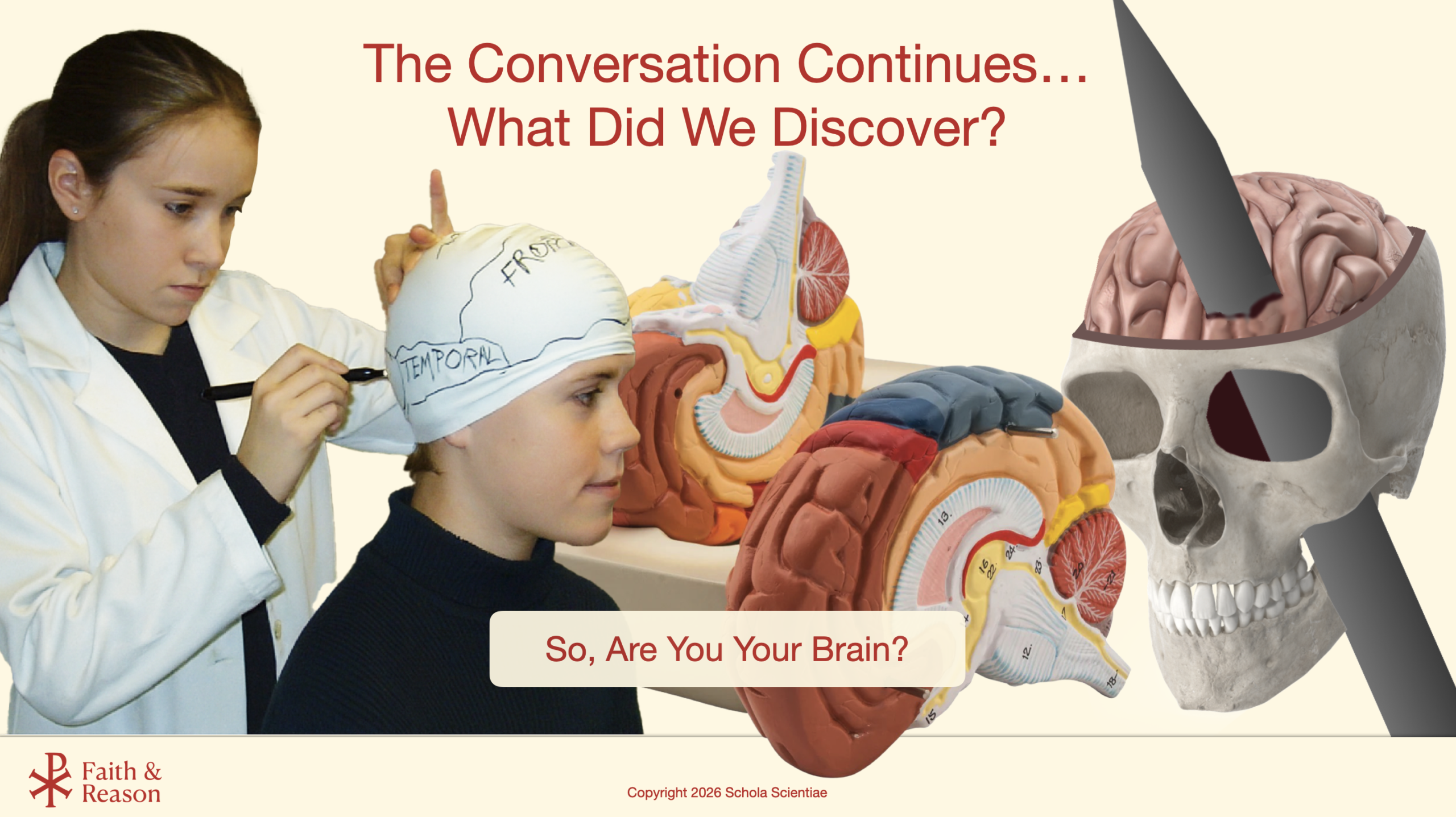
Slide 2 — The Conversation Continues: What Did We Discover?
Look carefully at the images on this slide. Each represents something you explored during this Investigation.
What do you remember about each one?
What did it teach you about the brain?
You discovered that the brain is deeply involved in thought, emotion, memory, behavior, movement, and other aspects of cognition. Changes to the brain can change how a person thinks, feels, remembers, and acts.
That leads to a much bigger question:
Are you your brain?
Don’t rush to answer. First consider what the scientific evidence tells you—and whether it tells you everything about the human person.
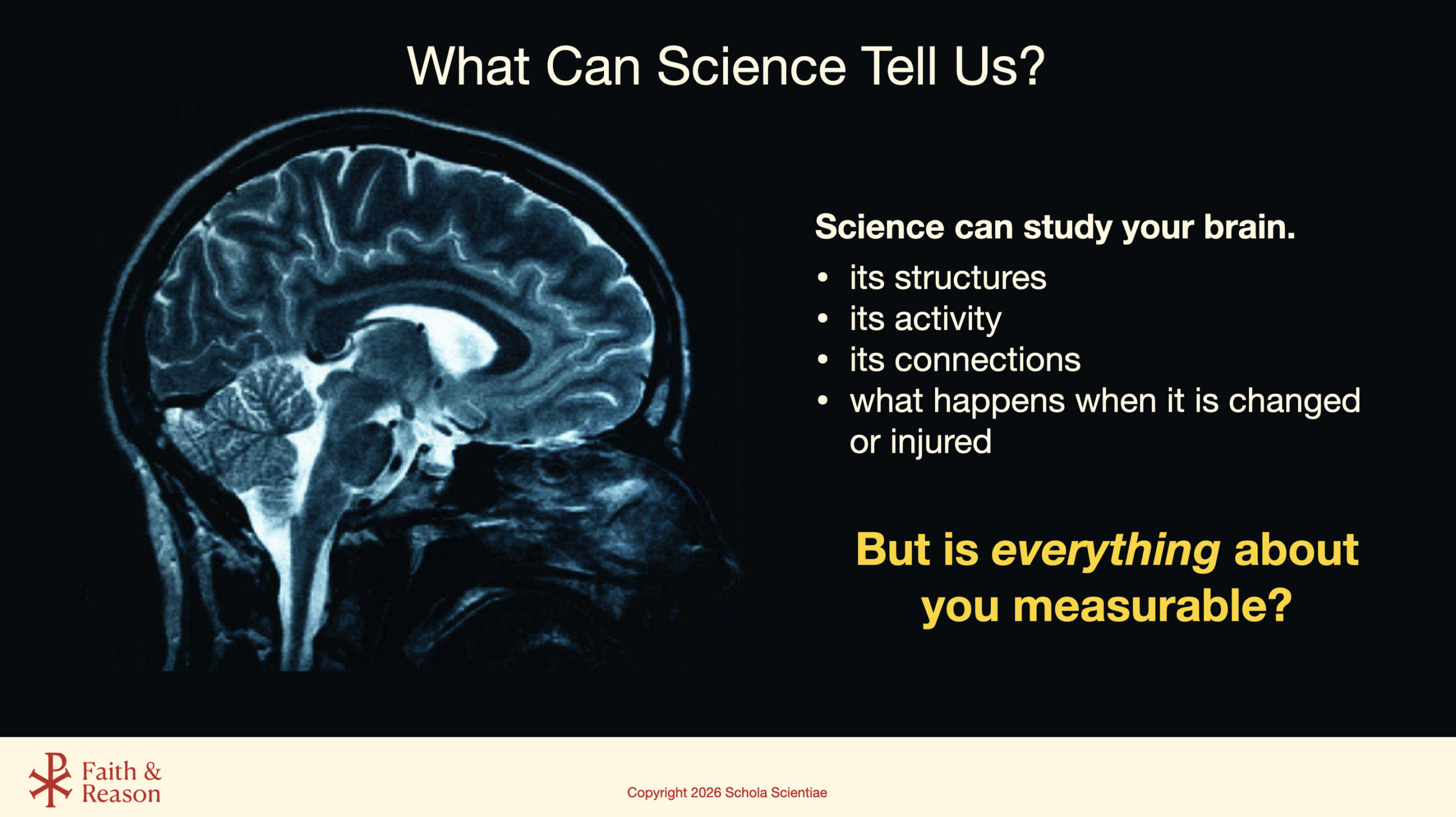
Slide 3 — What Can Science Tell Us?
Science gives us powerful ways to study the physical world—including the human brain.
Scientists can investigate:
- brain structures
- patterns of brain activity
- connections between different brain regions
- what happens when the brain is changed or injured
These observations can tell us an enormous amount about how the brain works.
But consider the question at the bottom of the slide:
Is everything about you measurable?
This isn’t a question about whether science is valuable—it clearly is. It asks us to recognize that different kinds of questions may require different ways of seeking truth.
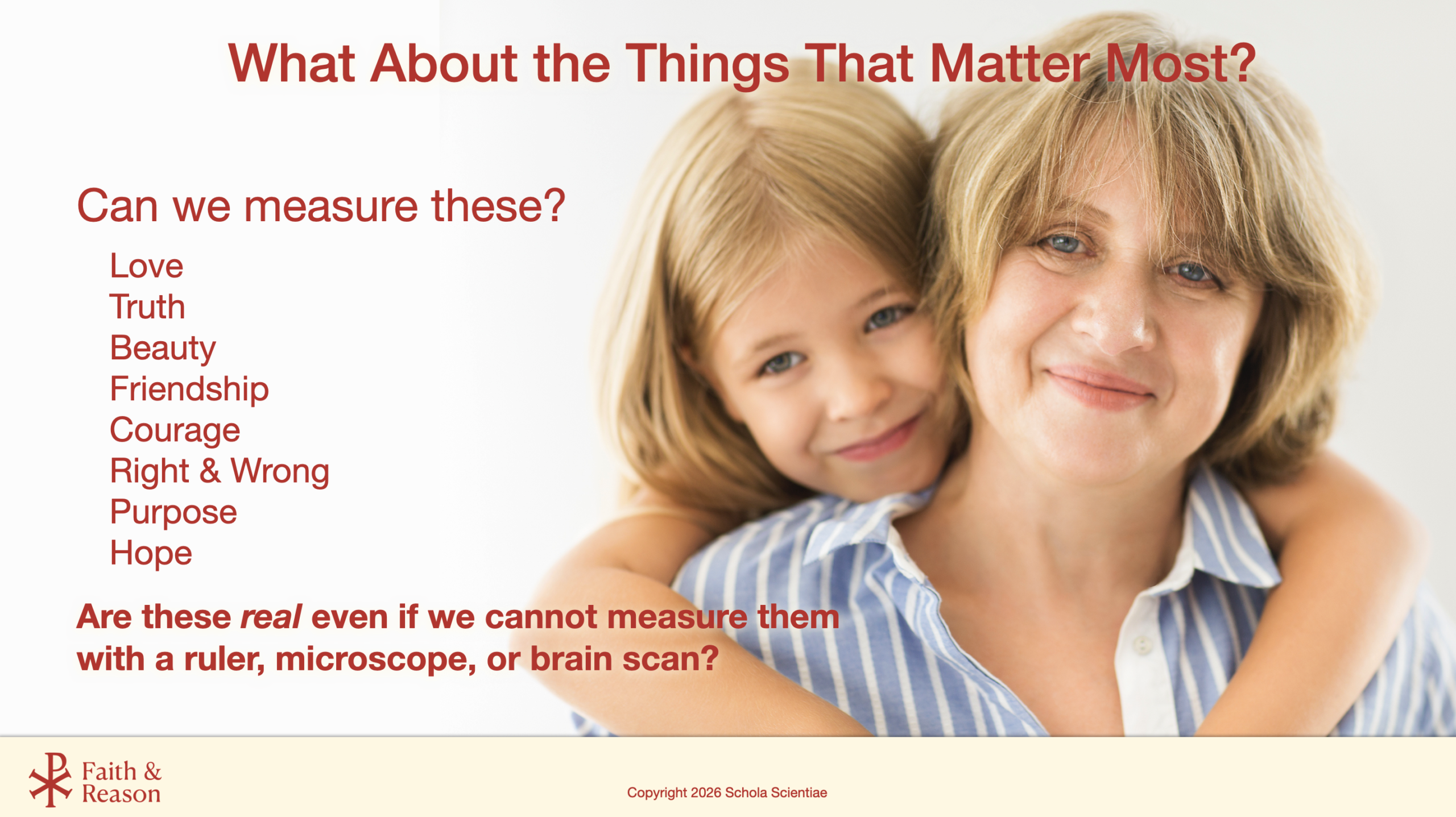
Slide 4 — What About the Things That Matter Most?
Consider the words on the slide: love, truth, beauty, friendship, courage, right and wrong, purpose, and hope.
Are these things real?
If they are, how do we know? Can we measure them with a ruler, microscope, or brain scan?
Scientists can study brain activity associated with experiences such as love, hope, moral judgment, or beauty. But measuring what the brain is doing may not tell us everything about what those experiences mean.
For example, a brain scan might reveal what happens in your brain when you look at someone you love.
Would that scan tell us everything about why you love that person?
Something can be real and important even when its full meaning cannot be captured by physical measurement alone.
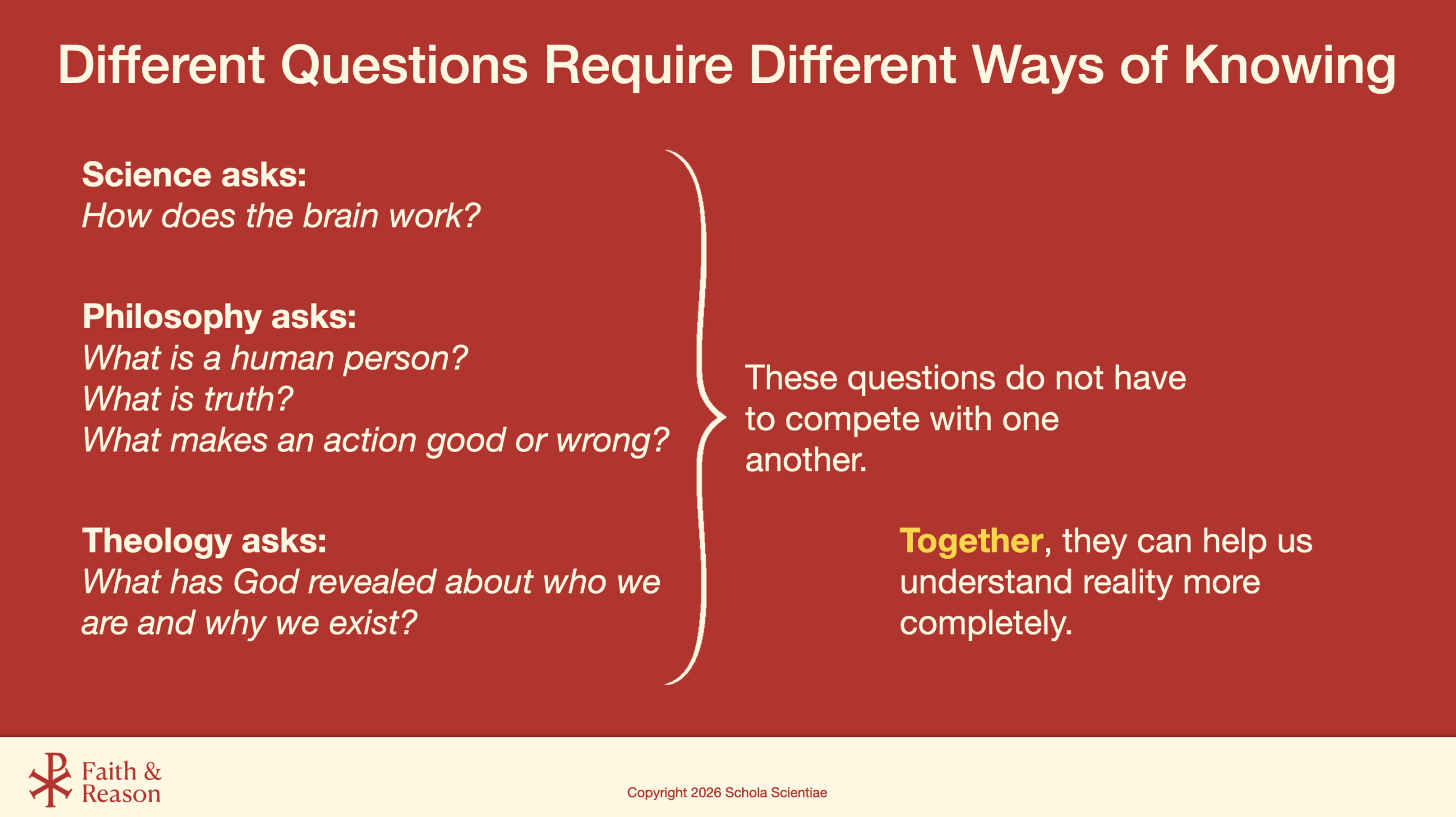
Slide 5 — Different Questions Require Different Ways of Knowing
Not every question is the same kind of question.
Science asks questions we can investigate through observation, measurement, evidence, and testing.
Philosophy uses reason to explore questions about truth, human nature, morality, and meaning.
Theology uses reason together with what God has revealed to explore questions about God and the human person.
These ways of seeking truth do not have to compete.
For example, science can investigate what happens in your brain when you make a decision. Philosophy can ask what it means to choose freely and responsibly. Theology can ask what God has revealed about human freedom and dignity.
Different questions may require different ways of seeking truth—and together they can help us understand the human person more fully.
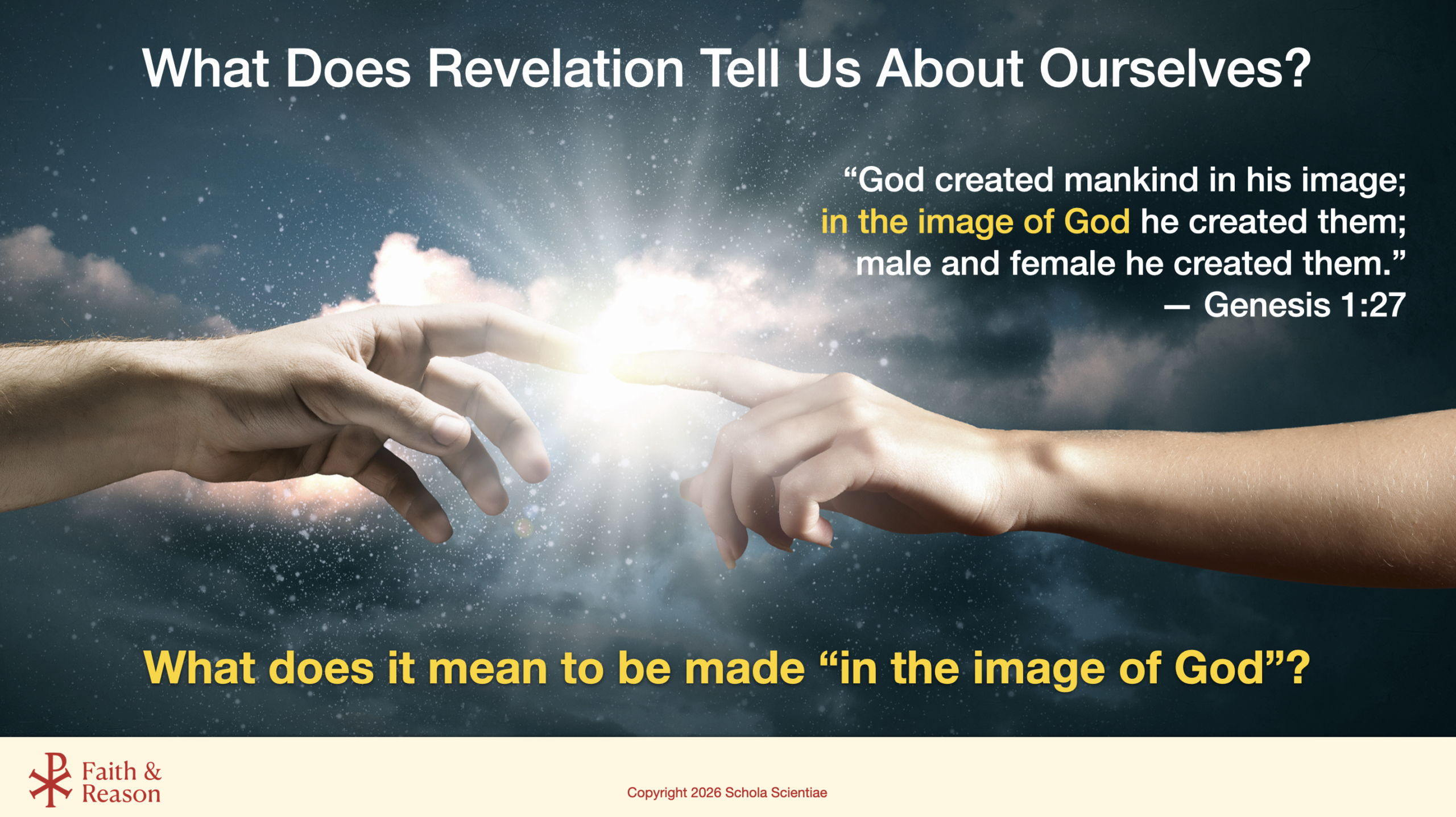
Slide 6 — What Does Revelation Tell Us About Ourselves?
Genesis tells us:
“God created mankind in his image; in the image of God he created them.” — Genesis 1:27
What does it mean to be created “in the image of God”?
It does not mean that human beings physically look like God. Instead, Scripture is making a theological statement about who we are and our relationship with God.
Think about the remarkable human abilities you have been studying throughout this Investigation.
Could our abilities to reason, choose, love, create, and enter into relationships help us begin thinking about what it means to bear God’s image?
Science asks how the brain works. Revelation invites us to consider a different question: What has God revealed about who we are?
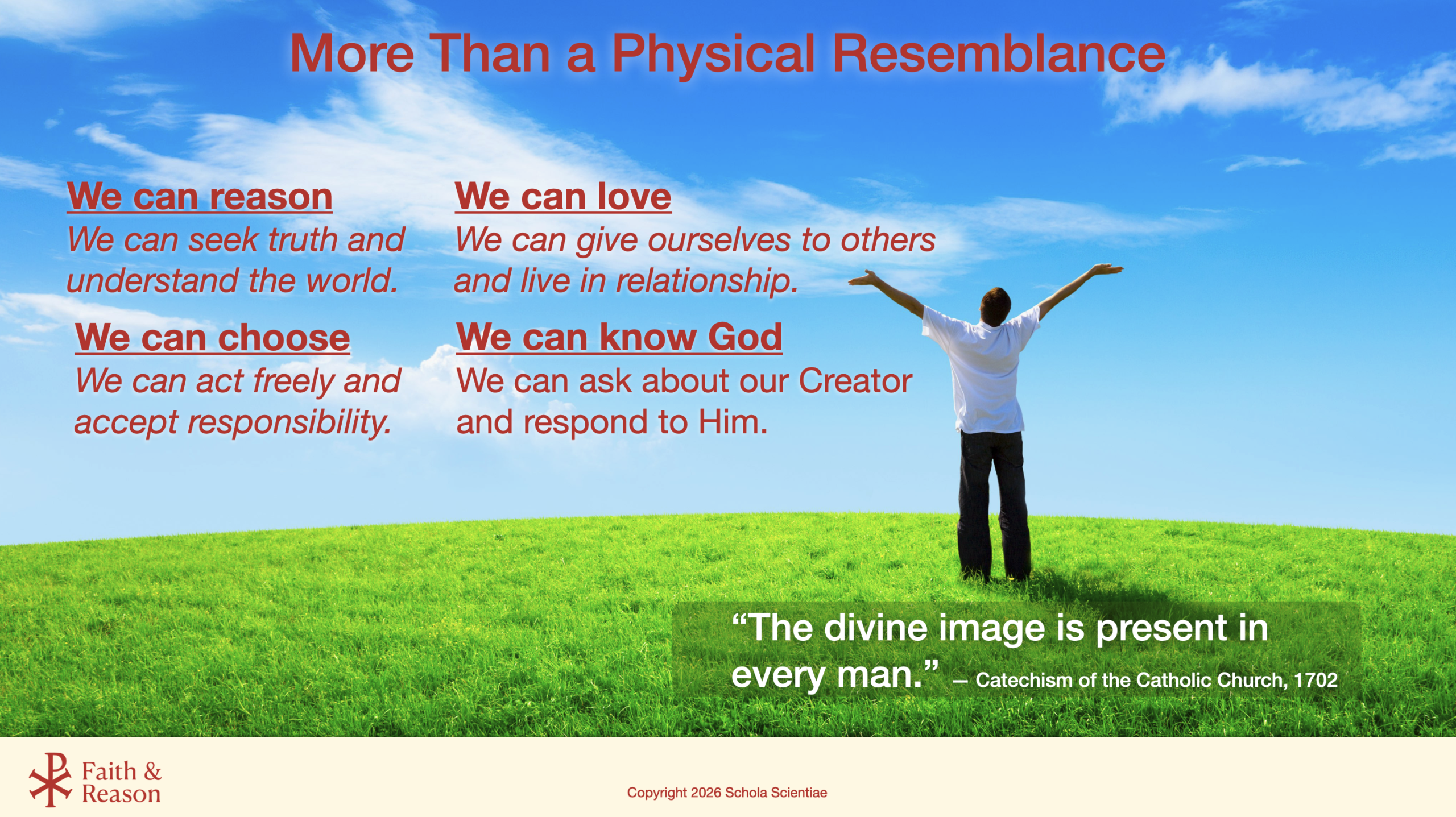
Slide 7 — More Than a Physical Resemblance
Catholic thought helps us reflect on several human capacities connected with being created in the image of God:
We can reason. We can choose. We can love. We can know God.
Several of these capacities connect directly with what you are studying in Human Cognition. Your brain is involved when you think, make choices, communicate, and form relationships.
Neuroscience can investigate what the brain is doing during these activities. Faith & Reason asks another question:
What do these remarkable capacities tell us about the human person?
But there is an important distinction: our abilities do not determine our worth. A newborn baby or a person whose brain has been severely injured remains fully human and possesses the same human dignity.
As the Catechism teaches:
“The divine image is present in every man.” — CCC 1702
Being made in God’s image concerns who the person is, not how well that person can perform particular tasks.
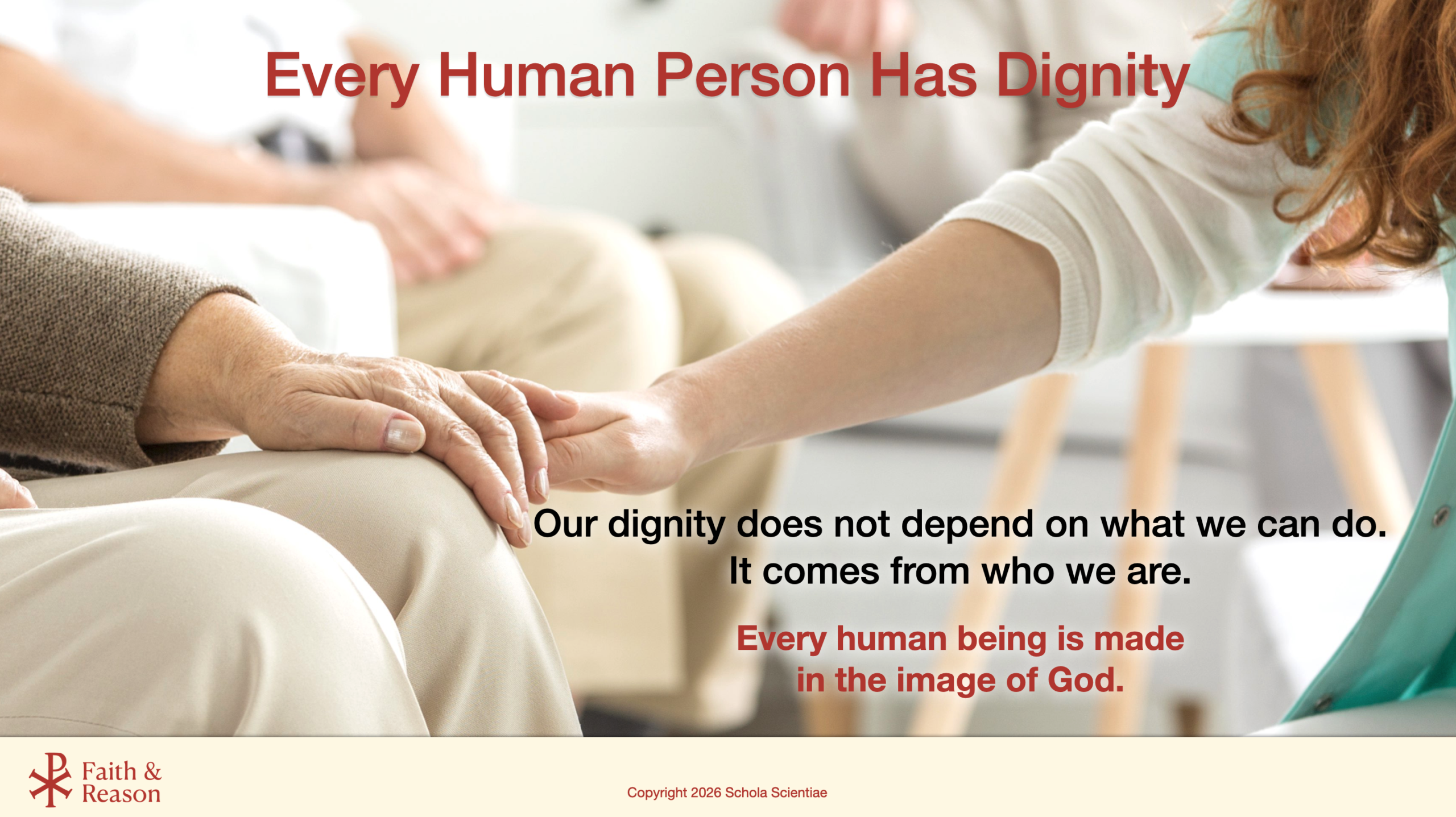
Slide 8 — Every Human Person Has Dignity
Our dignity does not depend on what we can do. It comes from who we are.
Consider a baby who cannot yet speak or reason like an adult. Does that baby have less dignity than an adult?
What about an older person who has lost some abilities, or someone whose brain has been seriously injured?
Our abilities can develop, improve, decline, or even be lost. But Catholic teaching holds that these changes do not make someone less human or less worthy of dignity.
Why?
Every human being is made in the image of God.
Science can describe differences in brain development, function, injury, and ability. But those differences do not determine the fundamental dignity of the human person.
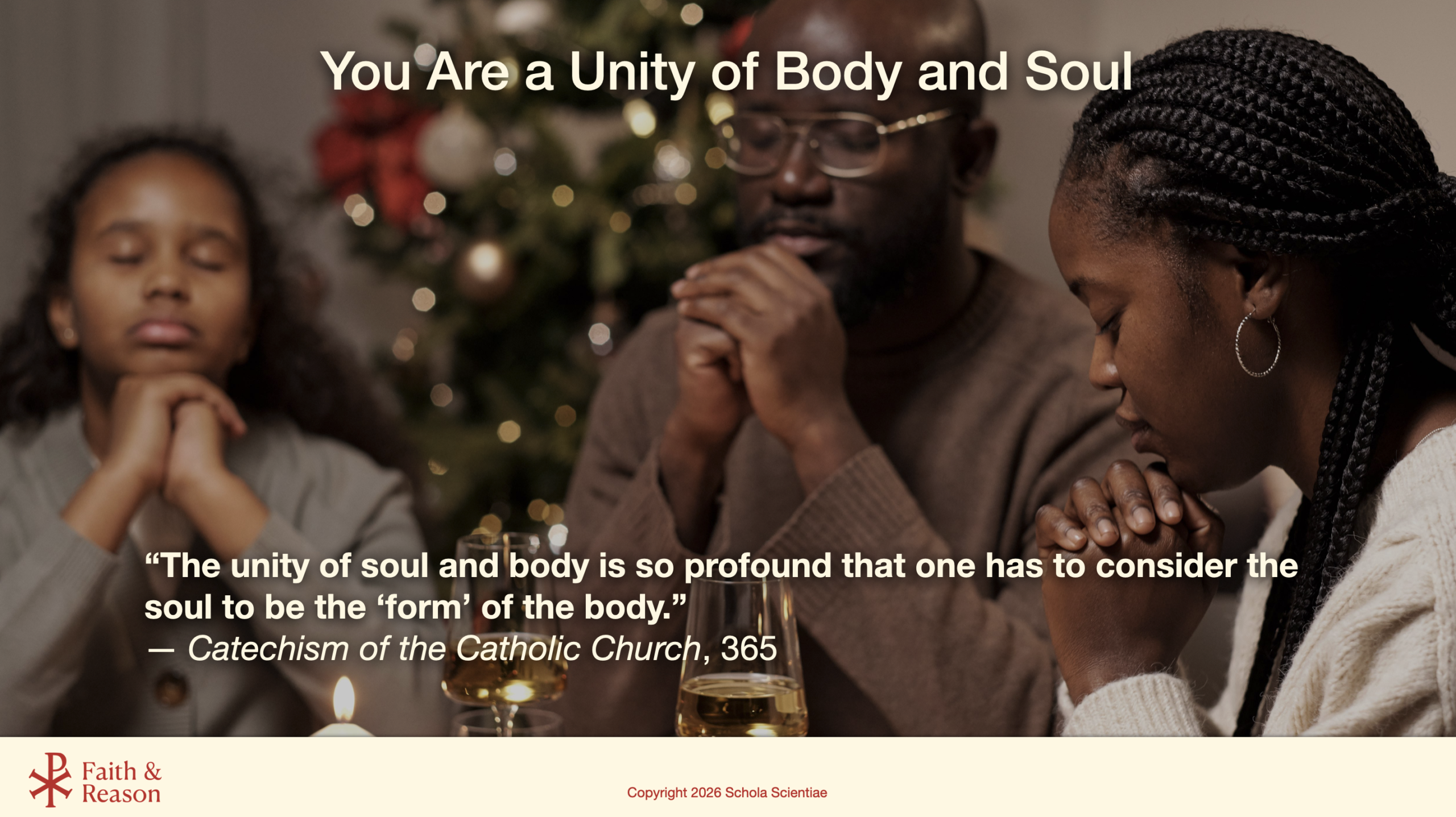
Slide 9 — You Are a Unity of Body and Soul
Are you a soul that happens to live inside a body—or is your body actually part of who you are?
Catholic teaching describes the human person as a profound unity of body and soul. Your soul is not simply an invisible “thing” living inside your body. Body and soul belong together as one human person.
The Catechism states:
“The unity of soul and body is so profound that one has to consider the soul to be the ‘form’ of the body.” — CCC 365
Here, “form” does not mean physical shape. The important idea is simpler:
You are not merely a brain or body—and your body is not simply a container for the “real” you.
That is one reason studying the brain matters so much. The brain is part of your body, and your body is truly part of who you are.
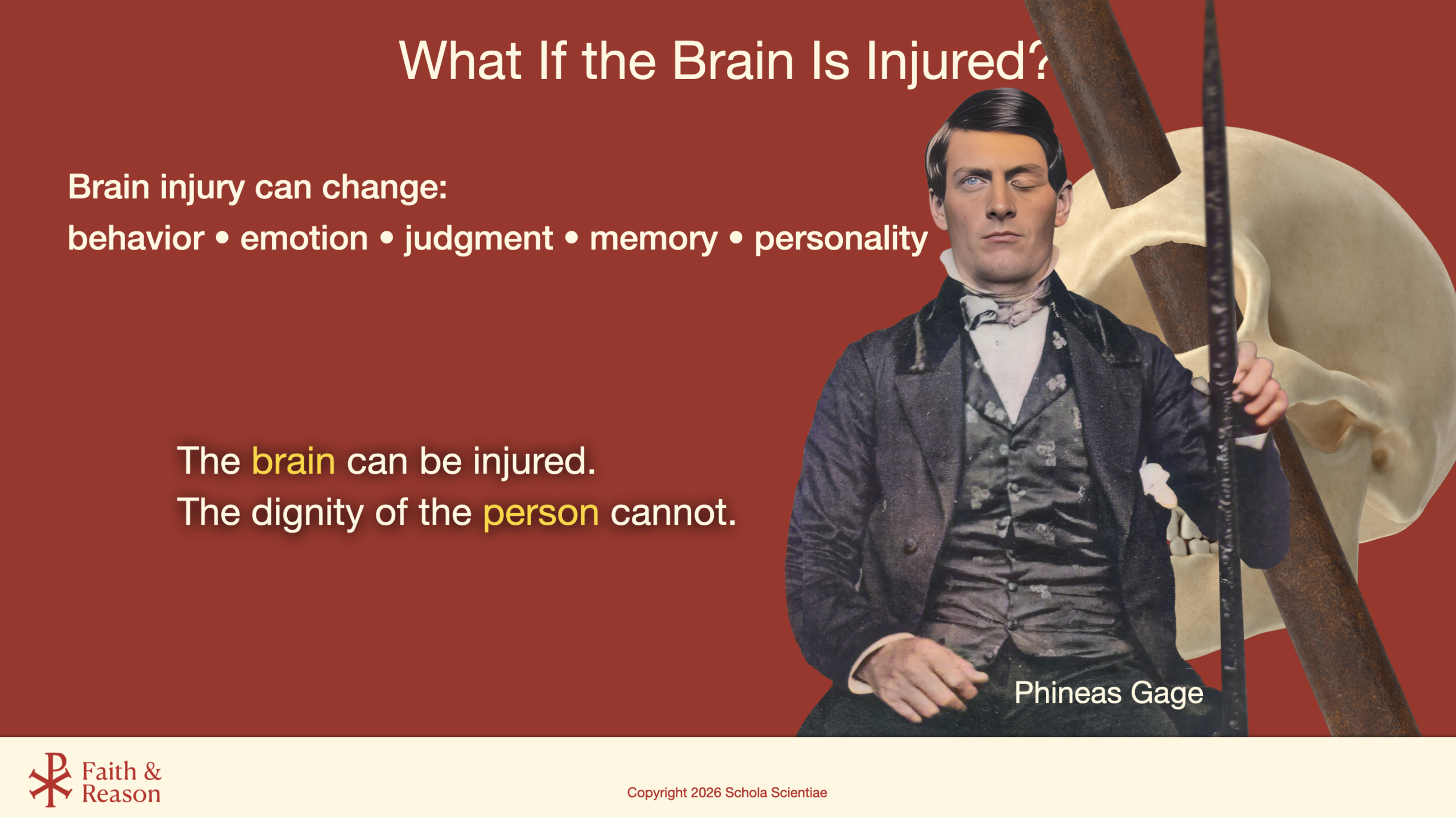
Slide 10 — What If the Brain Is Injured?
Let’s return to Phineas Gage.
His injury provided important scientific evidence that damage to the frontal lobes can affect behavior, judgment, emotion, and self-regulation.
So the brain clearly matters enormously.
But consider a different question:
When Gage’s brain and behavior changed, did he become less human? Did he become less deserving of dignity, care, or respect?
Brain injury can profoundly change what a person is able to do and how that person experiences the world. But Catholic teaching makes an important distinction:
The brain can be injured. The dignity of the person cannot.
Science helps us understand what happened to Gage’s brain. Faith & Reason asks us also to consider Gage as a human person.
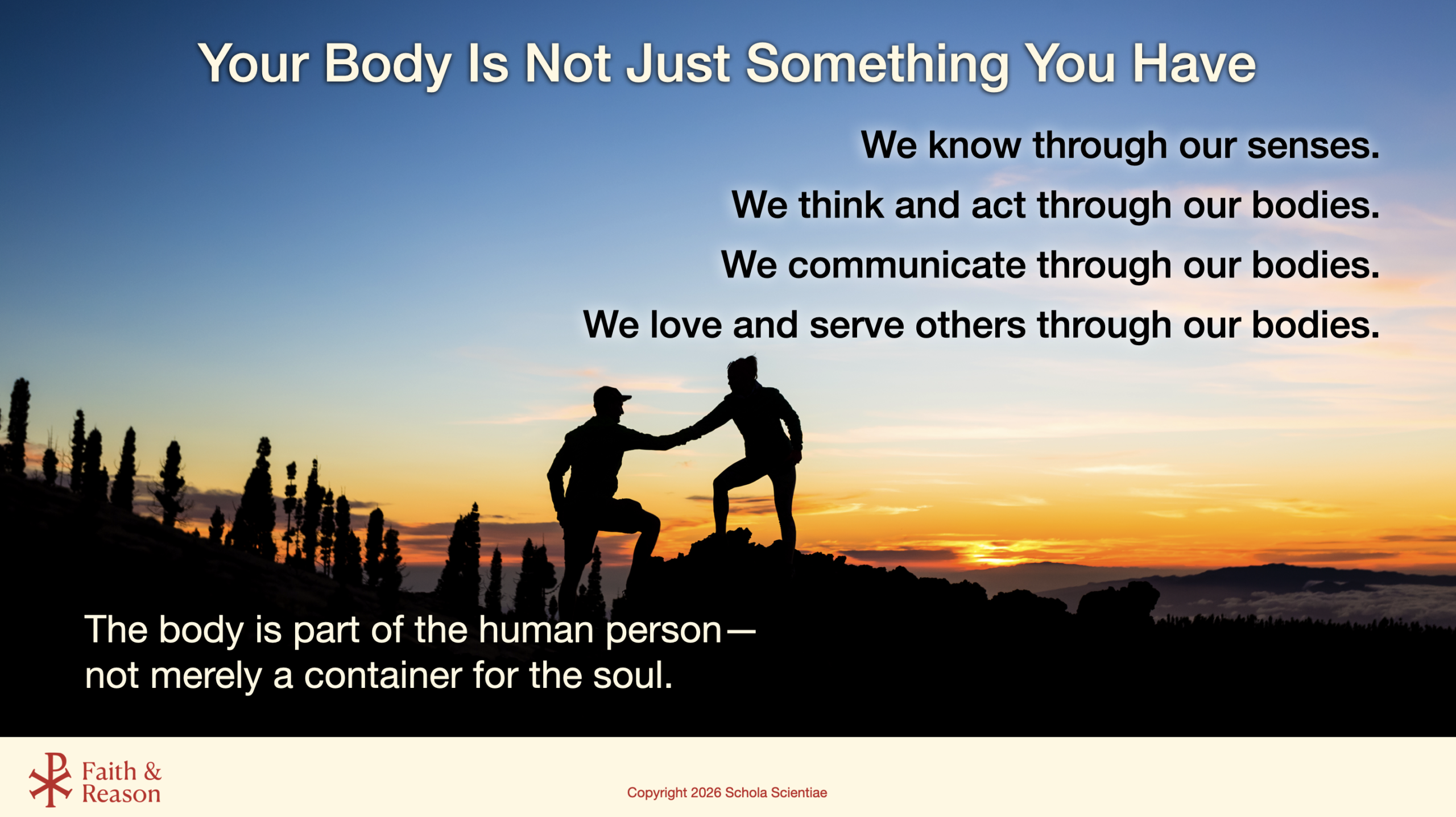
Slide 11 — Your Body Is Not Just Something You Have
Think about how much of your everyday life happens through your body.
You see and hear through your senses. You think and act through your body. You communicate by speaking, writing, smiling, and listening. You show love and care by helping, comforting, serving, and simply being present with another person.
Your body is not like a computer or bicycle that you simply own and operate.
Your body is part of you.
That brings us back to the brain. Your brain is part of your embodied human life, which helps explain why changes in the brain can have such profound effects on perception, thought, emotion, communication, and action.
Catholic teaching about the unity of body and soul does not make the physical body less important.
It helps us understand why the body matters so much.
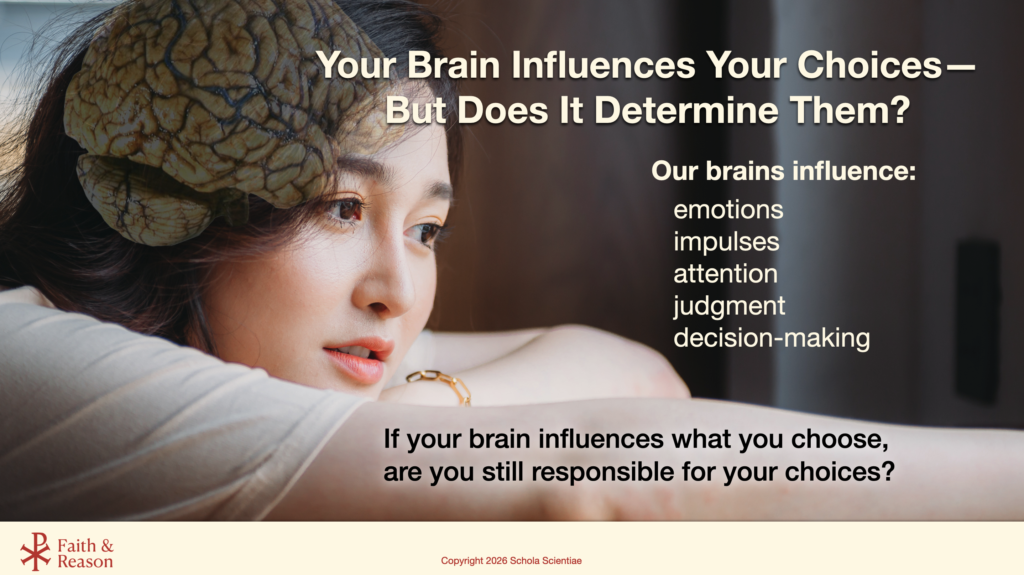
Slide 12 — Your Brain Influences Your Choices—But Does It Determine Them?
Your brain contributes to your emotions, impulses, attention, judgment, and decision-making.
But think about your own experience.
Have you ever felt like doing one thing but chosen to do something else? Maybe you were angry but decided not to say something hurtful, wanted to quit but kept going, or felt nervous but chose to speak anyway.
So consider this question:
If your brain affects what you feel, notice, and think about, does that mean you have no real choice about what you do?
Neuroscience can investigate the brain processes involved in making decisions. But studying those processes raises rather than settles larger questions about human freedom and responsibility.
The brain matters enormously—but understanding the brain and understanding human choice are not exactly the same question.
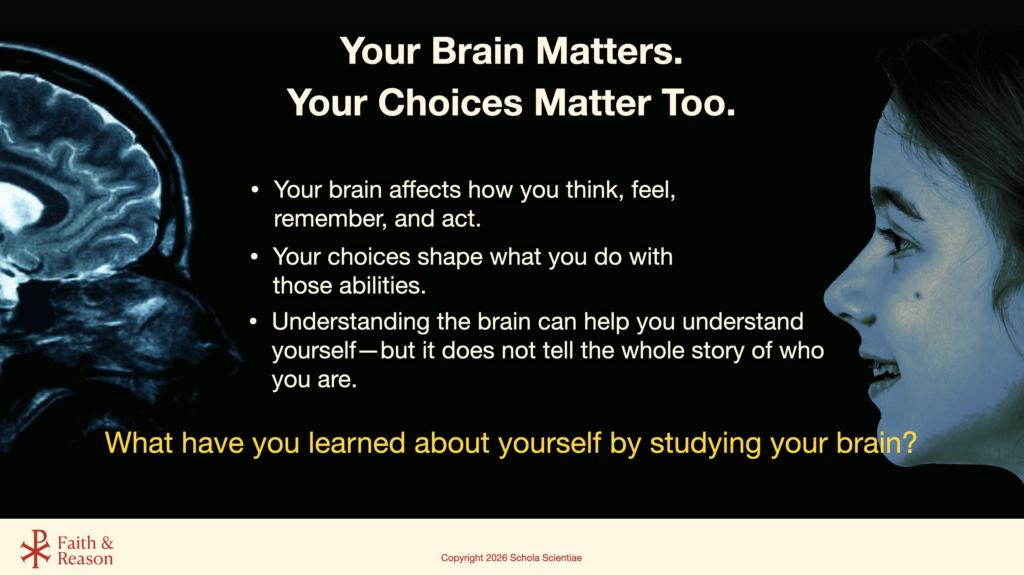
Slide 13 — Your Brain Matters. Your Choices Matter Too.
You have reached an important point in this Investigation.
Your brain affects how you think, feel, remember, judge, and act. What happens to the brain can profoundly affect how a person experiences the world.
But your choices matter too. What you choose to do with your abilities helps shape your actions, relationships, and the person you become.
Understanding the brain is essential to understanding ourselves—but it does not tell the whole story of who we are.
So bring the conversation back to yourself:
What have you learned about yourself by studying your brain?
You don’t need to have every question answered. Sometimes learning something important leads us to even deeper questions.
Slide 14 — Faith and Reason
We began this Investigation by studying the physical brain—its structures, functions, and relationship to human behavior.
We end by bringing together two important ideas:
Science helps us understand the human brain.
Faith reminds us of the dignity of the person whose brain we study.
These ideas do not have to compete. Science, philosophy, and theology can ask different questions while sharing a commitment to truth.
And that brings us to the final statement on the slide:
“Truth does not fear discovery.”
What do you think that means?
If something is true, learning more about reality should not threaten it. Greater knowledge can lead us to deeper questions—and greater wonder.