Teacher Portal

Investigation 1: Lab

MINDSET

This investigation is designed to:

  • Enhance student understanding of the brain’s anatomy and its correlation with function.

  • Develop proficiency in identifying and modeling major brain structures.

  • Foster skills in comparative anatomy through hands-on dissection and modeling activities.
BE PREPARED

Teacher Preparation:

  • Place all materials at the distribution center.

  • Divide students into cooperative groups.

  • Ensure all dissection tools and safety equipment are sanitized and ready for use.


Student Preparation:

Each lab group will need the following materials:

  • Chromebook/Laptop with Student Guide

  • Human brain model

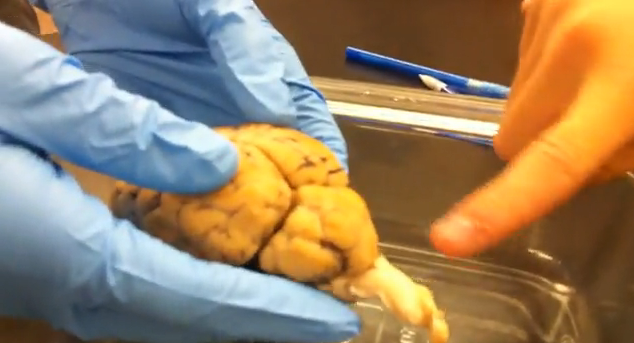
  • Whole sheep brain

  • Sectioned sheep brain

  • Dissection pads and probes

  • Swim cap (1 per student)

  • Markers

INVESTIGATE

Sheep Brain Dissection:

Students will:

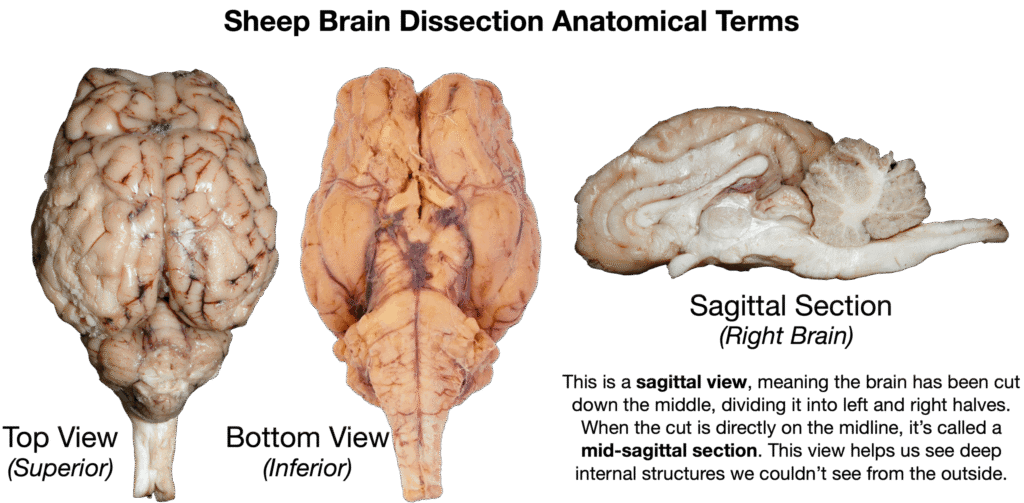
  • Examine both whole and sectioned sheep brains.

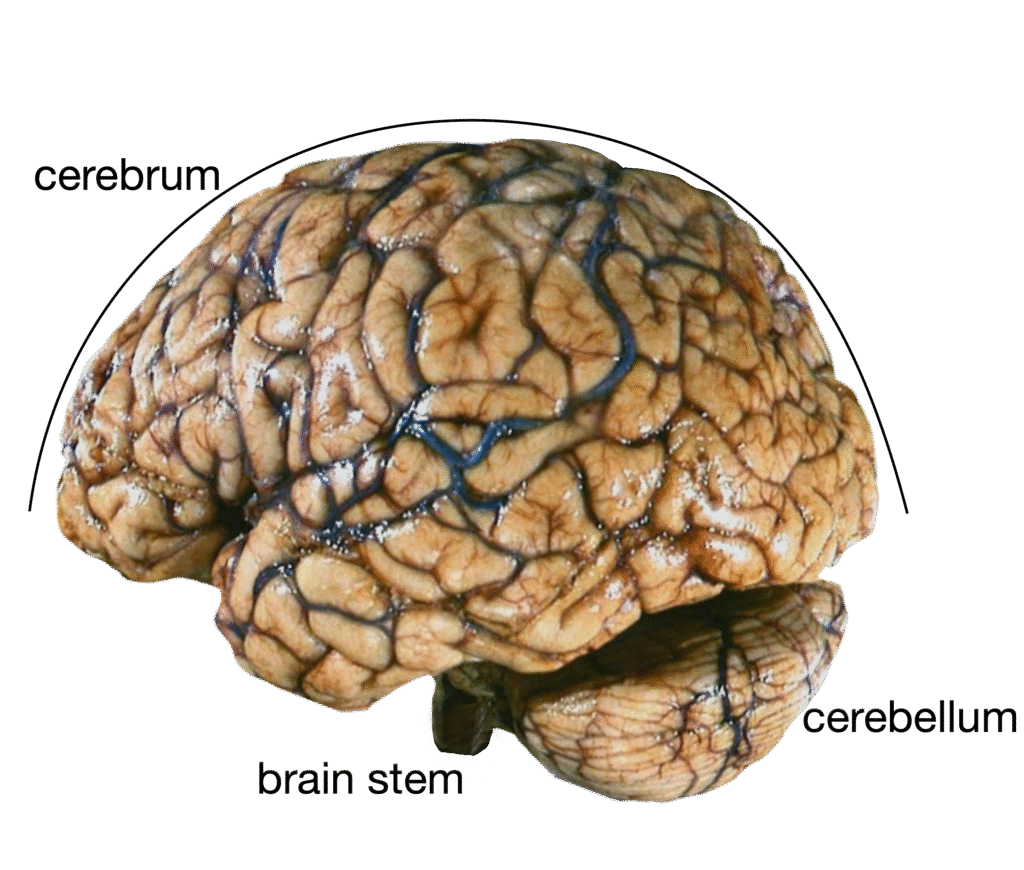
  • Identify major structures such as the cerebrum, cerebellum, brainstem, gyri, and sulci.

  • Compare these structures with those on a human brain model.

Brain Cap Modeling Activity:

Students will:

  • Use a swim cap as a wearable model of the brain.

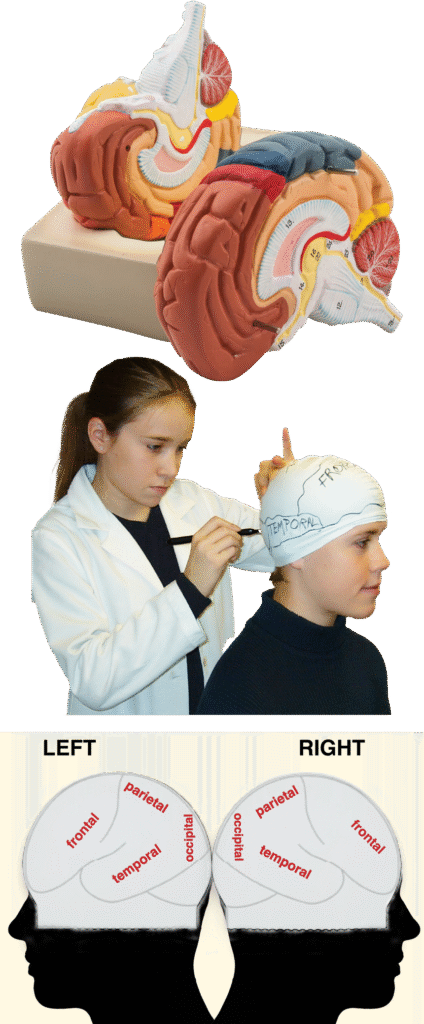
  • Outline and label the cerebral hemispheres, cerebellum, frontal, parietal, occipital, and temporal lobes, as well as the central sulcus, lateral sulcus, and longitudinal fissure.

EXPERIMENT

This experiment is made up of two parts:

  • Sheep brain dissection
  • Brain cap modeling activity

Below is the full step-by-step procedure teachers and students should follow:

PART 1: Sheep Brain Dissection

1. Observe the human brain model

  • Identify the cerebrum, cerebellum, and brainstem.

  • Note the wrinkled appearance caused by gyri (ridges) and sulci (grooves).

  •  

2. Examine the whole sheep brain

  • Locate and compare the cerebrum, cerebellum, and brainstem.

3. Use the dissection probe

    • Gently explore the surface to find gyri and sulci.

    • Identify the cerebral cortex — the outer layer of the cerebrum.

4. Compare the sheep and human brains

    • Discuss similarities and differences in shape, size, and orientation.

    • Pay special attention to the brainstem’s angle and the relative size of the cerebellum.

PART 2: Brain Cap Modeling Activity

1. Distribute a swim cap to each student.

  • One student in each group wears the cap.

2. Trace brain features on the cap using a marker.
a. Place the swim cap securely on the student’s head.
b. Have a partner outline the cerebral hemispheres and the cerebellum.
c. Be sure to reverse the orientation when labeling the opposite side.

3. Add major anatomical landmarks to the cap:

    • Longitudinal fissure – groove dividing left and right hemispheres
    • Central sulcus – vertical groove near the top center
    • Lateral sulcus – horizontal groove near the side of the brain

4. Label the four major lobes:

    • Frontal lobe (front)
    • Parietal lobe (top)
    • Temporal lobe (side)
    • Occipital lobe (back)

5. Wear and present your labeled brain model.

    • Use the cap as a wearable study tool during discussion or review.