
Investigation 1: PostLab
PostLab Assessment — Investigation 1
Download and administer after completing the Investigation.
Teacher Framing for PostLab
The purpose of the HC1 PostLab is to help students move from physical observation of the brain to conceptual understanding of cognition as a system.
During the Lab, students interact directly with brain structures and observe differences in size, shape, and organization. The PostLab is not intended to introduce new content. Instead, it consolidates what students have already seen and prepares them for the Information Processing Model introduced in later investigations.
At this stage, students should not yet be expected to describe detailed cognitive mechanisms. The goal is to establish the idea that structure supports function, and that cognition emerges from coordinated activity across multiple brain regions..
What Students Should Come Away With
By the end of the PostLab discussion, students should understand that:
The brain functions as an integrated system, not a collection of isolated parts
Physical structure places constraints and possibilities on mental processes
Information must move through the brain in an organized and coordinated way to produce learning and behavior.
Understanding cognition requires looking at relationships, not just locations
Discussion Angles
Emphasize that no single brain region “thinks” on its own; cognition emerges from interaction.
Reinforce that observing physical structure provides evidence, not explanations, for cognitive function.
Help students distinguish between receiving information and processing information.
Encourage students to reflect on how disruption in one area could affect the entire system.
Connect lab observations to everyday experiences (attention, confusion, learning effort) without yet naming memory systems.
Focus Questions:
1. How does studying brain structure help us understand human behavior and decision-making?
Studying brain structure allows scientists to link specific regions of the brain to particular functions and behaviors. Different areas of the brain are responsible for tasks such as movement, sensation, emotion, and decision-making. When a specific region is damaged or altered, changes in behavior often follow, helping researchers infer the role of that region. Understanding brain structure therefore provides insight into how physical systems support thought, personality, and action.
Discussion angles students may raise:
“Different brain parts do different jobs.”
“Damage can change behavior.”
“You can learn about thinking by studying the brain.”
“The brain controls more than just movement.”
Teacher move:
Reinforce the idea that structure and function are connected, and emphasize that behavior is not random but reflects underlying neural organization.
2. What did the case of Phineas Gage reveal about the role of the frontal lobes?
The case of Phineas Gage demonstrated that damage to the frontal lobes can dramatically alter personality, judgment, and social behavior without eliminating basic intelligence or memory. After his injury, Gage retained many physical and cognitive abilities but showed profound changes in self-control and decision-making. This provided early evidence that the frontal lobes play a critical role in executive functions such as planning, impulse control, and moral reasoning.
Discussion angles students may raise:
“He was the same person, but also different.”
“Personality can change if the brain is damaged.”
“The frontal lobe affects choices and behavior.”
“You can be smart but still make bad decisions.”
Teacher move:
Highlight the concept of executive function and explain that higher-order thinking depends heavily on frontal lobe integrity.
3. Why is it important to divide the brain into regions such as the frontal, parietal, temporal, and occipital lobes?
Dividing the brain into regions helps scientists and doctors describe, study, and diagnose brain function more precisely. Each lobe is associated with dominant functions—such as vision, sensation, language, or planning—allowing clearer interpretation of injuries, diseases, and imaging data. This organizational framework makes the complex brain easier to understand and communicate about scientifically.
Discussion angles students may raise:
“It’s like a map.”
“Doctors need names for parts.”
“Different jobs need different areas.”
“It helps explain symptoms.”
Teacher move:
Use this question to stress the value of models and classifications in science as tools for understanding complexity.
4. How do neurons communicate information within the brain?
Neurons communicate using electrical signals within the cell and chemical signals between cells. An electrical impulse travels down a neuron’s axon, triggering the release of neurotransmitters at the synapse. These chemicals cross the synaptic gap and bind to receptors on the next neuron, continuing the signal. This process allows information to move rapidly and precisely through neural networks.
Discussion angles students may raise:
“Electricity and chemicals both matter.”
“Messages jump between cells.”
“Signals can speed up or slow down.”
“Interruptions cause problems.”
Teacher move:
Clarify the phrase “electrical within, chemical between” and connect communication breakdowns to brain disorders or injuries.
5. Based on your lab experience, does your understanding of brain anatomy explain how information is processed and how cognition actually works? Why or why not?
No. The lab experience helps students recognize that the brain is a physical system with organized structures, but anatomy alone does not explain how information is processed or how cognition occurs. Examining a sheep brain and using the brain cap provides evidence of structure and organization, while leaving unanswered questions about how information flows, how it is transformed, and how meaning or thought emerges. This distinction is intentional and prepares students to explore information processing models in subsequent investigations.
Discussion angles students may raise:
The brain has different parts, but seeing them does not show how thinking happens
Structure suggests organization, but not the steps involved in processing information
Damage to one area might affect thinking, even if the rest of the brain looks normal
Anatomy shows where things are, but not how they work together
The lab raised new questions about learning, memory, and attention rather than answering them
Teacher move: Teachers should affirm these observations and emphasize that recognizing the limits of structural evidence is a key part of scientific reasoning.
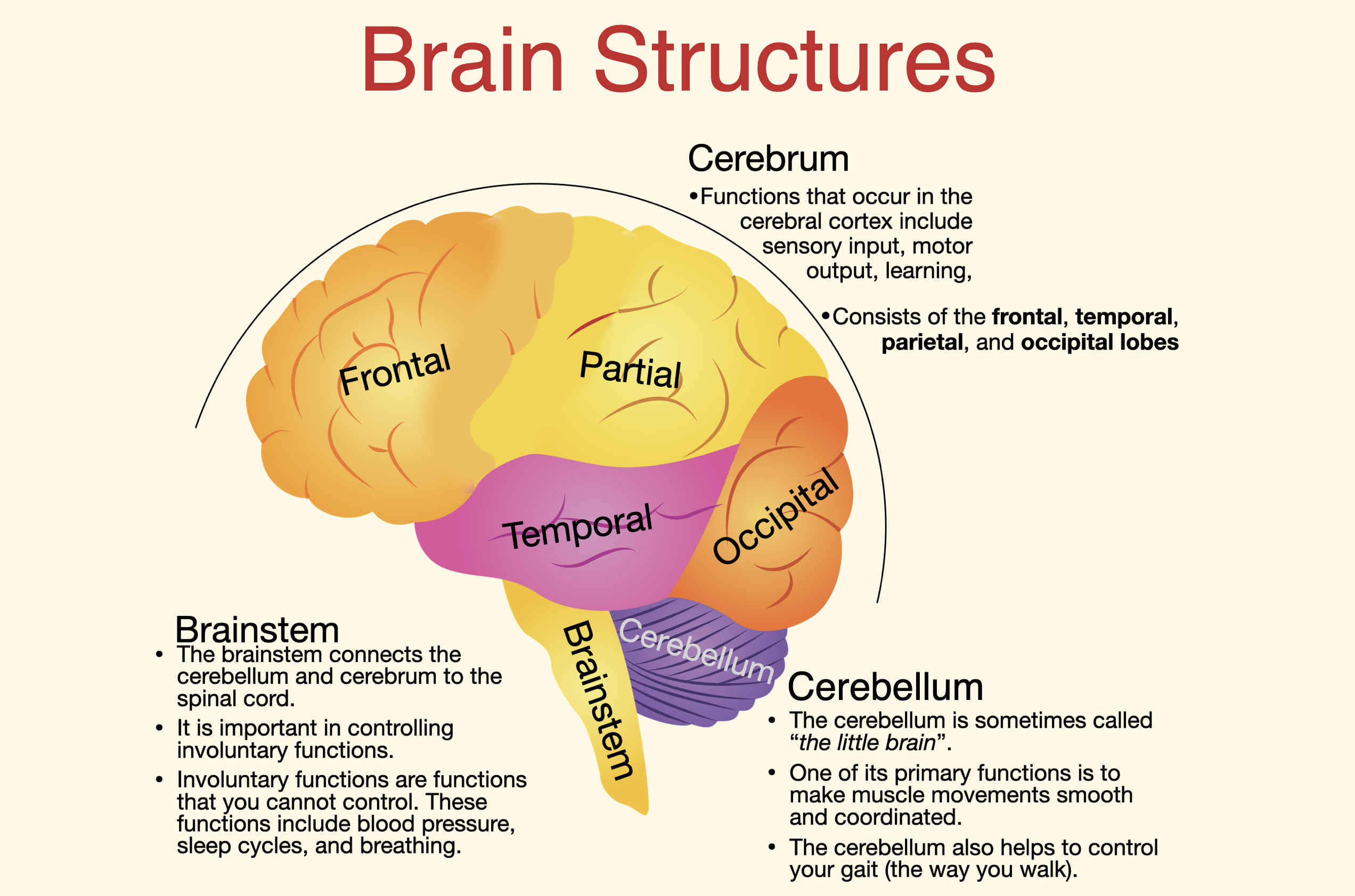
Reference Diagram: Human Brain Structures
Think Critically:
How teachers should use these answers
Do not read them aloud verbatim. Use them to:
- Probe student reasoning
- Redirect misconceptions
- Connect answers back to the Lab experience
Encourage students to explain why, not just what
1. Imagine a person could see and label all the major parts of the brain. Would that automatically mean they understand how thinking works? Why or why not?
Good Answer (Teacher Explanation):
No. Knowing the names and locations of brain structures provides useful information about organization, but it does not explain how information is processed or how cognition occurs. Structure can suggest specialization and constraints, while understanding thinking requires explaining interactions, timing, and information flow across multiple regions.
Key teaching point:
Structure provides clues about function, while cognition depends on processes and interactions.
Possible student responses to affirm and extend:
“It tells you where things are, not what they do together.”
“It’s like knowing the parts of a computer without knowing how it runs.”
“You still wouldn’t know how information moves.”
2. During the lab, you examined a sheep brain and used the brain cap. How did these activities help you understand what brain structure can — and cannot — tell you about cognition?
Good Answer (Teacher Explanation):
The lab activities provide concrete evidence that the brain is structured and organized. Students can see regions, connections, and relative size, which supports the idea that structure matters. At the same time, the lab does not reveal the invisible processes of information processing, interpretation, and meaning-making. This is intentional and prepares students to study cognitive models in later investigations.
Key teaching point:
A lab can provide strong evidence about structure, while leaving important questions about process unanswered.
Possible student responses to affirm and extend:
“We saw anatomy, not thinking.”
“It raised questions about how signals move.”
“The cap showed where parts are, but not how learning happens.”
3. Why is it more accurate to describe cognition as a coordinated system rather than a single brain “location”?
Good Answer (Teacher Explanation):
Cognition involves multiple functions—attention, perception, interpretation, memory, and response—that require coordinated activity across many brain regions. Even if certain regions are associated with particular roles, cognition depends on communication and integration. Thinking is not produced by one isolated area; it emerges from relationships among parts working together.
Key teaching point:
Cognition is system-level behavior—it emerges from coordinated interactions.
Possible student responses to affirm and extend:
“If one part is damaged, it affects everything.”
“Different parts contribute to one outcome.”
“It’s like a team, not a single player.”
4. What kinds of questions about cognition remain unanswered after studying anatomy—and what would we need next to answer them?
Good Answer (Teacher Explanation):
Anatomy cannot show how information is encoded, processed, stored, or retrieved. It cannot show how attention shifts or how meaning is formed. To answer these questions, students need models and experiments that focus on information flow and processing—exactly what later investigations provide.
Key teaching point:
Unanswered questions are not failure; they guide the next level of inquiry.
Possible student responses to affirm and extend:
“We need to know how messages travel.”
“We need experiments about memory and attention.”
“We need a model of information processing.”
Synthesis Prompt (Whole-Class Discussion):
How did examining real brain structures during the lab help you understand both the importance and the limits of brain anatomy in explaining cognition? What kinds of questions about thinking and learning remain unanswered?
Teacher Guidance (optional, brief)
Students should recognize that:
brain anatomy provides essential information about organization and constraints,
structure alone cannot explain how information is processed,
unanswered questions naturally lead to the need for models of information processing.
This synthesis prepares students to transition from structure to process in the next investigation.