
Back to: Human Cognition – Teacher
Student Portal
Investigation 2: PostLab
PostLab Overview
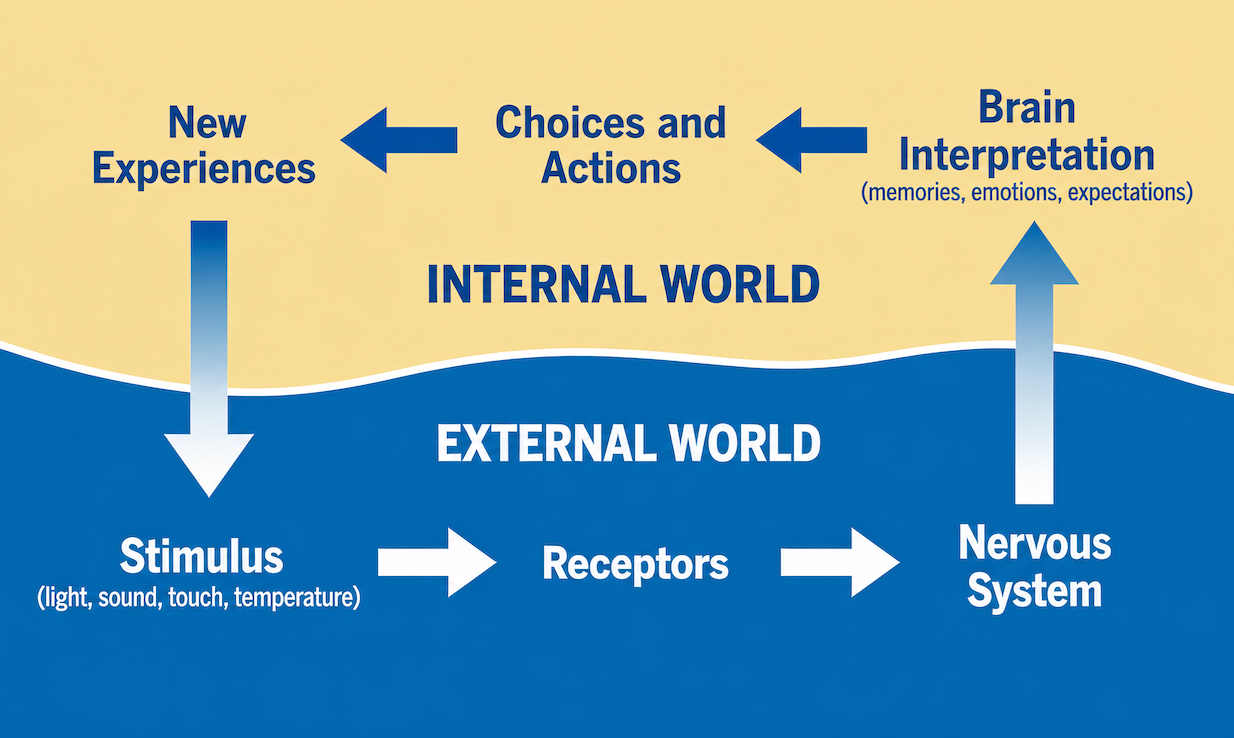
Now that you have completed the Lab, use your observations and results to think more deeply about how the nervous system receives information and produces responses. This PostLab will help you connect reflexes, sensory processing, and the organization of the nervous system to the evidence you observed during the Investigation.
Focus Questions
Use your observations from the Lab and what you learned in the PreLab to think through the questions below.
1. Why can reflexes occur before you are consciously aware of what has happened?
Reflexes are rapid, automatic responses to stimuli. Some reflex pathways can begin producing a response before you become consciously aware of what caused it.
Ideas to Consider:
- What happens first when a stimulus is detected?
- Does a reflex require you to consciously decide how to respond?
- How can the spinal cord or brainstem help produce a response before conscious awareness?
- Why might responding quickly be useful to the body?
2. What do the results of the two-point discrimination test tell us about how the brain “values” different parts of the body?
The two-point discrimination test showed that some parts of the body can distinguish two nearby points more accurately than others. These differences reflect how sensory information from different body regions is represented and processed in the brain.
Ideas to Consider:
- Which body regions were most sensitive to two nearby points?
- How might the number and density of sensory receptors affect the results?
- Why does the brain devote more sensory-processing space to some body regions than others?
- How does the sensory homunculus help explain the differences you observed?
3. What do reflexes and sensory maps (like the homunculus) together teach us about how the nervous system is organized?
Reflexes and sensory maps reveal different aspects of nervous system organization. Reflexes show how information can travel through pathways that produce rapid responses, while sensory maps show that different parts of the body receive different amounts of processing space in the brain.
Ideas to Consider:
- What do reflex pathways reveal about how sensory information can lead to a response?
- What does the sensory homunculus show about how different body regions are represented in the brain?
- Why are some body regions represented more prominently than others?
- What do reflexes and sensory maps together suggest about specialization within the nervous system?
4. Reflexes are very fast and automatic. How do they compare to more complex thinking and decision-making, and why does the brain need both?
Reflexes allow the nervous system to respond rapidly and automatically, while more complex situations may require conscious thought, judgment, learning, and planning. Both kinds of processing are important for responding effectively to the world.
Ideas to Consider:
- What kinds of situations can be handled effectively by a reflex?
- What kinds of situations require conscious thought, planning, or judgment?
- What would be the limitations of a nervous system that relied only on reflexes?
- How can automatic and conscious processing work together to guide behavior?
Think Critically
Now that you have examined reflexes and sensory responses, use the questions below to think more deeply about what your observations reveal about how the nervous system processes information. Draw on evidence from the Lab, connect ideas from throughout this Investigation, and be prepared to explain the reasoning behind your conclusions.
1. How can the same stimulus produce both an automatic response and a conscious response?
A single stimulus can be processed through more than one pathway in the nervous system. Some processing can produce a rapid, automatic response, while other information continues to the brain and contributes to conscious awareness.
Ideas to Consider:
- What happens immediately after a stimulus is detected?
- How can a motor response begin before conscious awareness?
- Does the brain still receive information after the automatic response begins?
- How might the automatic and conscious responses serve different purposes?
2. What evidence from your two-point discrimination results suggests that sensory processing is not distributed evenly across the body?
Different body regions showed different levels of sensitivity during the two-point discrimination test. These differences provide evidence that the nervous system does not process sensory information from every part of the body in the same way.
Ideas to Consider:
- Which body regions could distinguish two points at the smallest distances?
- How did the minimum detectable distance vary across body regions?
- How might sensory receptor density help explain these differences?
- How does the sensory homunculus relate to the pattern you observed?
3. What do the knee-jerk and pupillary reflexes reveal about how the nervous system can process information without conscious decision-making?
Although the knee-jerk and pupillary reflexes produce very different responses, both show that the nervous system can detect a stimulus and produce an appropriate response automatically, without requiring a conscious decision.
Ideas to Consider:
- What was the stimulus and response for each reflex?
- What role did sensory information play in initiating each response?
- How was a motor response produced without a conscious decision?
- What similarities between the two reflexes reveal a common information-processing pattern?
4. Why does the nervous system need both rapid, automatic processing and slower, more complex processing?
Different situations place different demands on the nervous system. Some require an immediate response, while others require information to be evaluated, compared with past experience, and used to guide a thoughtful decision.
Ideas to Consider:
- What advantages come from rapid, automatic processing?
- What kinds of situations require slower, more complex processing?
- Why would either type of processing alone be insufficient?
- How might automatic and conscious processing work together in everyday behavior?
Synthesis: Bringing It All Together
How do the reflexes and sensory responses you investigated demonstrate that the nervous system uses different strategies to process information, and why is this important for understanding human cognition?