
Teacher Portal
Investigation 2: Teacher Assistant
The assessment has been completed. This page summarizes how well your students understood the key concepts of Investigation 2 and highlights opportunities for review before moving on.
How Did Your Students Do?
CLASS SUMMARY
Students completing assessment: ________
Class average: ________
Highest score: ________
Lowest score: ________
Average completion time: ________
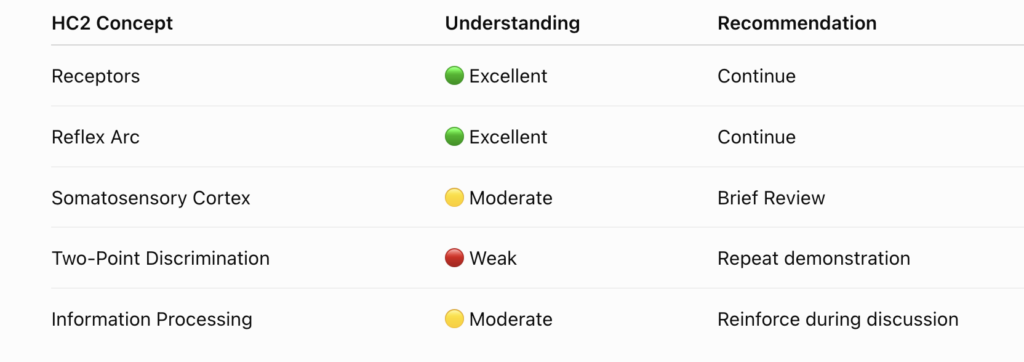
How Well Did Students Understand Each Concept?
Teacher Insight: Where Might Students Be Struggling?
Two-Point Discrimination
Many students appear to understand what happened during the investigation but not why it happened.
The most common incorrect response suggests that students are attributing fingertip sensitivity to skin thickness rather than receptor density and cortical representation.
This misconception is common because students tend to focus on the physical activity instead of the underlying biological explanation.
A five-minute review should correct this.
• Repeat the paperclip demonstration.
• Compare fingertip, palm, forearm, and back.
• Return to the sensory homunculus illustration.
• Ask:
“If the skin isn’t different, what is?”
Teaching Recommendation
Based on your students’ assessment results, the following recommendations will help reinforce key concepts before moving to Investigation 3.
Based on your class’s assessment, students appear to have developed a solid understanding of the major concepts in Investigation 2.
Before beginning Investigation 3, consider spending 5–10 minutes reinforcing the following ideas:
- ✓ Receptor density determines sensory sensitivity.
- ✓ The sensory homunculus explains why different body regions vary in sensitivity.
- ✓ Much of the nervous system processes information automatically before conscious awareness.
- ✓ Conscious perception represents only a small portion of ongoing neural activity.
Once these concepts are secure, your class should be well prepared to move forward.
Questions Worth Asking Tomorrow
Before reteaching, begin the next lesson by asking one or two questions that encourage students to explain their thinking. Their responses will quickly tell you whether additional review is needed.
Examples:
- Why are your fingertips more sensitive than your forearm?
- What does the sensory homunculus actually represent?
- Why doesn’t the brain process every stimulus consciously?
- How can two people experience the same event differently?
Students who can explain these ideas are generally ready for the next investigation.
Looking Ahead
In Investigation 3, students will begin exploring how the brain learns, remembers, and reconstructs experience.
Understanding today’s ideas about sensory processing provides the foundation for understanding how experience becomes memory—and why human memory is not simply a recording of reality.
Assessment Center
Need more detail? Explore your class results below:
Use these reports to understand how your class performed, identify misconceptions, and plan your next lesson.