
Back to: Human Cognition – Teacher
Teacher Portal
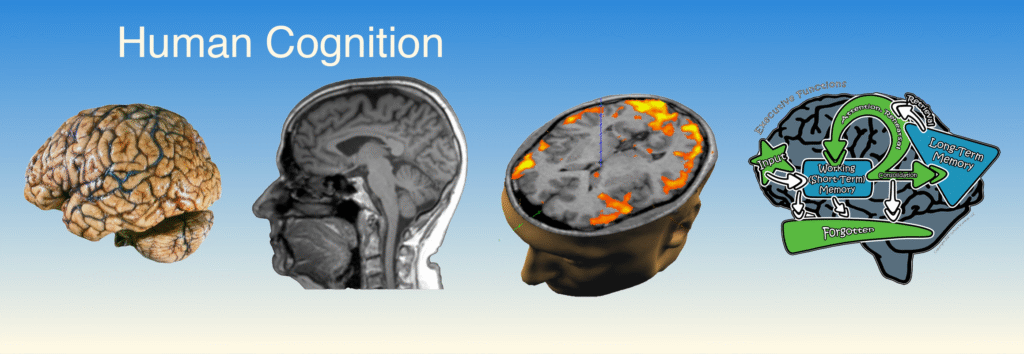
Investigation 1: Reflection and Meaning
NAVIGATE
Once the slide presentation is launched
- use your left and right arrows to advance or go back in the slide presentation, and
- hover your mouse over the left edge of the presentation to get a view of the thumbnails for all the slides so that you can quickly move anywhere in the presentation.
Click on any image below to expand
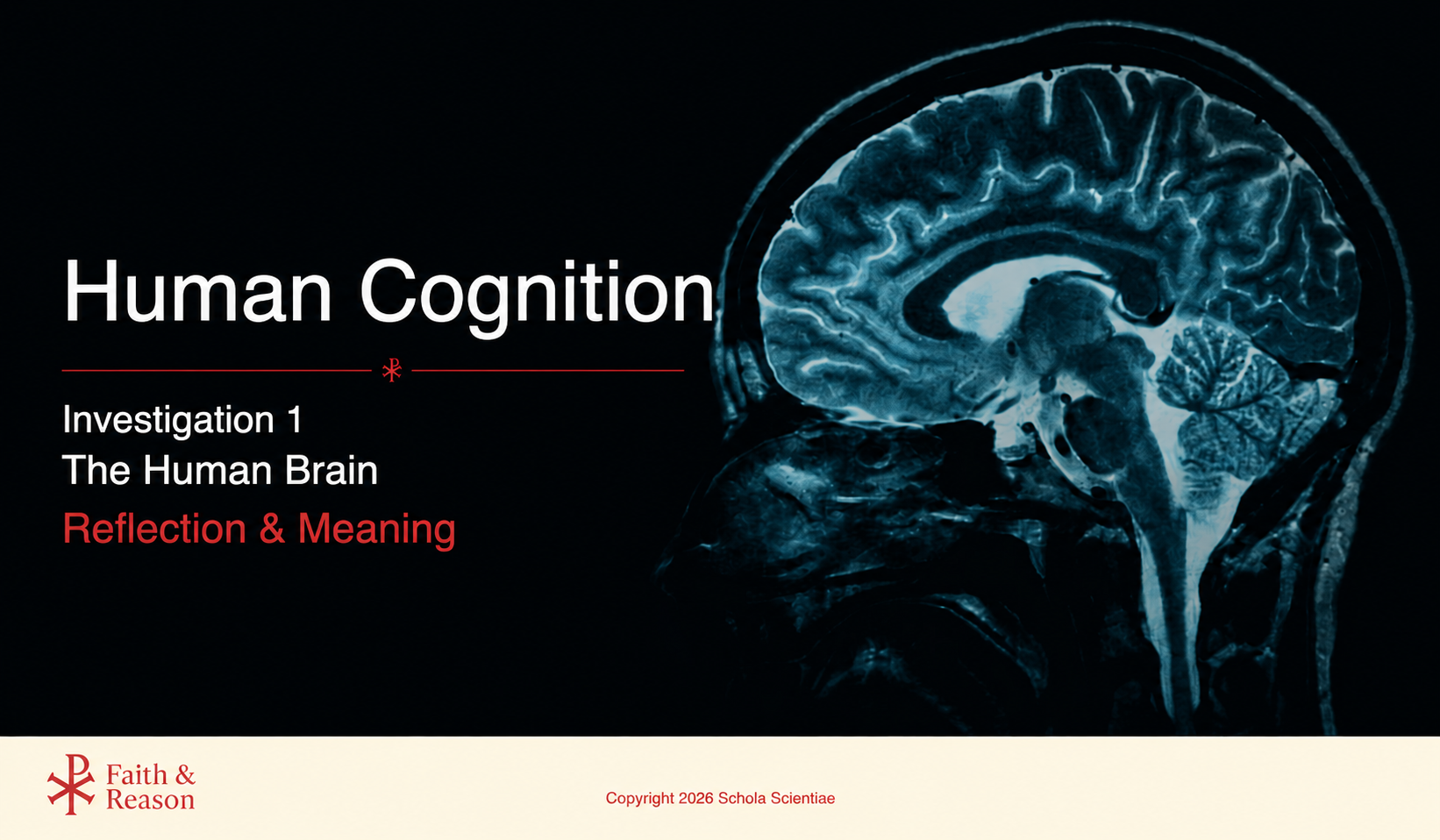
1. Human Cognition – The Human Brain
Teaching Tips
Begin by welcoming students:
“Today we begin something different. Throughout this Investigation, you discovered remarkable things about the human brain. In Reflection & Meaning, we’ll begin asking what those discoveries might mean.”
Explain that today’s lesson is not about learning new scientific facts. Instead, students will use what they have already learned to think more deeply about themselves, their relationships, and what it means to be human.
Encourage students to participate freely, support their ideas with evidence, and respectfully consider the ideas of their classmates.
Then explain:
“Scientists work to discover how the natural world works. Once those discoveries are made, another question naturally follows: What do those discoveries teach us about ourselves?”
Emphasize that Reflection & Meaning builds upon scientific investigation rather than replacing it.
Conclude by saying:
“Today’s discussion begins a conversation that will continue throughout the Human Cognition unit.”
Purpose
This opening slide marks the beginning of the Reflection & Meaning portion of Human Cognition Investigation 1. Students transition from scientific investigation to thoughtful reflection, using the discoveries they have already made as the foundation for exploring broader questions about the human person.
Key Idea
Scientific discoveries explain how the brain works.
Reflection explores what those discoveries mean for understanding ourselves and the human person.
Leading the Conversation
Help students understand that today’s lesson is not a review of neuroscience, nor is it intended to provide simple answers to life’s biggest questions.
Instead, Reflection & Meaning invites students to build upon scientific evidence by asking thoughtful questions, listening respectfully to different perspectives, and developing well-reasoned conclusions.
Encourage curiosity rather than certainty. The goal is not to end the conversation but to begin one.
Connections
Scientific Investigation
This slide marks the transition from scientific investigation to Reflection & Meaning. Students should continually draw upon the evidence they gathered throughout Investigation 1, including brain anatomy, localization of function, case studies, and modern neuroimaging. Reflection begins with scientific evidence—not speculation.
Human Cognition
This discussion introduces one of the central themes of the Human Cognition curriculum: understanding the brain helps us better understand ourselves. Later Investigations will continue building this relationship as students explore perception, learning, memory, executive function, and other aspects of human cognition.
Reflection & Meaning
Students begin considering questions that science naturally raises but cannot answer completely by laboratory investigation alone. Reflection & Meaning encourages thoughtful dialogue grounded in scientific evidence, careful reasoning, and respectful discussion as students seek a deeper understanding of the human person.
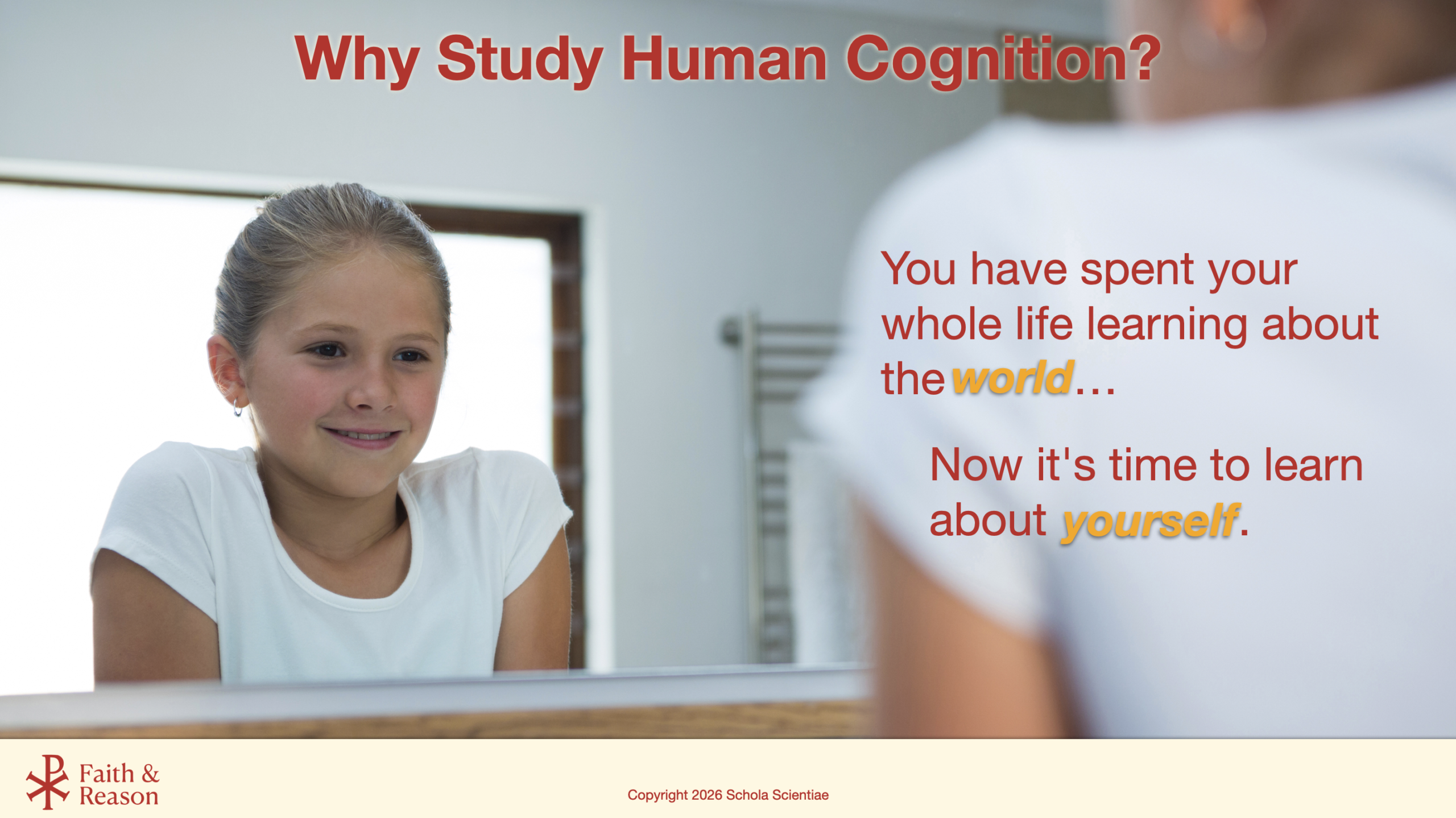
2. Why Study Human Cognition?
Teaching Tips
Begin by welcoming students:
“Today we begin something different. Throughout this Investigation, you discovered remarkable things about the human brain. In Reflection & Meaning, we’ll begin asking what those discoveries might mean.”
Explain that today’s lesson is not about learning new scientific facts. Instead, students will use what they have already learned to think more deeply about themselves, their relationships, and what it means to be human.
Encourage students to participate freely, support their ideas with evidence, and respectfully consider the ideas of their classmates.
Then explain:
“Scientists work to discover how the natural world works. Once those discoveries are made, another question naturally follows: What do those discoveries teach us about ourselves?”
Emphasize that Reflection & Meaning builds upon scientific investigation rather than replacing it.
Conclude by saying:
“Today’s discussion begins a conversation that will continue throughout the Human Cognition unit.”
Purpose
This slide invites students to recognize something they may never have considered: much of their education has focused on understanding the world around them, while comparatively little attention has been given to understanding the mind and brain through which they experience that world.
The slide shifts the focus inward and establishes Human Cognition as an investigation of the student as well as the brain.
Key Idea
Students have spent years learning about the world.
Human Cognition gives them an opportunity to begin learning about themselves—how they perceive, learn, remember, think, and make decisions.
Leading the Conversation
Give students time to recognize the contrast for themselves. The point is not that subjects such as science, history, mathematics, or literature are unimportant. Rather, all of those subjects are encountered through the human mind.
Encourage students to consider how unusual it is that they may have spent thousands of hours learning about the world without ever taking a sustained look at the processes that make learning itself possible.
This realization should generate curiosity rather than provide an answer. Students are beginning a study in which the object of investigation is, in part, the investigator.
Connections
Scientific Investigation
Investigation 1 introduced students to the structure and function of the human brain. They examined specialized brain regions, considered evidence from brain injury and neurological cases, and explored how modern neuroscience allows scientists to study the living brain.
Human Cognition
This slide broadens the purpose of the unit. Students are not studying the brain simply as an organ. They are investigating the biological system that contributes to perception, memory, language, learning, movement, decision-making, and much of their conscious experience.
Reflection & Meaning
The slide begins the inward turn that defines Reflection & Meaning. Scientific discoveries about the brain become the starting point for questions about identity, thought, choice, and the human person. Students are encouraged to approach those questions with curiosity, evidence, careful reasoning, and humility.
3. The Conversation Continues
Teaching Tips
Begin by asking:
“Think about all the years you’ve been in school. Since kindergarten, what have you spent most of your time learning about?”
Allow students to answer naturally. Responses may include:
- science
- history
- mathematics
- language
- geography
- music
- art
- sports
Then ask:
“How many classes have taught you how your own brain works—or how you think, learn, remember, and make decisions?”
Most students will answer, “None.” Allow students a moment to appreciate the contrast before continuing.
Then conclude:
“That’s why this Investigation is different. It isn’t just about learning more science. It’s about learning more about yourself.”
Purpose
This slide encourages students to recognize that although they have spent years learning about the world around them, they have rarely been asked to study the remarkable organ that makes all learning possible. It introduces Human Cognition as a study of the learner as well as the brain.
Key Idea
Understanding the world is important.
Understanding how we understand the world is equally important.
Leading the Conversation
Allow students to discover the point for themselves before explaining it. As they list the subjects they have studied, help them recognize that nearly every school subject teaches them about something outside themselves.
Then ask students to consider the instrument through which every lesson, every memory, every decision, and every experience is processed—the human brain. Explain that Human Cognition is an opportunity to investigate that remarkable system and, in doing so, better understand themselves.
Connections
Scientific Investigation
Investigation 1 introduced students to the organization and specialization of the human brain. They explored how neuroscientists use scientific evidence to understand brain structure and function and how specific brain regions contribute to different abilities.
Human Cognition
This slide establishes the purpose of the Human Cognition curriculum. Students are not simply studying another body system—they are studying the biological foundation of perception, learning, memory, language, reasoning, and decision-making.
Reflection & Meaning
The Conversation Continues by inviting students to turn their attention inward. Scientific discoveries about the brain become an invitation to reflect on their own learning, thinking, choices, and growth. Throughout the Human Cognition curriculum, scientific understanding will serve as the foundation for thoughtful reflection.
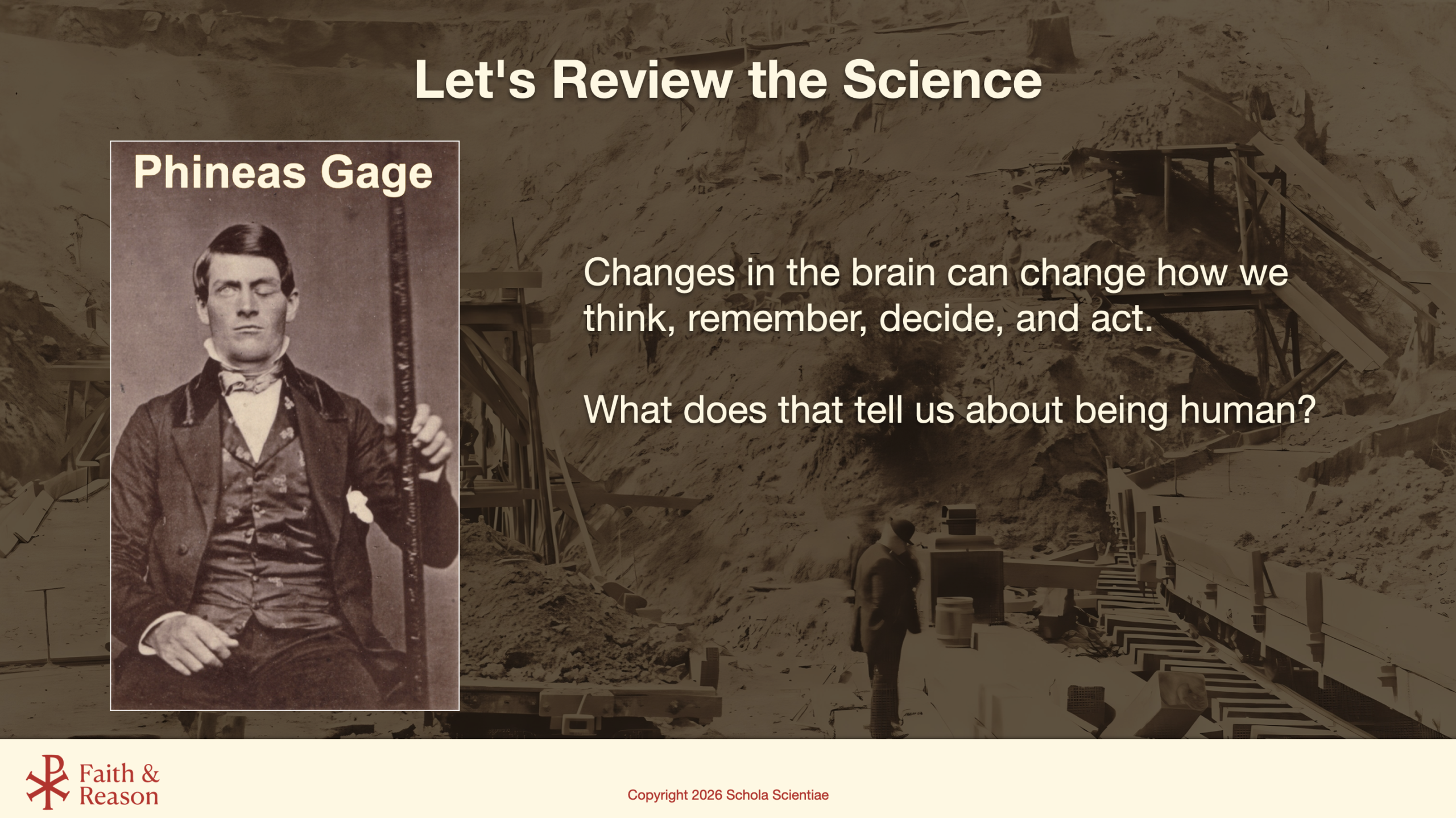
4. Let’s Review the Science
Teaching Tips
Begin by reviewing the science:
“What happened to Phineas Gage, and what did scientists learn from his accident?”
Allow students to summarize the evidence from the Investigation. Guide them toward the conclusion that damage to specific regions of the brain can produce predictable changes in thinking, personality, decision-making, and behavior.
Then ask:
“If changing the brain can change how a person thinks or behaves, what questions does that raise about the human person?”
Do not answer the question immediately. Encourage students to think aloud and respectfully consider different ideas. Their task is not to solve the question but to recognize that important scientific discoveries naturally lead to deeper reflection.
Conclude by saying:
“Science has shown us that the brain matters profoundly. Our next task is to consider what those discoveries may tell us about ourselves.”
Purpose
This slide reconnects students with one of the Investigation’s most important scientific discoveries before inviting them to consider its broader significance. Phineas Gage provides compelling evidence that changes in the brain can influence thinking, personality, decision-making, and behavior.
Key Idea
Scientific evidence demonstrates that the brain plays a vital role in shaping human thought and behavior.
Reflection asks what those discoveries may reveal about the nature of the human person.
Leading the Conversation
Help students distinguish between what science has demonstrated and the larger questions that scientific discoveries naturally raise.
The Phineas Gage case provides convincing evidence that brain injury can alter behavior. Reflection & Meaning begins by asking what significance that evidence may have for understanding identity, responsibility, free choice, and the relationship between the brain and the human person.
Encourage thoughtful discussion rather than quick conclusions. Students should recognize that careful scientific investigation often opens the door to important philosophical and theological questions.
Connections
Scientific Investigation
The Investigation demonstrated that different regions of the brain perform specialized functions and that damage to those regions can produce predictable changes in cognition and behavior. Phineas Gage remains one of neuroscience’s classic examples supporting localization of function.
Human Cognition
This discussion reinforces a central theme of Human Cognition: understanding how the brain works provides important insights into human learning, memory, judgment, and behavior while also raising deeper questions about the human person.
Reflection & Meaning
Students begin to appreciate that scientific discoveries do more than increase knowledge. They also invite reflection about who we are, how we make choices, and what it means to be human. Reflection & Meaning encourages students to approach these questions with humility, curiosity, and respect for both scientific evidence and thoughtful reasoning.
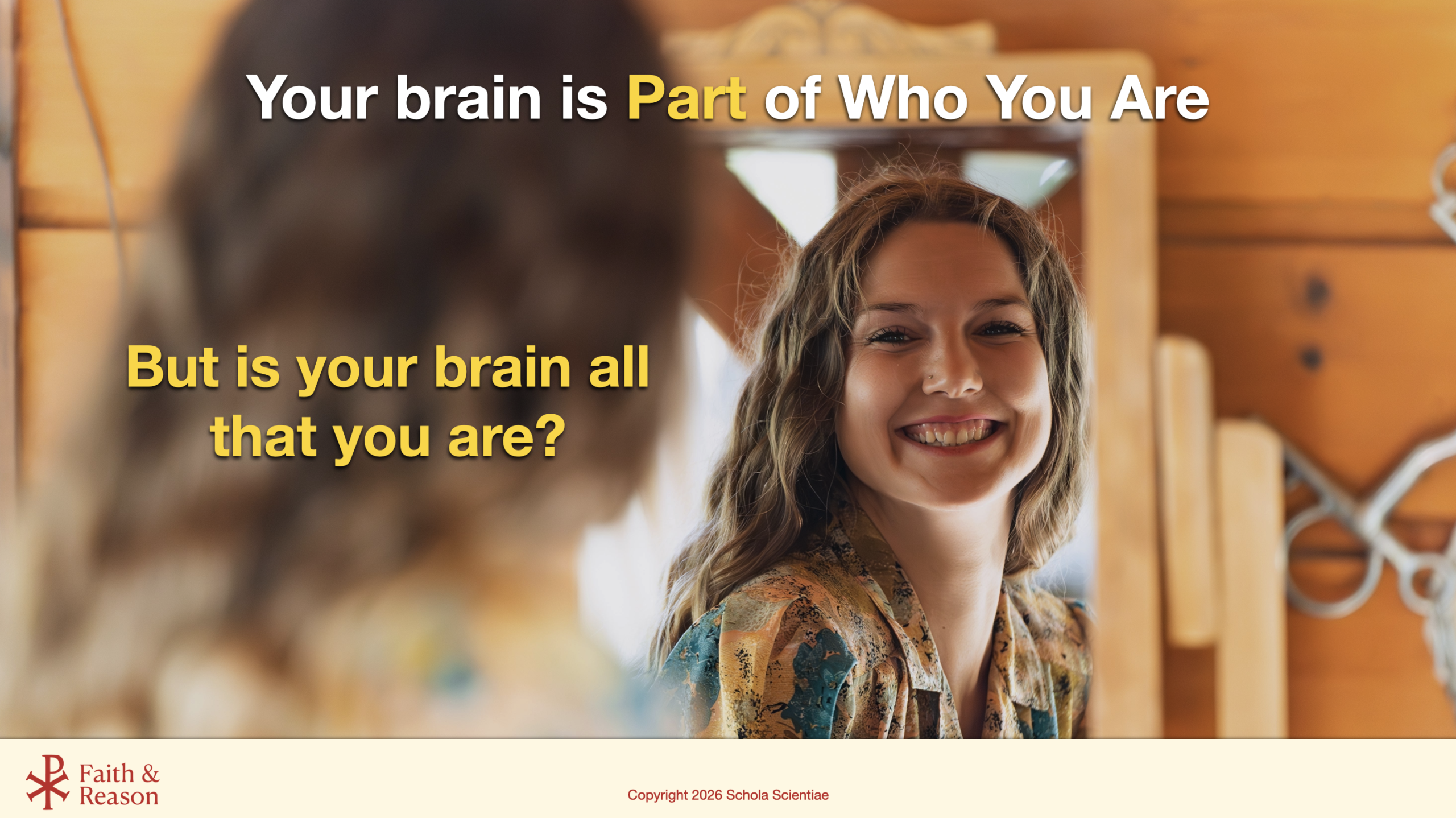
5. Your Brain is Part of Who You Are
Teaching Tips
Begin by asking:
“Based on everything you’ve learned in this Investigation, would you say your brain is an important part of who you are?”
Students will almost certainly answer “Yes.” Encourage them to explain why, drawing upon evidence from the Investigation rather than personal opinion alone.
Then ask:
“But is your brain all that you are?”
Allow students time to think before answering. Explain that this question has been discussed by scientists, philosophers, and theologians for thousands of years and that today’s goal is not to settle the question but to begin exploring it thoughtfully.
Conclude by saying:
“Science has taught us a great deal about the brain. Now we’ll consider what those discoveries may tell us about the whole human person.”
Purpose
This slide introduces one of the central questions of the Human Cognition curriculum. Students have learned that the brain plays a profound role in perception, memory, language, decision-making, and behavior. The next step is to ask whether understanding the brain completely explains the human person.
Key Idea
The brain is an essential part of every human person.
Reflection invites students to consider whether the human person is fully explained by the brain alone.
Leading the Conversation
Students may feel pressure to choose an immediate answer. Encourage them to resist that impulse. The purpose of this lesson is not to reach a conclusion but to appreciate the importance of the question itself.
Remind students that good scientific thinking often leads to new questions. Reflection & Meaning builds upon scientific knowledge by inviting students to examine questions that extend beyond laboratory investigation while remaining grounded in scientific evidence.
Encourage students to listen carefully to one another, support their ideas with reasons, and recognize that thoughtful questions are often as valuable as immediate answers.
Connections
Scientific Investigation
Students investigated how specific regions of the brain contribute to thinking, memory, language, perception, and behavior. These discoveries demonstrate the extraordinary importance of the brain in everyday human life.
Human Cognition
This question becomes a recurring theme throughout the Human Cognition curriculum. As students continue investigating learning, memory, perception, executive function, and decision-making, they will repeatedly return to the relationship between the brain and the human person.
Reflection & Meaning
This slide marks the transition from asking “How does the brain work?” to asking “What does understanding the brain reveal about ourselves?” Students begin to recognize that scientific knowledge and thoughtful reflection complement one another in the search for truth.
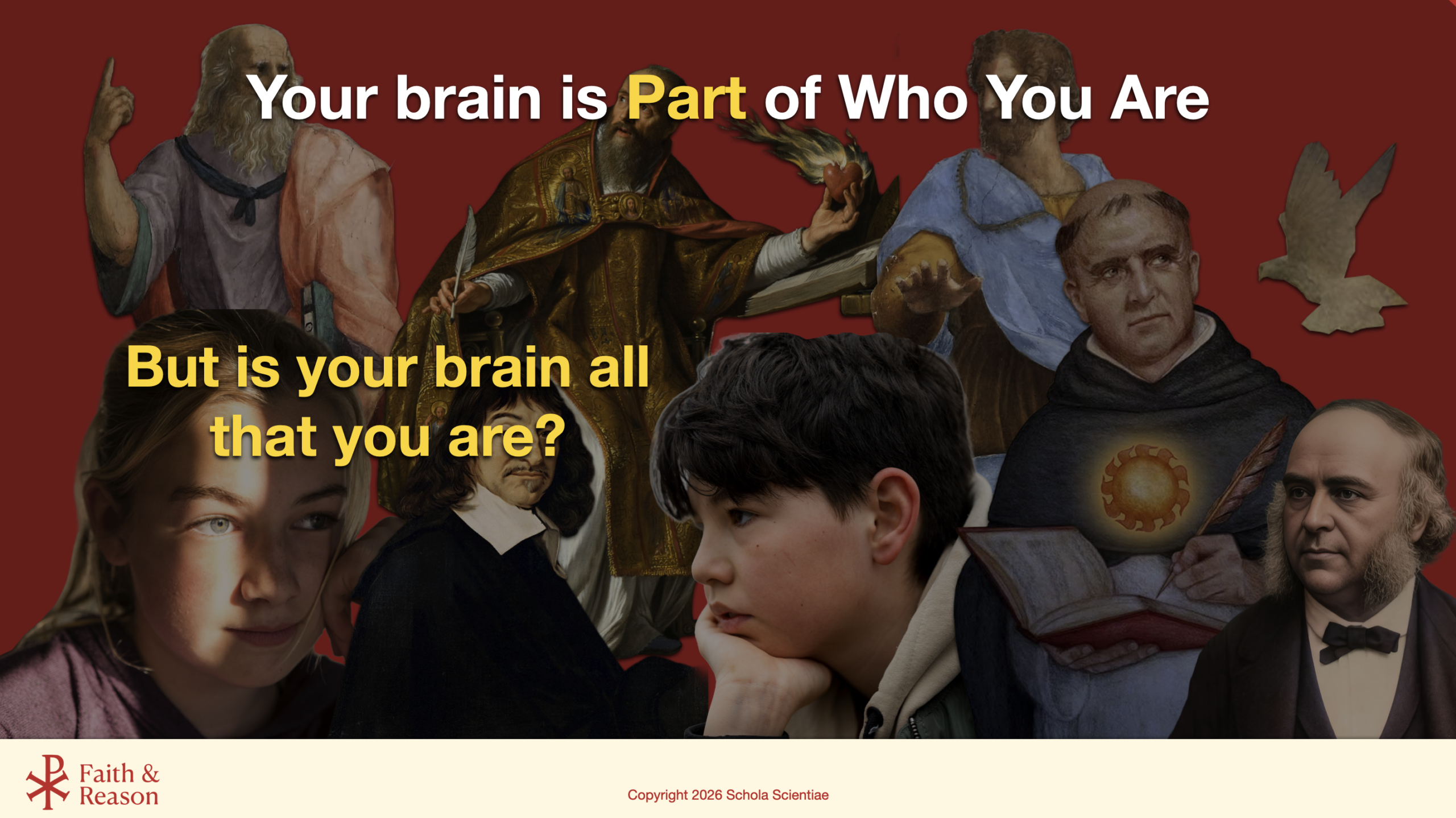
6. One Question… Thousands of Years
Teaching Tips
Begin by asking:
“Do you think you’re the first person to wonder whether the brain is all that you are?”
Allow students to answer before revealing the slide’s main point. Explain that thoughtful people have been discussing this question for thousands of years. Every generation has asked it in different ways.
Then explain:
“Great questions don’t belong to one generation. They become conversations that continue across centuries.”
Tell students that the next few slides introduce several remarkable thinkers who approached this question from different perspectives. Their goal is not simply to memorize names, but to understand how thoughtful people have searched for truth.
Conclude by saying:
“Today, you’re becoming part of that same conversation.”
Purpose
This slide broadens the discussion from an individual student’s question to one of humanity’s enduring questions. Students discover that the relationship between the brain, mind, and human person has been explored across cultures and centuries.
Key Idea
Some questions are so important that people continue asking them generation after generation.
Students are invited to become participants in one of history’s longest and most important conversations.
Leading the Conversation
Help students appreciate that intellectual progress often occurs through conversation rather than immediate answers. Different thinkers build upon, challenge, refine, or expand the ideas of those who came before them.
Encourage students to see themselves as thoughtful participants rather than passive observers. Their opinions matter most when they are informed by evidence, careful reasoning, and a willingness to learn from others.
This perspective also encourages intellectual humility. The purpose is not merely to express an opinion but to understand why thoughtful people have reached different conclusions throughout history.
Connections
Scientific Investigation
The Investigation provided scientific evidence about the structure and function of the human brain. Those discoveries naturally lead to broader questions that science alone cannot fully resolve.
Human Cognition
Human Cognition encourages students to integrate scientific understanding with thoughtful reflection. The study of cognition includes not only how the brain works but also why those discoveries matter.
Reflection & Meaning
This slide prepares students to encounter some of history’s greatest thinkers. Rather than presenting isolated opinions, Reflection & Meaning invites students to join a centuries-long search for truth, understanding, and wisdom.
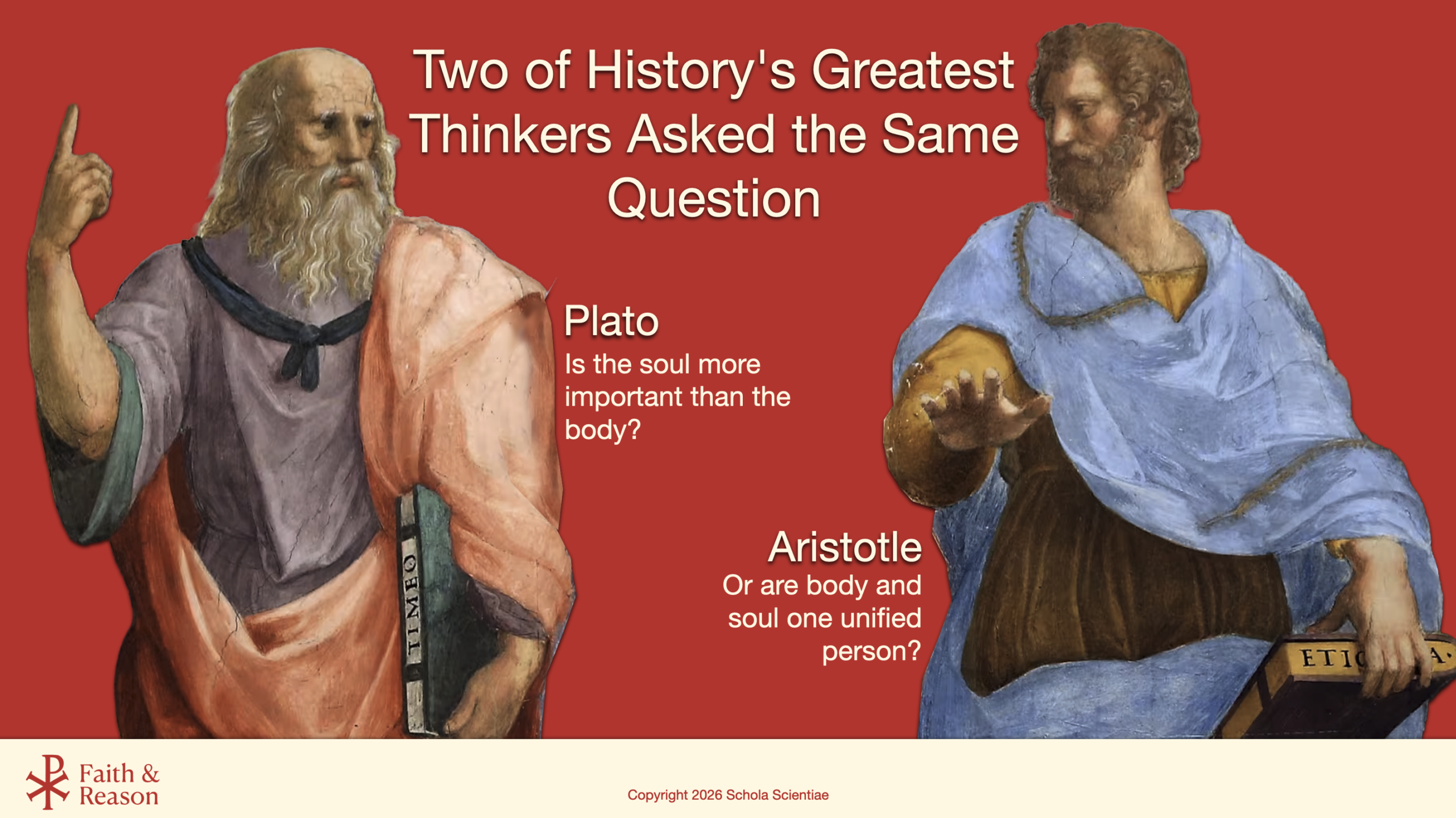
7. Two of History’s Greatest Thinkers Asked the Same Question
Teaching Tips
Begin by asking:
“Have you ever wondered whether people have always asked questions like the one we’re discussing?”
Point out that long before modern neuroscience existed, thoughtful people were already asking profound questions about human nature. Although they did not possess today’s scientific knowledge, they used careful observation and reasoning to explore these questions.
Introduce the thinkers:
“Plato and Aristotle were among the greatest thinkers in history. They agreed that understanding the human person was important, but they approached the question differently.”
Explain that today’s purpose is not to determine who was right. Rather, students should recognize that intelligent people can begin with the same question yet arrive at different conclusions through thoughtful reasoning.
Conclude by saying:
“One mark of an educated person is the willingness to understand an idea before deciding whether to agree or disagree with it.”
Purpose
This slide introduces students to two foundational thinkers whose ideas shaped centuries of discussion about the human person. Students discover that enduring questions often invite multiple thoughtful perspectives rather than immediate agreement.
Key Idea
Great thinkers often begin with the same question but reason toward different conclusions.
Understanding their ideas helps students appreciate the importance of careful reasoning and respectful dialogue.
Leading the Conversation
Emphasize that the goal is not to debate Plato and Aristotle or declare a winner. Instead, encourage students to appreciate how each thinker attempted to answer one of humanity’s oldest questions.
Help students recognize that learning often begins by understanding an idea before evaluating it. This habit develops intellectual humility and prepares students for the theological and philosophical discussions that follow.
Remind students that the scientific discoveries from Investigation 1 provide new evidence unavailable to either Plato or Aristotle, making today’s conversation both historical and contemporary.
Connections
Scientific Investigation
Students have learned how modern neuroscience investigates the brain through anatomy, physiology, neurological case studies, and imaging technologies. This scientific knowledge provides evidence that complements the philosophical questions raised on this slide.
Human Cognition
Human Cognition encourages students to integrate scientific evidence with thoughtful reasoning. Historical perspectives help students appreciate that important questions about the human person extend beyond any single discipline.
Reflection & Meaning
This slide introduces students to the long tradition of philosophical reflection that accompanies scientific discovery. It demonstrates that the search for truth often advances through respectful conversation across generations.
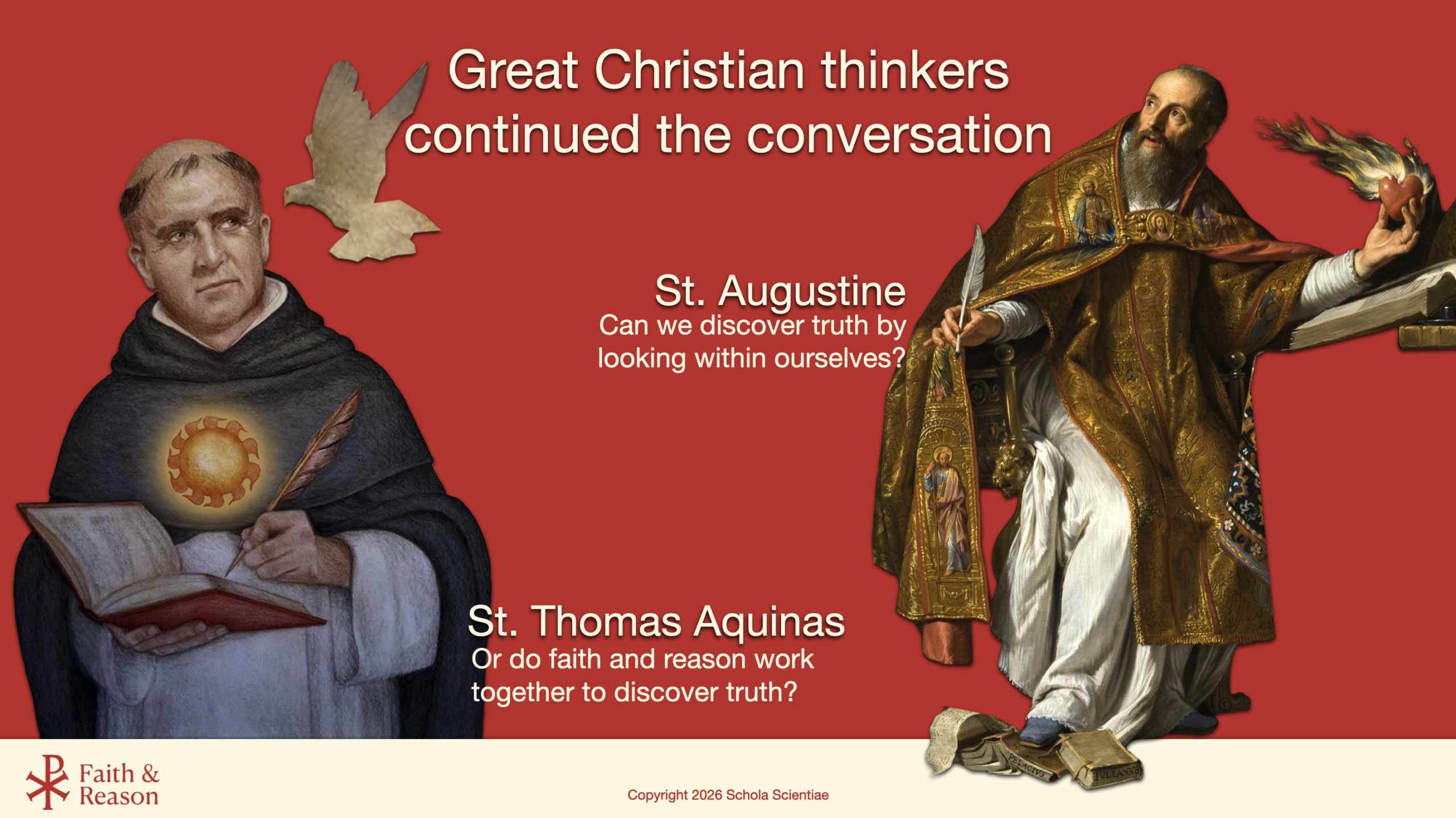
8. Great Christian Thinkers Continued the Conversation
Teaching Tips
Begin by explaining:
“The conversation did not end with Plato and Aristotle. For centuries, other great thinkers continued asking the same questions.”
Explain that Augustine and Thomas Aquinas were not scientists in the modern sense. Instead, they asked how careful reasoning, personal experience, and faith could help people understand themselves and discover truth.
Then ask:
“Can different ways of seeking truth work together rather than compete with one another?”
Encourage students to discuss the question without trying to settle it immediately. Help them recognize that the slide introduces two complementary approaches represented by Augustine and Aquinas.
Conclude by saying:
“One of the most important questions throughout history has not simply been ‘What is true?’ but ‘How do we discover what is true?’”
Purpose
This slide extends the historical conversation by introducing two influential Christian thinkers who explored how human beings discover truth. Rather than replacing reason, Augustine and Thomas Aquinas each emphasized different ways in which careful thinking contributes to understanding the human person.
Key Idea
The search for truth continued long after the ancient Greek philosophers.
Throughout history, thoughtful people have explored how reason, experience, and faith contribute to understanding ourselves and the world.
Leading the Conversation
Help students recognize that Augustine and Thomas Aquinas shared a commitment to truth while emphasizing different aspects of the search for understanding. The goal is not to compare them as opponents but to appreciate the richness of the conversation they continued.
Encourage students to notice that this discussion builds naturally upon the scientific discoveries of Investigation 1. Understanding the brain raises questions that invite both scientific investigation and thoughtful reflection.
Avoid turning this slide into a detailed lesson on theology or philosophy. Instead, use it to demonstrate that important questions often benefit from multiple complementary perspectives.
Connections
Scientific Investigation
Investigation 1 demonstrated how scientific methods help us understand the structure and function of the brain. Those discoveries provide reliable knowledge about the natural world and establish the foundation for further reflection.
Human Cognition
Human Cognition encourages students to appreciate that understanding the human person involves more than gathering facts. It also requires thoughtful interpretation, careful reasoning, and meaningful discussion about the significance of scientific discoveries.
Reflection & Meaning
This slide reinforces the central theme of Reflection & Meaning: the search for truth is an ongoing conversation. Students are invited to join that conversation by thinking carefully, listening respectfully, and allowing scientific evidence to inform deeper reflection.
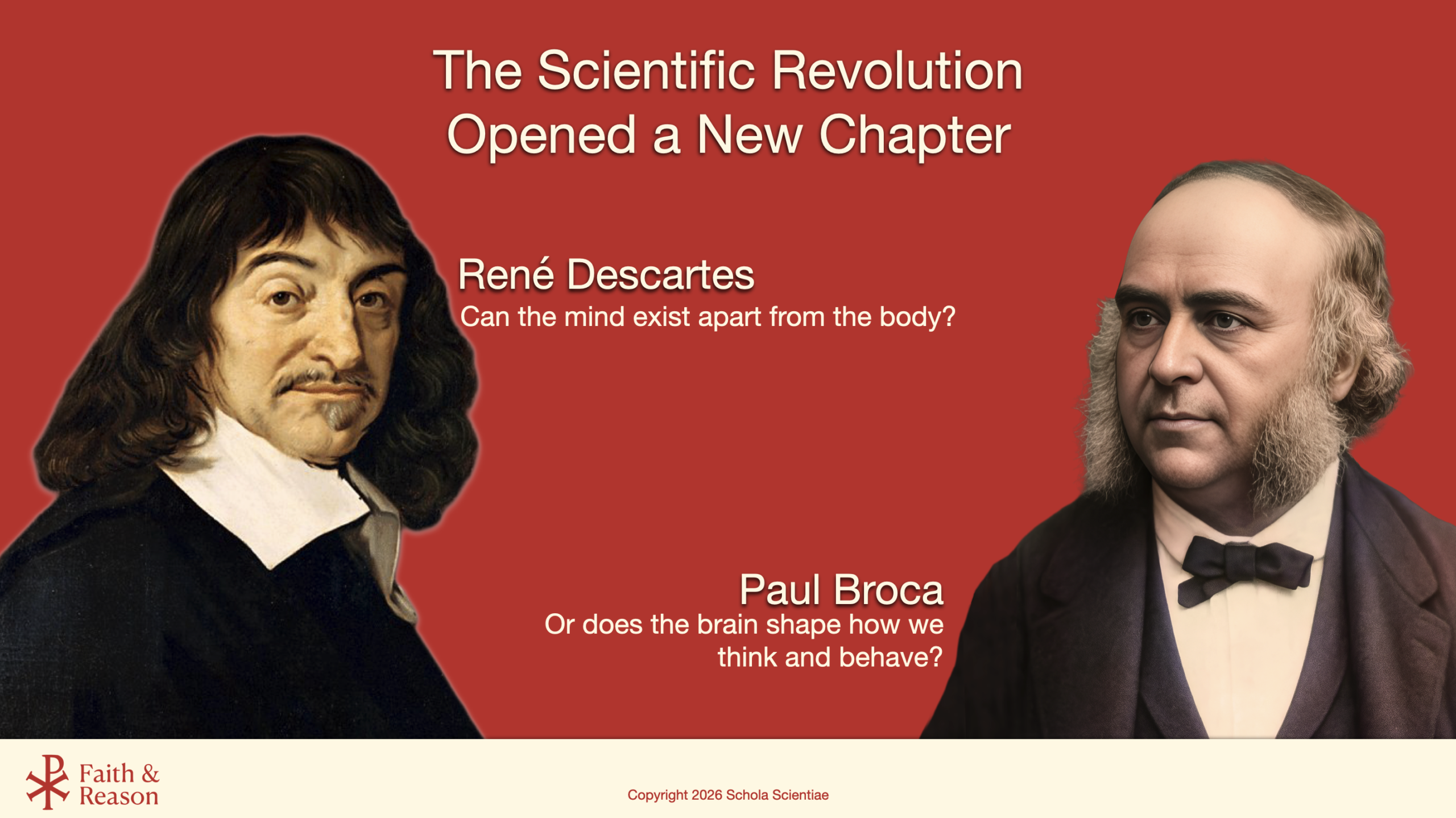
9. The Scientific Revolution Opened a New Chapter
Teaching Tips
Begin by asking:
“What changed during the Scientific Revolution that allowed people to investigate questions about the brain in new ways?”
Help students recognize that advances in observation, experimentation, and scientific reasoning opened new opportunities to study the human brain directly rather than relying only on philosophical discussion.
Then explain:
“Descartes asked important philosophical questions about the relationship between the mind and the body. Later, scientists such as Paul Broca began gathering evidence from patients to investigate those questions scientifically.”
Emphasize that science did not replace philosophy. Instead, scientific discoveries provided new evidence that enriched the conversation.
Conclude by saying:
“Scientific discoveries often answer old questions while raising new ones.”
Purpose
This slide introduces an important turning point in the history of ideas. During the Scientific Revolution, advances in observation and experimentation allowed questions about the brain and human cognition to be investigated using scientific methods as well as philosophical reasoning.
Key Idea
The Scientific Revolution expanded humanity’s ability to investigate the brain through scientific evidence.
Rather than ending the conversation about the human person, scientific discoveries provided new insights that deepened it.
Leading the Conversation
Help students appreciate that scientific progress often builds upon questions that people have been asking for centuries. Descartes and Broca represent different stages of that continuing search for understanding.
Explain that Broca’s work demonstrated how careful observation of patients could reveal relationships between specific brain regions and particular cognitive abilities. Such discoveries transformed the study of the brain from speculation into scientific investigation.
Encourage students to recognize that scientific evidence and thoughtful reflection are complementary. As scientific knowledge grows, new questions naturally emerge about the meaning and significance of those discoveries.
Connections
Scientific Investigation
Students studied Paul Broca’s discoveries during Investigation 1 as evidence that particular brain regions contribute to specific functions. This slide places that scientific work within its broader historical context.
Human Cognition
The Human Cognition curriculum demonstrates how scientific discoveries about the brain have transformed our understanding of language, learning, memory, behavior, and other cognitive functions while continuing to inspire deeper questions about the human person.
Reflection & Meaning
This slide reminds students that scientific progress does not eliminate thoughtful reflection. Instead, each new discovery becomes another opportunity to consider what science reveals—and what questions remain—about who we are.

10. The Conversation Continues…
Teaching Tips
Begin by reminding students:
“For thousands of years, thoughtful people have discussed these questions. Now it’s your turn to become part of the conversation.”
Explain that students are not expected to produce perfect answers. Instead, they should use what they have learned, listen carefully to one another, and explain the reasons behind their ideas.
Then ask:
“What do you think? Has what you’ve learned about the brain changed the way you think about yourself? Why or why not?”
Encourage students to support their responses with examples from Investigation 1 rather than simply stating opinions.
Conclude by saying:
“Good conversations continue long after class ends. Keep thinking about these questions as we continue exploring Human Cognition.”
Purpose
This slide shifts the conversation from history’s great thinkers back to the students themselves. Having encountered scientific discoveries and historical perspectives, students are now invited to formulate their own thoughtful responses.
Key Idea
Learning becomes meaningful when students actively engage with important questions rather than merely remembering information.
Every student is invited to become a thoughtful participant in humanity’s continuing search for truth.
Leading the Conversation
Create an atmosphere where students feel comfortable expressing tentative ideas and asking sincere questions. The objective is not to reach unanimous agreement but to practice thoughtful discussion grounded in scientific evidence, careful reasoning, and mutual respect.
Encourage students to refer back to the Investigation as they explain their thinking. Reflection & Meaning should always remain connected to the science that preceded it.
Model intellectual humility by acknowledging that some questions invite continued reflection rather than immediate certainty.
Connections
Scientific Investigation
The discussion should continually draw upon the evidence students gathered throughout Investigation 1. Scientific discoveries provide the foundation for every reflection that follows.
Human Cognition
Human Cognition encourages students to integrate scientific understanding with thoughtful reflection. This integration prepares students to approach future Investigations with both curiosity and intellectual discipline.
Reflection & Meaning
This slide demonstrates the central purpose of Reflection & Meaning: helping students transform scientific knowledge into personal understanding through careful reflection, respectful dialogue, and a lifelong love of learning.

11. One Question. More Than 2,000 Years of Conversation
Teaching Tips
Begin by asking:
“What does it tell you that intelligent people have continued discussing the same question for more than 2,000 years?”
Allow students to respond before adding your own comments. Encourage them to recognize that some questions are so important that each generation continues exploring them rather than expecting simple answers.
Then explain:
“Great questions are rarely settled by one experiment, one book, or one generation. They invite us to keep learning and thinking.”
Emphasize that science contributes essential knowledge to this conversation while philosophy and theology continue exploring questions of meaning and purpose.
Conclude by saying:
“You are now part of one of humanity’s oldest and most important conversations.”
Purpose
This slide reinforces the remarkable continuity of humanity’s search for understanding. Students recognize that the questions raised throughout Human Cognition are not new but have inspired thoughtful discussion for more than two millennia.
Key Idea
The most enduring questions continue to challenge every generation.
Scientific discoveries deepen the conversation rather than bringing it to an end.
Leading the Conversation
Encourage students to appreciate that intellectual maturity includes recognizing the value of questions that remain open. Rather than viewing uncertainty as weakness, students should see it as an invitation to continued learning.
Help students understand that scientific progress and thoughtful reflection often advance together. New discoveries provide fresh evidence, while enduring questions encourage deeper interpretation of that evidence.
This perspective also fosters humility. Students become participants in a conversation much larger than themselves.
Connections
Scientific Investigation
Investigation 1 introduced students to modern scientific discoveries about the human brain. Those discoveries now become part of a much longer historical conversation about the human person.
Human Cognition
Human Cognition demonstrates that scientific understanding continues to evolve. As new evidence emerges, our understanding of the brain grows, yet important questions about human nature remain worthy of careful reflection.
Reflection & Meaning
This slide encourages students to see themselves as lifelong learners. Reflection & Meaning is not intended to end the conversation but to cultivate the habits of curiosity, careful reasoning, and intellectual humility that sustain it.
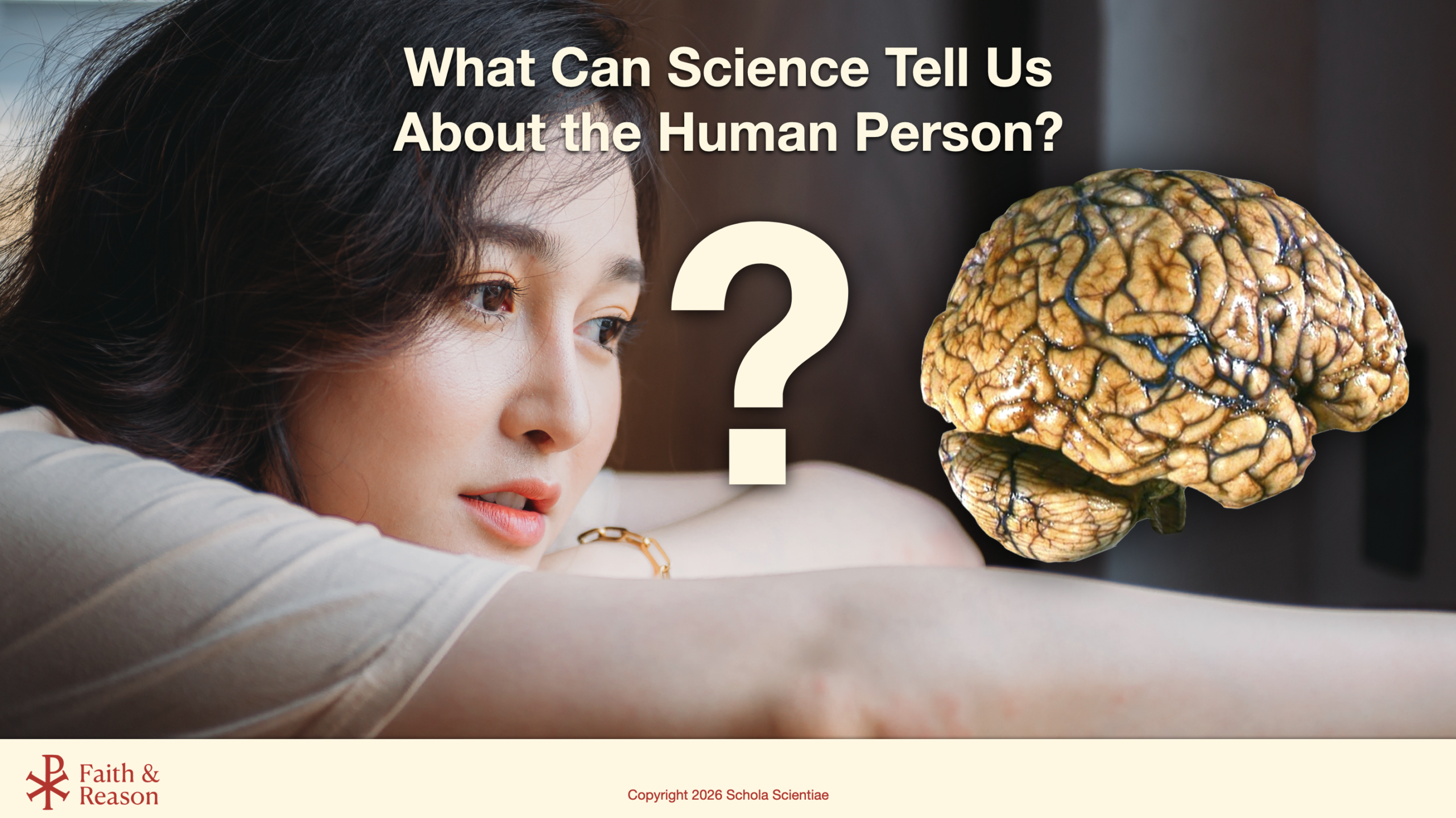
12. What Can Science Tell Us About the Human Person?
Teaching Tips
Begin by asking:
“After everything we’ve learned, what do you think science can tell us about the human person?”
Allow students to answer freely. Encourage them to support their ideas with evidence from Investigation 1 rather than speculation alone.
Then ask:
“Are there questions about the human person that science may not be designed to answer?”
Do not encourage students to choose between science and other ways of knowing. Instead, guide them to consider both the remarkable strengths of scientific investigation and its natural scope.
Conclude by saying:
“One of the greatest strengths of science is helping us understand the natural world. Reflection begins by asking what those discoveries may mean.”
Purpose
This slide brings together everything students have encountered throughout Reflection & Meaning. Rather than asking students to choose between scientific knowledge and deeper reflection, it invites them to consider the unique contribution that science makes to understanding the human person.
Key Idea
Science provides powerful and reliable knowledge about the natural world, including the human brain.
Its discoveries become the foundation for thoughtful reflection about the human person.
Leading the Conversation
Encourage students to distinguish between appreciating the power of science and expecting science to answer every possible question. Help them recognize that every discipline has both remarkable strengths and a natural scope.
Students should leave this discussion with increased respect for scientific investigation and an appreciation that important discoveries often invite further reflection rather than ending the conversation.
Remind students that Reflection & Meaning has consistently begun with scientific evidence. Thoughtful reflection grows out of reliable knowledge rather than replacing it.
Connections
Scientific Investigation
Throughout Investigation 1, students explored brain anatomy, localization of function, neurological case studies, and modern neuroscience. These discoveries illustrate what scientific investigation can reveal about the human brain.
Human Cognition
Human Cognition demonstrates that understanding the brain helps us better understand perception, learning, memory, language, and behavior. These scientific discoveries enrich our understanding of ourselves.
Reflection & Meaning
This slide captures the central purpose of Reflection & Meaning: to begin with scientific discovery, recognize its profound contribution to understanding the human person, and thoughtfully consider the broader questions that naturally arise from that knowledge.
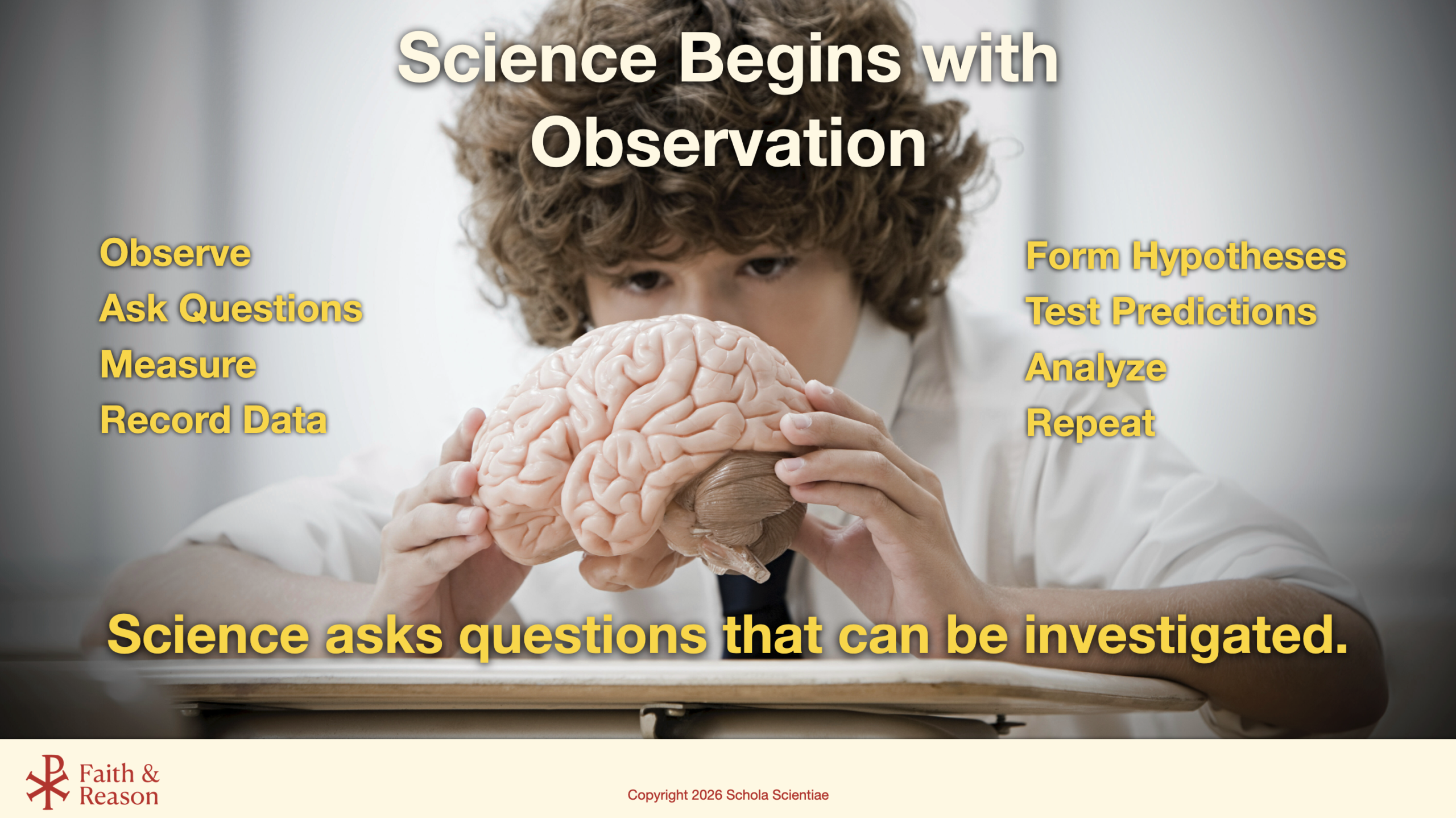
13. Science Begins with Observation
Teaching Tips
Begin by asking:
“After all of our discussions, where does science always begin?”
Allow students to identify the first step on the slide. Reinforce that every scientific investigation begins with careful observation of the natural world.
Then explain:
“Science asks questions that can be investigated. It gathers evidence before reaching conclusions.”
Review the sequence shown on the slide and remind students that this same process guided every Investigation they completed in Human Cognition.
Conclude by saying:
“Scientific thinking is one of the greatest tools humans have developed for discovering how the natural world works.”
Purpose
This slide returns students to the foundation of scientific inquiry. After reflecting on important questions about the human person, students are reminded that scientific knowledge is built through systematic observation, investigation, and evidence.
Key Idea
Science begins with careful observation and follows a disciplined process for investigating the natural world.
Reliable conclusions depend upon evidence rather than opinion or speculation.
Leading the Conversation
Help students recognize that Reflection & Meaning has never replaced science. Instead, every discussion throughout this Investigation has been grounded in the scientific discoveries students made about the human brain.
Review the steps shown on the slide and encourage students to see scientific thinking as a disciplined habit of mind that can be applied throughout their lives. Emphasize that careful observation, thoughtful questions, evidence, and reasoned conclusions are essential characteristics of good science.
This slide provides an opportunity to celebrate science itself while reminding students why it remains indispensable for understanding the natural world.
Connections
Scientific Investigation
This slide summarizes the scientific practices students used throughout Investigation 1. Observation, questioning, measurement, hypothesis formation, testing, data analysis, and replication formed the basis of every laboratory experience and scientific discussion.
Human Cognition
Human Cognition demonstrates how the methods of science have transformed our understanding of the human brain. Every discovery students explored during the Investigation resulted from careful scientific investigation.
Reflection & Meaning
This slide reinforces one of the central themes of Reflection & Meaning: thoughtful reflection begins with trustworthy knowledge. Scientific investigation provides the evidence upon which deeper questions and meaningful discussions are built.
14. Our Journey Begins Here
Teaching Tips
Conclude the Investigation by saying:
“Today we discovered something important. Learning about the brain is not the end of the journey—it is the beginning.”
Remind students that throughout this Investigation they explored how scientists investigate the human brain and what those discoveries reveal about learning, memory, perception, language, and behavior.
Then explain:
“As we continue through Human Cognition, every new scientific discovery will help us better understand ourselves and the remarkable gift of being human.”
Encourage students to remain curious. Great learners continue asking questions long after a lesson ends.
Conclude with:
“Our journey has begun. Let’s continue discovering what science can teach us—and thoughtfully consider what those discoveries mean.”
Purpose
This concluding slide serves as both a summary and a beginning. Students leave Human Cognition Investigation 1 with a deeper appreciation for what science has revealed about the human brain and an eagerness to continue exploring the remarkable questions that arise from those discoveries.
Key Idea
Scientific discovery is not the end of learning.
Each new discovery becomes the beginning of deeper understanding, thoughtful reflection, and lifelong curiosity.
Leading the Conversation
Celebrate what students have accomplished throughout the Investigation. They have learned important neuroscience, practiced scientific thinking, and begun asking enduring questions about the human person.
Encourage students to recognize that learning is a lifelong journey. The habits they have practiced—careful observation, thoughtful questioning, evidence-based reasoning, respectful discussion, and intellectual humility—will serve them well far beyond this classroom.
Leave students with a sense of anticipation. Investigation 1 has established the foundation upon which the remainder of the Human Cognition curriculum will build.
Connections
Scientific Investigation
Investigation 1 introduced students to the structure and function of the human brain and demonstrated how scientific investigation expands our understanding of ourselves and the natural world.
Human Cognition
The Human Cognition curriculum now continues by exploring how the brain receives information, processes experiences, learns, remembers, makes decisions, and shapes human behavior. Each Investigation builds upon the scientific foundation established here.
Reflection & Meaning
Reflection & Meaning concludes this Investigation by reminding students that scientific knowledge and thoughtful reflection work together. The search for truth is not completed in a single lesson but continues throughout life as we learn, question, and grow.