Back to: Human Cognition – Teacher
Teacher Portal
Investigation 2: PostLab
The PostLab brings the Investigation together. Guide students as they connect their Lab observations to larger ideas about how the nervous system receives, processes, and responds to information. Use the sections below to revisit key evidence, deepen student thinking, and prepare students for the PostLab Assessment.
Teacher Framing
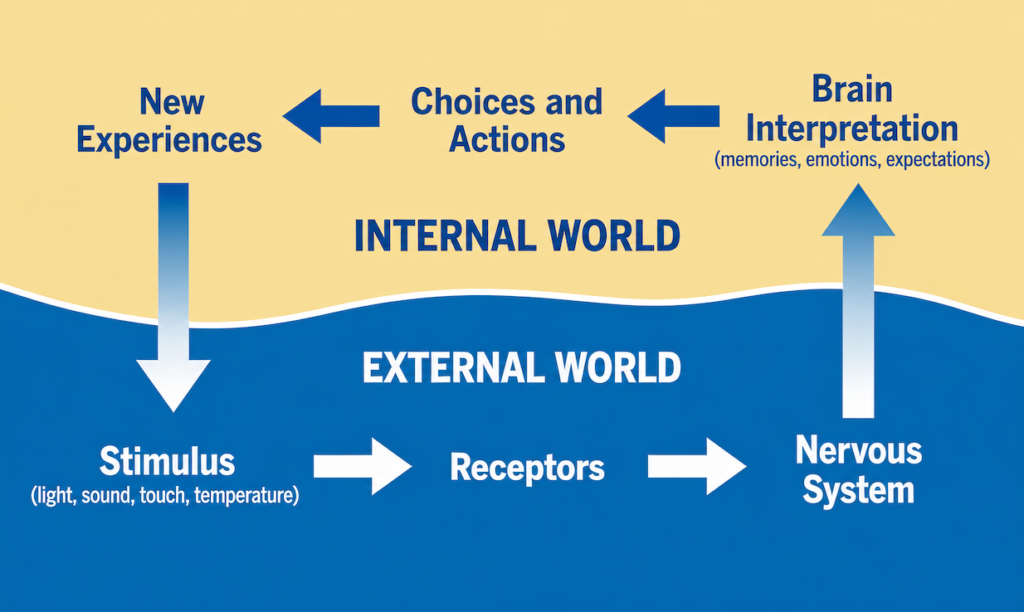
The purpose of this PostLab is to help students move from individual observations made during the Lab to a broader understanding of information processing in the nervous system.
Students investigated several different responses to stimuli, including two-point discrimination, the knee-jerk reflex, and the pupillary light reflex. Although these responses differ, each illustrates the same basic pattern: the nervous system receives information, processes it, and produces a response.
As you guide the discussion, encourage students to use evidence from their own observations rather than simply recalling facts. Help them recognize that some responses occur rapidly and automatically, while other information may be processed in ways that contribute to perception, interpretation, and conscious action.
The goal is not for students to master every detail of a neural pathway. The goal is for them to recognize a fundamental principle that will carry forward through Human Cognition: the nervous system continually receives information from within and outside the body and uses that information to guide responses and behavior.
Focus Questions
1. Why can reflexes occur before you are consciously aware of what has happened?
Reflexes are rapid, automatic responses to stimuli that do not require conscious decision-making before the response begins. In a reflex pathway, sensory information can trigger a response through the spinal cord or brainstem before the brain has fully processed the event consciously. This allows the nervous system to respond quickly, which can help protect the body from harm or maintain important body functions.
Discussion Angles:
- “The nervous system can respond before we consciously decide what to do.”
- “A reflex is automatic, but information is still being processed.”
- “Different reflexes involve different parts of the nervous system.”
- “Speed can be important when the body needs to respond quickly.”
Teacher Tip:
Reinforce the distinction between automatic and unprocessed. Reflexes still involve sensory input, neural processing, and a response; they simply do not require a conscious decision before that response begins.
2. What do the results of the two-point discrimination test tell us about how the brain “values” different parts of the body?
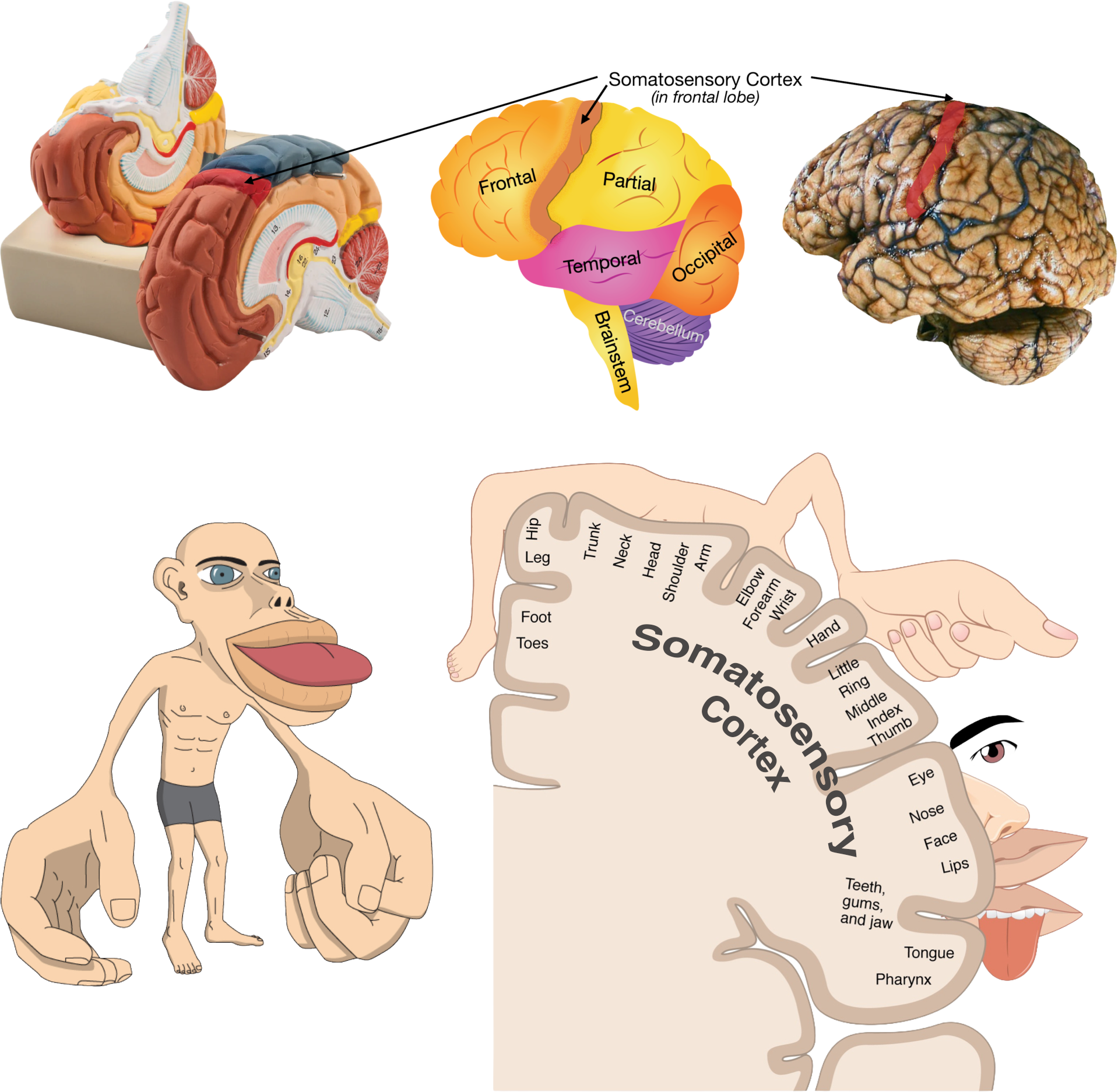
The two-point discrimination test shows that different parts of the body have different levels of sensitivity to touch. Areas such as the fingertips can distinguish two nearby points more easily because they contain many sensory receptors and are represented by relatively large areas of the sensory cortex. Other areas, such as the back, have fewer receptors and less cortical representation. This shows that the nervous system does not devote equal processing resources to every part of the body.
Discussion Angles:
- “Some parts of the body can detect finer differences in touch.”
- “Our fingertips need more detailed sensory information than our backs.”
- “More sensitivity is related to both sensory receptors and how the brain processes their signals.”
- “The brain devotes more processing space to some body regions than others.”
Teacher Tip:
Students may interpret “values” as meaning that one body part is more important than another. Clarify that here “values” refers to the amount of sensory processing resources devoted to information from different regions of the body. Connect this back to their own two-point discrimination results.
3. What do reflexes and sensory maps (like the homunculus) together teach us about how the nervous system is organized?
Reflexes and sensory maps show that the nervous system is specialized for different kinds of information processing. Reflex pathways allow some information to produce rapid, automatic responses, while sensory maps show that the brain devotes more processing resources to information from some parts of the body than others. Together, these examples demonstrate that the nervous system is organized in different ways depending on what the body needs to accomplish.
Discussion Angles:
- “Different pathways can process information differently.”
- “Some pathways are organized for speed.”
- “Some parts of the brain devote more space to detailed sensory information.”
- “The nervous system is specialized rather than organized the same way everywhere.”
Teacher Tip:
Use the two Lab activities to reinforce a common principle: organization reflects function. Students do not need detailed neuroanatomy here. The important idea is that different neural systems are organized differently because they perform different kinds of information-processing tasks.
4. Reflexes are very fast and automatic. How do they compare to more complex thinking and decision-making, and why does the brain need both?
Reflexes allow the nervous system to respond rapidly and automatically when speed is important. More complex thinking and decision-making require additional processing and therefore take more time, but they allow us to interpret information, consider alternatives, solve problems, plan, and learn from experience. The nervous system needs both because different situations require different kinds of responses—sometimes an immediate reaction is most useful, while other situations benefit from slower, more deliberate processing.
Discussion Angles:
- “Reflexes are fast because we don’t have to decide what to do first.”
- “Thinking takes longer because more information has to be processed.”
- “Fast isn’t always better; sometimes we need time to make a good decision.”
- “The nervous system can respond automatically or more deliberately depending on the situation.”
Teacher Tip:
Avoid presenting reflexes and complex thought as two completely separate systems. Both involve receiving information, processing it, and producing a response. What differs is the pathway and complexity of the processing. This distinction prepares students for the more complex forms of information processing explored in later Investigations.
Reference Diagram: The Sensory Homunculus
Think Critically
How teachers should use these answers
Do not read them aloud verbatim. Use them to:
- Probe student reasoning
- Redirect misconceptions
- Connect answers back to the Lab experience
- Encourage students to explain why, not just what
1. Why does the same stimulus sometimes produce an automatic response and other times lead to conscious thought or action?
Good Answer (Teacher Explanation):
The nervous system can process information in different ways depending on the stimulus and the response required. Some sensory information travels through relatively simple pathways that produce rapid, automatic responses, such as reflexes. Other information is processed through additional brain regions, where it can contribute to perception, interpretation, memory, and conscious decision-making. In both cases, the nervous system receives information, processes it, and produces a response; what differs is the pathway and complexity of the processing.
Key teaching point:
Information processing can range from rapid and automatic to complex and deliberate.
Possible student responses to affirm and extend:
- “Sometimes the body needs to react before we have time to think.”
- “More complicated decisions require more processing.”
- “A reflex and a conscious action both start with information coming into the nervous system.”
- “The same nervous system can handle information in different ways.”
2. How does the two-point discrimination experiment provide evidence that the nervous system does not process sensory information equally from all parts of the body?
Good Answer (Teacher Explanation):
Students could distinguish two nearby points more easily on some body regions than on others. This difference reflects variations in the number and spacing of sensory receptors and in the amount of sensory cortex devoted to processing information from different body regions. Areas such as the fingertips provide more detailed sensory information than less sensitive areas such as the back.
Key teaching point:
Sensory processing is specialized according to the information different parts of the body need to provide.
Possible student responses to affirm and extend:
- “My fingertips could tell two points apart when my arm couldn’t.”
- “Some parts of the body give the brain more detailed information.”
- “More receptors can provide more precise information.”
- “The homunculus shows that the brain doesn’t give every body part the same amount of processing space.”
3. What do the knee-jerk reflex and pupillary light reflex reveal about how the nervous system can process information without conscious decision-making?
Good Answer (Teacher Explanation):
Both reflexes show that sensory information can be received, processed, and used to produce a response without requiring a conscious decision first. In the knee-jerk reflex, processing occurs primarily through the spinal cord; in the pupillary light reflex, brainstem pathways control the response. These pathways allow the nervous system to respond rapidly and automatically to changing conditions.
Key teaching point:
Processing information does not necessarily require conscious thought.
Possible student responses to affirm and extend:
- “The nervous system can respond before we decide to do anything.”
- “The spinal cord can help produce a response without waiting for conscious thought.”
- “The pupil changes automatically when the light changes.”
- “Automatic doesn’t mean that no processing is happening.”
4. Why does the nervous system need both rapid automatic responses and slower, more complex information processing?
Good Answer (Teacher Explanation):
Different situations place different demands on the nervous system. Reflexes provide rapid responses when speed is important, while more complex processing allows information to be interpreted in relation to experience, memory, goals, and changing circumstances. This slower processing makes learning, planning, problem-solving, and deliberate action possible. Together, automatic and more complex processing allow humans to respond effectively to both immediate conditions and situations requiring thought and judgment.
Key teaching point:
The nervous system uses different levels of information processing for different kinds of demands.
Possible student responses to affirm and extend:
- “Sometimes reacting quickly is more important than thinking about it.”
- “Other situations need time to figure out what to do.”
- “Reflexes protect us right away, but thinking helps us learn and plan.”
- “We need both fast responses and more complicated thinking.”
Synthesis Prompt (Whole-Class Discussion):
How do the reflexes and sensory responses you investigated demonstrate that the nervous system uses different strategies to process information, and why is this important for understanding human cognition?
Teacher Guidance (optional, brief)
Students should recognize that:
- sensory information can be processed through different neural pathways,
- some processing produces rapid, automatic responses while other processing contributes to conscious perception and action,
- different parts of the nervous system are specialized for different information-processing demands.
This synthesis prepares students to investigate increasingly complex forms of information processing in the next Investigation.
PostLab Assessment — Investigation 2
Download and administer after completing the Investigation.